Roselyne Sachiti
Day Editor
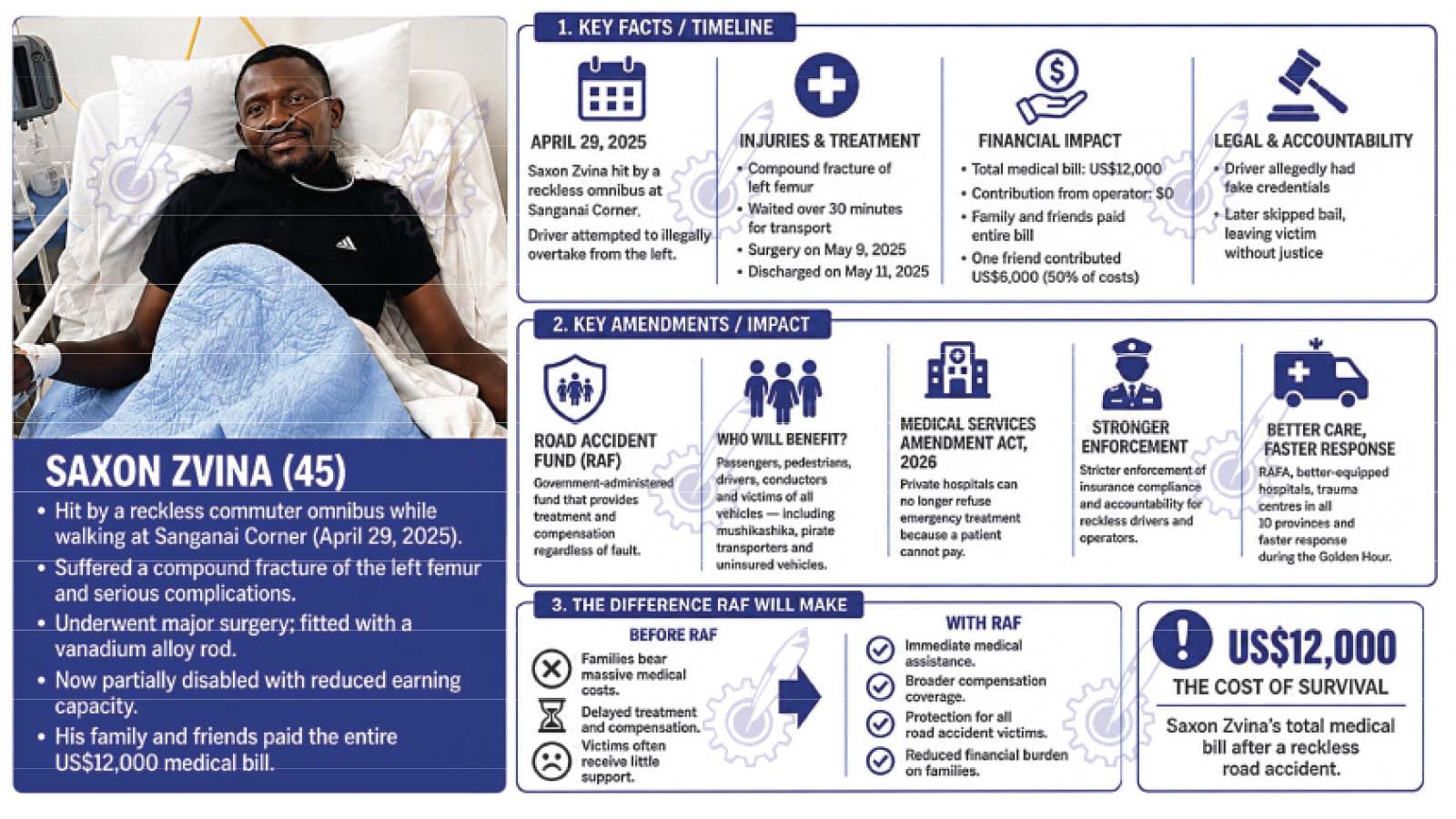
SAXON ZVINA (45) of Dema was run over by a reckless commuter omnibus driver in April last year while walking from Living Waters Theological Seminary to Solomon Mujuru Road (former Kirkman Road).
He had just attended a meeting at his church and hoped to see his children back home in Dema, but fate had other plans.
A kombi struck him, leaving his family with a crippling bill.
“I was near Sanganai Corner when a commuter omnibus on the City-Dzivaresekwa route tried to overtake another vehicle from the left-hand side.
“It suddenly veered into the area where pedestrians were, and before I could react, I was struck,” he told The Sunday Mail Society.
The impact was devastating.
Zvina was struck on the left leg, shattering bone and sending shockwaves through his entire body.
The agonising wait for help
His nightmare was just beginning.
“The kombi hit me on the left femur around 1.45 pm,” he said.
“It took over 30 minutes for me to be ferried to hospital.”
The delay, he added, was compounded by police who “took long to attend” to the scene.
In that half-hour, lying on the side of a dusty road, Zvina did not know the extent of the injuries.
A church colleague, identified only as Mr Sadza, rushed him to a private hospital.
But even there, relief was denied.
The facility, ill-equipped to handle road traffic accident victims, could only offer a scan.
“The scan showed that I had suffered a compound fracture. The hospital did not have an orthopaedic specialist,” he said.
Salvation came in the form of family.
His cousin, Dr Kelvin Nyikayaramba, intervened.
“He engaged his friend, Dr Nyamutora, an orthopaedic surgeon, who assessed the situation and delivered a sobering verdict: I was moved to a facility that was well-equipped for my injuries.”
At the Avenues Clinic, Zvina was not just seeking treatment, but clinging to hope, unaware that the greatest burden was yet to come.
The plan was straightforward.
His surgery was scheduled for May 2, at 9 am, but during the pre-operative examination in the theatre, the anaesthetist discovered a complication that would delay everything — He had fat embolism syndrome (FES) around the lungs.
“The surgery was cancelled and I was moved to the High Dependency Unit (HDU),” he said.
In that moment, surrounded by beeping monitors and the hushed urgency of medical staff, Zvina felt the ground shift beneath him once more.
The fracture was one battle, but now his lungs were waging another war of their own. Every extra day in hospital meant his bill was going up.
A desperate plea
As he lay in hospital, his family desperately appealed to the company responsible.
“They reached out to a Mr Kalajila, the manager of Johwa Transport.
“He promised to inform the owner. My family and friends continued to engage him to no avail,” Zvina said.
As the medical costs mounted, the silence from Johwa Transport grew louder and days passed.
Physiotherapy addressed the FES, slowly preparing his body for the inevitable.
Finally, on May 9, 2025, Dr Nyamutora performed the operation.
“He replaced the fractured bone with vanadium alloy,” Zvina revealed.
A metal rod now holds together what once was bone — a permanent reminder of the accident. The hospital discharge papers on May 11 did not erase the damage nor the staggering debt that came with it.
Johwa Transport contributed nothing.
“I incurred a US$12 000 medical bill, which was settled by family and friends. One of my closest friends, understanding the gravity of the situation, contributed US$6 000 towards the bill — half the total,” he said.
It was an act of love that saved not just Zvina, but a family, from financial ruin.
“If I didn’t have a family nor supportive friends, my two children Ruvarashe (11) and Kunashe (4) would have been fatherless,” he said.
Survival came at a cost far beyond money.
“I am now partially disabled as a result of this accident, rendering me incapable of carrying out other tasks,” Zvina added.
His ordeal, however, was far from over.
Zvina was called to be a witness in the court case and discovered the driver had no licence.
“It turned out that Warren Park Police Station were given fake credentials and the driver skipped bail,” he lamented.
“I am still seeking redress in my case.”
His spirit remains unbroken.
“I am glad that God preserved life. It’s better to be alive, disabled than being late,” he said.
Another family’s ordeal
Another road traffic accident victim (name withheld) is currently admitted at Parirenyatwa Group of Hospitals.
On July 3, a Kuwadzana-bound commuter omnibus he was travelling on rammed into a bus at Warren Park 1 traffic lights.
His brother Edmore Bvunzawabaya shared their family’s ordeal.
“He sustained serious head injuries and a broken leg,” said Bvunzawabaya.
In just three days, the family paid US$1 200 in medical bills and some hospital medical supplies, with more coming.
“We were told to buy some hospital medical supplies including feeding tubes, drips and blood.
“His wife sold some household furniture so that we pay the required money. Other relatives have been contributing funds to help. It is hard,” he said.
Bvunzawabaya said the owner of the commuter omnibus has reached out but not offered financial support yet.
“He wanted to tell us that he was sorting out insurance and was holding a stack of papers.
“But the medical bills are urgent. We have already paid for procedures like CT scan (US$150) and specialised ambulance (US$350) so that we save our relative’s life,” he said.
The ordeals of Zvina, the Bvunzawabaya family and thousands of other road traffic accident victims are not isolated incidents.
These are the very human drivers behind the Government’s urgent push for systemic change.
Road Accident Fund: A beacon of hope
The Government is actively developing a comprehensive, multi-pronged strategy to address road safety. This approach includes legislative, institutional and infrastructural reforms.
The Road Accident Fund (RAF) seeks to take over the administration of compulsory third-party motor insurance from private players to ensure victims receive medical attention and compensation more adequately and timeously, regardless of who was at fault.
Cabinet approved the principles of the Bill in June 2025, and nationwide public consultations have been conducted. It is expected to be enacted into law.
Currently, third-party insurance is a mandatory requirement under the Road Traffic Act, provided by private insurance companies. Speaking during the Corporate Governance Oversight Meeting in Bulawayo last month, Transport and Infrastructural Development Minister Felix Mhona said road traffic management, administration and safety remains a national priority and a shared responsibility, and more should be done on this front.
Questions sent to the Traffic Safety Council of Zimbabwe had not been responded to by the time of going to print.
Parirenyatwa Group of Hospital’s public relations officer Tariro Masunda was out of the office and said: “I am currently out of office and would need to engage our accounts team to be able to give you full information.”Grim statistics driving reform
The urgency behind these reforms is driven by a high number of road accidents.
According to the Zimbabwe Statistics Agency (ZimStat), a total of 12 808 road traffic accidents were reported in the first quarter of 2025, representing a 12,5 percent decrease from 14 640 accidents reported during the fourth quarter of 2024.
There were 2 599 injuries as a result of accidents in the first quarter of 2025, while 2 614 injuries were recorded in the fourth quarter of 2024. Amid individual tragedy — and the crushing financial toll it exacts on families — the RAF Bill emerges as a beacon of hope.
Zvina, who has lived through the nightmare the Bill seeks to prevent, recognises its potential.
“The RAF Bill is a noble move as it will cater for accident victims, many who are dying due to lack of this legislature,” he said.
Also, in a landmark move to safeguard the right to life over the ability to pay, the Medical Services Amendment Act, 2026, signed into law by President Mnangagwa last week, introduces a transformative obligation on private health institutions.
Private healthcare facilities will now be mandated to admit and stabilise emergency patients for at least 48 hours before transferring them to Government hospitals, even if the patient cannot afford.
The new law amends the Medical Services Act [Chapter 15:13] and introduces sweeping reforms that redefine the obligations of healthcare providers while expanding legal protections for patients and health workers.
Zimbabwe United Deregulated Commuter Operators Association (ZUDAC) president Fradreck Maguramhinga said he is hopeful that the Road Accident Fund (RAF) will bridge the gap left by non-compliant vehicles currently operating on the country’s roads.
He further noted that drivers and conductors have historically struggled to access accident compensation, as current passenger insurance excludes them.
Funding and healthcare infrastructure
Maguramhinga emphasised the need for more substantial funding to sustain the RAF and cover the full spectrum of medical care, including physiotherapy, surgeries and doctors’ fees.
“The fund should finance existing hospitals, equip them and establish strategic highway centres. Trauma centres can be built on the country’s major highways and in all 10 provinces. This means an injured person will not be transported far for emergency treatment. I am speaking about the golden hour — that critical period where we see paramedics arriving promptly,” he explained.
He said ZUDAC members are aware of the RAF, having participated actively in the Bill’s consultation process.
“It is important for education and training as critical tools in the fight against road carnage, noting that proactive prevention would ultimately reduce the number of claims made against the fund,” he said.
The harrowing ordeals of Zvina and the Bvunzawabaya family are recurring chapters in a national tragedy that has played out thousands of times across Zimbabwe’s roads.
In the aftermath of an accident, survival often depends not on the severity of injuries alone, but on the depth of one’s pocket.
The Road Accident Fund Bill, once enacted, promises to dismantle the patchwork, profit-driven insurance regime and replace it with a unified, no-fault safety net that leaves no victim behind — be they passenger, pedestrian or driver.
Feedback roselyne. [email protected] @roselynesachiti