Online Reporter
Theseus Mauruki Shambare
WHEN Cyclone Eline tore through southern Africa in February 2000, it left behind flooded rivers, damaged roads and shattered communities. Across Zimbabwe, families gathered around radios and television sets, trying to understand the scale of the disaster.
Among them was a young girl who could sense that something important was happening, even if she did not fully understand it.
That girl was Shamiso Masuka.
Today, more than two decades later, the 32-year-old has become a pioneer in agricultural technology, helping livestock farmers use data and genetics to improve their herds. It is a journey that has taken her from childhood curiosity and engineering studies to cutting-edge livestock analytics, all driven by a desire to solve real-world problems.
Looking back, Masuka still remembers the impact Cyclone Eline had on her young mind.
“I had no idea what the news meant, but I just knew that if all the grown-ups were talking about something, then it must have been important,” she recalls.
At the time, she did not know what a cyclone was. She did not understand the science behind weather systems, infrastructure damage or disaster management. But something about the event captured her imagination.
“I decided I wanted to design bridges when I grew up.”
It was a simple childhood dream, but one that would shape the way she approached life and problem-solving.

Years later, Masuka enrolled at the University of Zimbabwe to study Agricultural Engineering. It was not necessarily the path she had imagined as a child, but it turned out to be the perfect blend of science, technology and practical problem-solving.
After graduating, one of her first jobs was with the City of Harare’s wastewater division. It was there that she encountered something that sparked another period of curiosity.
“At first I wondered why the wastewater department owned cattle,” she said.
The answer surprised her.
The cattle were part of a tertiary treatment system where engineering, agriculture and environmental management worked together to support each other. It was an example of different disciplines coming together to solve a common challenge.
For Masuka, it was another bridge.
Her interest soon shifted towards livestock production and technology. She became fascinated by ideas such as GPS tracking, virtual fencing, geofencing and the use of data in livestock management.
For six years, one question remained at the centre of her thinking:
“What could realistically work in Zimbabwe?”
Finding answers to that question eventually led her to the United Kingdom, where she studied for a Master’s degree in Environmental Engineering and Project Management at the University of Leeds.
The experience broadened her perspective and strengthened her belief in data-driven decision-making.
“I learnt to bring people, data and technology together to solve practical problems,” she said.
The next turning point came in 2025 when Masuka was selected for the prestigious Mandela Washington Fellowship and travelled to Oklahoma in the United States.
She went there hoping to learn more about livestock technologies such as geofencing. Instead, she discovered something she believes could have an even greater impact on Zimbabwean agriculture.
During the programme, she met AgBoost, a company that specialises in livestock genetics and herd analytics.
The encounter changed her thinking.
“I realised the bigger opportunity for Zimbabwe was helping breeders make sense of the information they already have,” she said.
The idea may sound simple, but it addresses a major challenge facing many farmers.
Most livestock producers already collect information about their animals. They record birth dates, calving histories, weights and parentage. However, many struggle to turn those records into decisions that improve productivity.
As Masuka puts it: “Data is as useful as your ability to use it.”
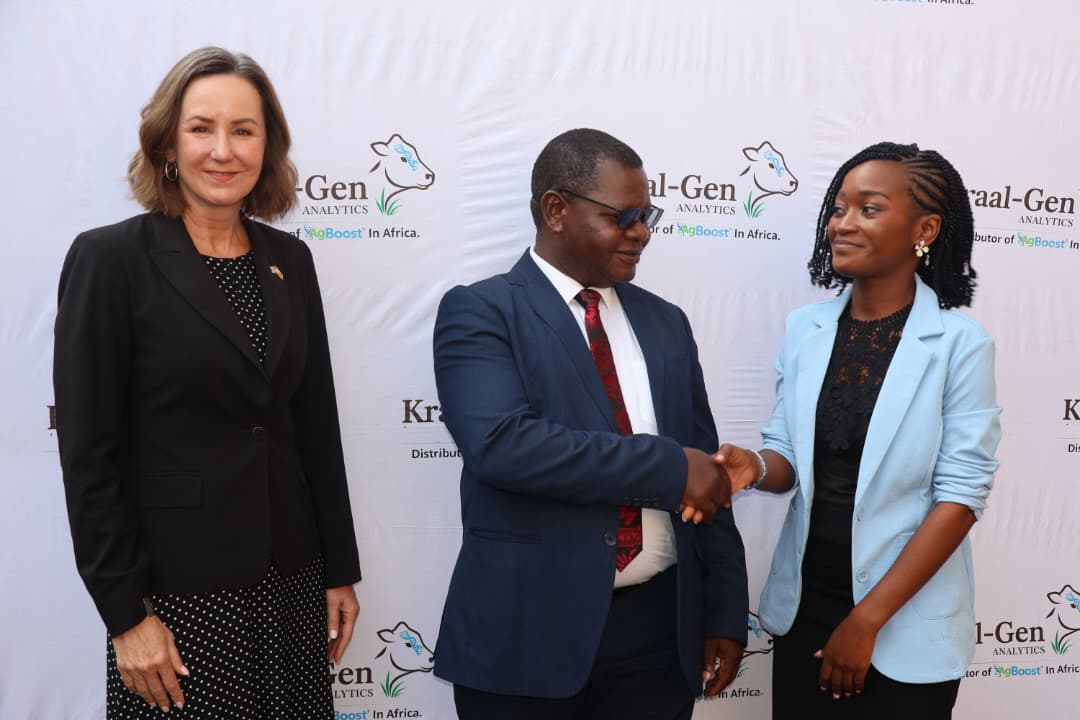
That belief led to the establishment of Kraal-Gen Analytics in 2025.
Through the company, Masuka works with AgBoost to help farmers combine animal performance records, genetics and other production data to make better breeding decisions.
The goal is straightforward: help farmers understand which animals are likely to produce stronger, healthier and more profitable offspring.
Some of that information cannot be seen with the naked eye.
A farmer may be able to assess the physical appearance of a bull or cow, but hidden genetic traits are another matter entirely.
This is where genomics comes in.
By analysing an animal’s DNA, farmers can gain insights into traits such as fertility, growth rates, feed efficiency and ease of calving.
“Genomics is one of the most powerful tools for improving livestock productivity,” Masuka said.
However, she is quick to point out that the technology is not a silver bullet.
“A DNA test on its own does not improve a herd. Its value lies in how the information is used.”
That principle formed the foundation of the Zimbabwe Genomics Pilot project, which sought to demonstrate how genetic and performance data could be translated into practical decisions for local farmers.
Among those who participated was stud breeder Dr Divine Simbi-Ndhlukula.
She immediately saw the business value of the technology.
“You can test for traits like rib-eye, a very expensive steak cut, and identify animals that can produce that,” she said. “The pilot showed us things we didn’t know about our animals. It helps improve productivity and profitability.”
The project also comes at a time when Zimbabwe is seeking to grow and strengthen its livestock sector.
Government aims to increase the national herd from 5,7 million cattle to 6,6 million by 2030. Beef production is expected to rise significantly, while milk production targets are also expanding.
However, Permanent Secretary in the Ministry of Agriculture Prof Obert Jiri believes the focus should go beyond numbers.
“The key question is: how do we improve the productivity, quality and economic value of each animal? Productivity is measured by value per head, not just numbers.”
That view mirrors Masuka’s own philosophy.
“If we are going to rebuild our national herd, it is not just about having more animals. It is about having better, healthier, more productive animals,” she said.
She emphasises that genomics should complement good farming practices, not replace them. Animal health, nutrition, management and record-keeping remain essential.
In fact, she encourages farmers to start with something as simple as a notebook.
The technology may sound sophisticated, but the first step is often recording information that many farmers already observe every day.
“Start with the records you already have. Which cow calves regularly? Which bull produces better offspring? Which bloodlines survive drought?”
Once those records are available, technology can help identify patterns more quickly and accurately.
Masuka’s broader mission is to ensure that advanced livestock analytics become accessible and understandable to ordinary farmers.
“It is not enough to give farmers complex genetic results. We have to convert them into insights producers can act on with confidence.”
In many ways, her life has come full circle. The little girl who watched adults discuss Cyclone Eline and dreamed of building bridges is still doing exactly that. Only now, the bridges are different.
They connect farmers to technology. They connect records to decisions. They connect genetics to productivity. They connect global innovation to the realities of Zimbabwean agriculture.
As Zimbabwe looks for ways to increase beef and milk production, create jobs and strengthen food security, Masuka believes the answer may not simply lie in having more cattle. It may lie in understanding the cattle already in the country’s fields and kraals far better than before.
“The future of livestock improvement is about better use of data,” she said.
It is a journey that began with a storm more than 26 years ago. Today, that same curiosity is helping build a smarter future for Zimbabwe’s livestock industry, one decision at a time.