Online Reporter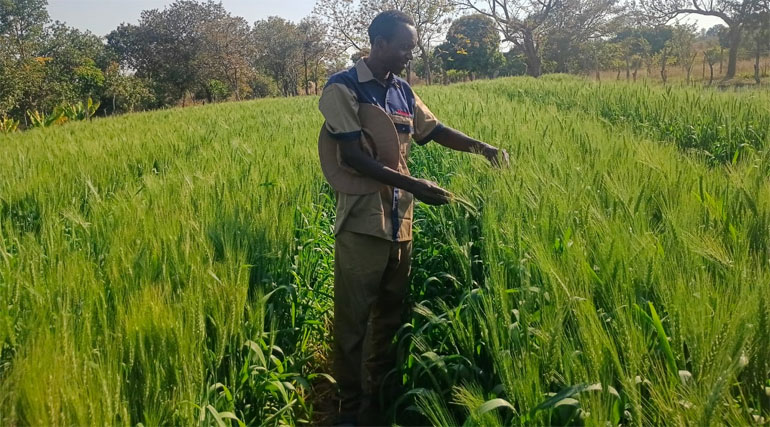
Lovemore Kadzura
Post Reporter
AS dawn breaks over the rugged hills of Marange, golden rays of sunlight wash over a sight that until recently belonged only in dreams.
Where hardy thorny shrubs and parched earth once dominated, small lush fields of wheat now dance gently in the cool morning breeze. The emerald crop, stretching across irrigated plots, has become a symbol of hope in a region long defined by erratic rainfall and recurring drought.
For the first time in history, communal farmers in Chipfatsura and Murwira villages, in Marange, under Mutare District, are growing wheat — and they are doing so successfully.
The remarkable transformation is part of the Government’s drive to combat poverty and hunger at household level by extending irrigation agriculture and winter farming to communities that have traditionally depended on rain-fed farming.
For many families in Marange, wheat was a crop they had neither intention nor motivation to grow, with attention previously focused only on maize despite disappointing harvests, and traditional grains.
Today, a small group of farmers proudly walk through their flourishing fields, marvelling at what they describe as nothing short of a miracle.
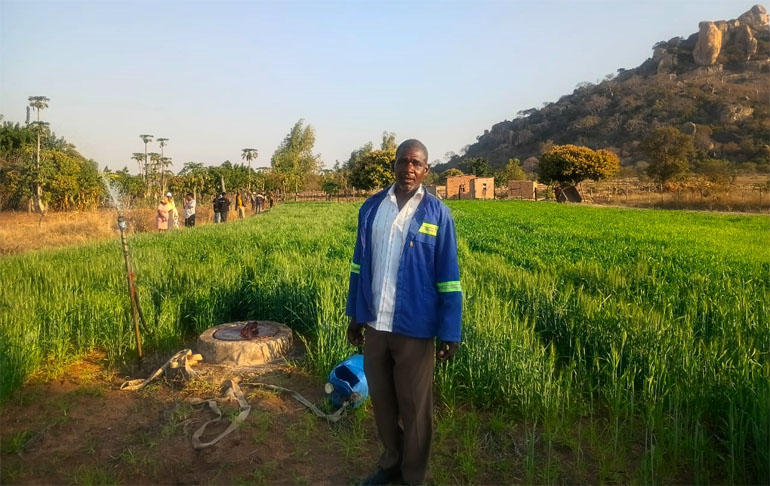
Among the success stories is innovative farmer and village head, Mr Sunrise Dhliwayo, who refused to let the region’s dry conditions stand in his way. Looking towards the nearby mountain range, he saw what others had overlooked — a dependable source of water. Using a simple siphoning system, he now channels water from the mountain to irrigate his quarter-hectare wheat plot and other crops, relying on gravity rather than expensive machinery.
“We never believed wheat could grow here,” said Mr Dhliwayo, his face breaking into a broad smile as he gently rubbed the ripening heads of grain between his fingers.
“When the Government brought us seed, fertiliser and other inputs, we were willing to try, although many of us had doubts. Now we are looking at this beautiful crop. We are overwhelmed with joy because this is proof that anything is possible. As the village head, I decided to lead by example and chose to do winter wheat here. I received free inputs to grow a quarter of hectare, and I am expecting to harvest around a tonne of wheat. Bocha is a very hot and arid area, but look what I have done. I am irrigating wheat and other crops with water I siphon from the mountain and store it in a weir dam. The water source runs up to October before drying up,” he said.
Standing beside the flowing water, he explained how determination and innovation have changed his fortunes.
“This mountain has always had water, but we never thought it could help us grow wheat. Now the water flows naturally into my fields. It costs very little to operate, and my crop has grown beyond my expectations. I am grateful to the Government for giving us this opportunity because without the inputs, I would never have attempted wheat farming,” said the 65-year-old pensioner. Wheat has become more than just another crop – it is a promise of better livelihoods, improved nutrition and increased household incomes.
His wife, Mrs Irene Muririkwa, was over the moon with the success of their trial crop, and said the era of buying bread is now over as they can now produce their own flour and bake whole wheat bread.
“As a family we were thrilled to see our inaugural wheat crop thriving so well. We no longer have to worry about buying bread. Besides feeding ourselves we will sell the surplus to fellow villagers. We encourage other families to embrace wheat farming,” she said.
A few kilometres away in Murwira Village, another farmer, Mr Solomon Marange, has embraced modern technology to beat the harsh climate. Rows of healthy wheat surround his field, nourished by water pumped from a solar-powered borehole.
“This wheat has shown us that even in Region Four, we can produce crops that many people thought were impossible. I use overhead sprinklers to irrigate the crop, and I draw the water from boreholes using solar power. As a first timer, I am pleased with the state of my crop, and next season, I intend to plant on a large piece of land. I utilised all the inputs I was given by the Government and never diverted anything. We are now at the same level with those who left Bocha to settle in farms as we are now growing the same crops,” he said.
Mutare District Agricultural Extension Officer, Ms Bertha Mashayamombe, said the success of the inaugural wheat crop demonstrates the enormous potential of irrigation development in transforming livelihoods in semi-arid regions.
She added that by combining the Government support, climate-smart technologies and farmers’ determination, communities are unlocking opportunities that were once unimaginable. “Pfumvudza winter wheat programme is going on very well. We managed to contract 1 340 hectares under small-scale farmers. Here in Chipfatsura which is in Natural Region Four, we have a farmer who is using natural source of water which comes from the mountain to grow the crop. At this homestead they have a quarter of hectare, and we are expecting a harvest of a tonne and above.
“The tilering effect was very high and they did good management practices according to advice given by extension officers. This programme will go a long way in terms of household food security. This family can actually realise excess to sale. The farmer is making good use of water that is flowing and trenching it so that it flows down through percolation. This is a good way of harvesting water. We are encouraging our farmers to do water harvesting methods so that they have water to use in winter.
“Farmers are also encouraged to drill boreholes and use solar to partake in irrigation. Waiting for summer season is no longer advisable because of unreliable and changing rainfall patterns. A single solarised borehole can make a huge impact on a homestead. With the success of this wheat next season, more farmers will come on board,” said Ms Mashayamombe.
Beyond the green fields lies a much bigger story.
Every stalk of wheat represents a family with greater food security, children whose parents can earn more from agriculture, and communities steadily breaking the cycle of poverty. As harvest time approaches, optimism is growing alongside the crop.
Farmers are already talking about expanding their hectarage next season, encouraged by the impressive performance of the first crop.
For Marange, wheat is no longer an experiment. It is a testament to resilience, innovation and the transformative impact of the Government programmes aimed at empowering rural communities. In a land where many believed only drought-resistant crops could survive, fields of golden wheat now tell a different story – one of possibility, prosperity and a brighter future taking root in the heart of Natural Region Four.