Online Reporter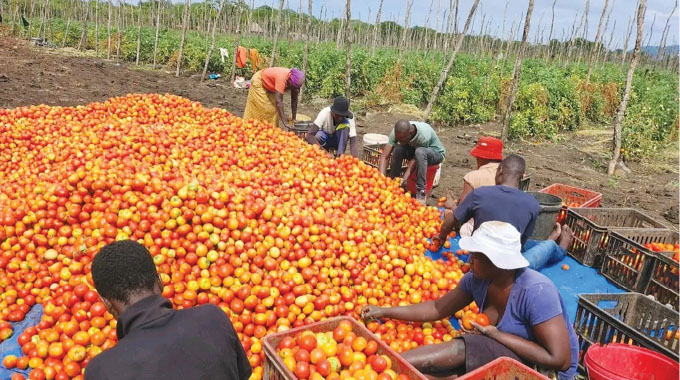
Theseus Mauruki Shambare
AT dawn in Gosha Village, Goromonzi District in Mashonaland East, the tomatoes shine like red lanterns in the mist.
Women in gumboots bend between rows heavy with fruit. Water threads quietly through irrigation lines. A rooster calls from a nearby homestead.
In the distance, schoolchildren in oversized uniforms hurry along a dusty path, lunch tins clanging against their sides. This is the hour when hope looks tangible.
For years, families here measured life by the clouds. If the rains came, there was food. If they failed, hunger entered homes quietly and stayed too long.
Now, in this village, less than 100 kilometres east of Harare, seasons no longer hold the same power.
Through the Government-backed Village Business Unit (VBU) model being rolled out by the Agricultural and Rural Development Authority (ARDA), communities like Gosha are farming year-round, earning dividends and reclaiming dignity amid drought.
But as the fields have turned green, a harder truth has emerged beyond the furrows: They can grow it, but can they sell it?
On a recent visit to the area by this publication, chairperson Mrs Violet Mayingire stood beside a mound of freshly picked tomatoes and cabbage, wiping her hands on an apron stained with soil.
“Before the VBU, many households survived from one rainy season to the next,” she said.
“When the rains failed, people suffered. Now we harvest almost year-round. Children go to school. Families eat better. There is money coming in.”
Around her, neighbours sort farm produce into crates. Some laugh. Others calculate transport costs to Harare.
The VBU initiative is one of the Government’s flagship rural transformation programmes under the Ministry of Lands, Agriculture, Fisheries, Water and Rural Development.
The target is to establish 35 000 VBUs across 35 000 villages nationwide, linking communities to irrigation, nutrition gardens, income generation and mechanisation.
Arda chief executive, Mr Tinotenda Mhiko, has described the Village Business Unit model as a deliberate shift from subsistence agriculture to rural industrialisation, saying communities must move from producing raw crops to owning profitable enterprises linked to markets, finance and processing.
“Our communities must not remain producers of raw commodities only,” he said in an earlier interview.
“They must become participants in value chains that create jobs, incomes and food security.”
Under the programme, each VBU is built around a one-hectare irrigated production hub equipped with solar-powered water pumping systems, piped water infrastructure, washing slabs, cattle troughs and fishponds, creating a year-round production base in rural villages.
The units are registered as commercial entities under the Companies and Other Business Entities Act, allowing beneficiaries to access credit and operate as formal businesses rather than informal gardens.
Mr Mhiko said Arda’s wider vision is to anchor processing, aggregation and employment in villages so that value is retained in rural communities.
Through a whole-of-government model, Arda works with agencies responsible for irrigation, water supply, finance and marketing to ensure production is tied to viable business cases and guaranteed markets.
“The village must become a centre of enterprise,” Mr Mhiko said.
“When farmers irrigate, process, package and sell from where they live, incomes rise and migration pressures fall.”
The broader programme targets 35 000 village business units nationwide, alongside school and youth business units, with Arda saying the initiative is designed to stimulate rural agro-industrialisation, create employment and support Zimbabwe’s Vision 2030 agenda.
That ambition aligns with the National Development Strategy 2 (NDS2) and Vision 2030, which seek to build an upper-middle-income economy driven by productivity, industrialisation and inclusion.
In villages like Gosha, industrialisation is not theory. It is a cold room that prevents rot; a processing plant that turns surplus tomatoes into paste, and a road that gets produce to market before it softens in the heat.
The harvest that bleeds away
Yet despite abundance in the field, loss waits on the road.
Mashonaland East districts such as Goromonzi, Murehwa and Mutoko are among Zimbabwe’s major smallholder tomato belts. But studies estimate farmers lose between 45 and 55 percent of tomatoes along the supply chain.
Some losses begin at harvest through rough picking methods. Others come from bruising in wooden crates.
More are caused by long transport journeys, poor roads, delays at markets and lack of cooling facilities. Then comes the glut.
“When everyone harvests at the same time, buyers know we are desperate,” said Mrs Mayingire.
“They offer prices that do not even cover seed, labour and transport.”
She pauses, then adds softly: “You can watch a season’s work rot in two days.”
The pain is national as well as personal.
The issue came into focus at the 2026 Zimbabwe International Trade Fair during a side event hosted by the Food and Agriculture Organisation (FAO), funded by the European union under the Support Towards the Operationalisation of the SADC Regional Agricultural Policy Project (STOSAR II).
Held under the theme, “From Data to Markets: Strengthening Zimbabwe’s Agricultural Competitiveness”, the meeting brought together policymakers, farmers, economists and development partners.
Economist Professor Gift Mugano said Zimbabwe needs about 1,2 million tonnes of tomatoes each year, yet produces between 300 000 and 400 000 tonnes, leaving a deficit of roughly 800 000 tonnes.
At the same time, tonnes already grown are being wasted.
“We are short of tomatoes and losing tomatoes simultaneously,” Prof Mugano said. “That shows structural inefficiencies in storage, logistics and market organisation.”
He said cold chains, warehousing, transport systems and agro-processing were no longer luxuries, but are “the difference between poverty and prosperity.”
Women carry the first burden
In Gosha, the first shock of loss is often absorbed by women. They plant, weed, harvest, sort and bargain.
They also stretch whatever money remains to buy mealie-meal, soap, uniforms and medicine.
When prices collapse, the mathematics of survival returns.
Food and Nutrition Council facilitator, Ms Mavis Dembedza, said agriculture must be judged by more than tonnage sold.
“Higher production alone is not enough,” she said. “Commercialisation must also improve household access to nutritious diets.”
That link is critical. According to the 2025 Zimbabwe Livelihoods Assessment Committee survey, 23,8 percent of children under five in rural households are stunted.
A wasted harvest can become a missed meal, a delayed clinic visit, and a child learning on an empty stomach.
Rural factories, rural futures
FAO has long argued that rural industrialisation is central to Africa’s transformation, not simply growing crops, but processing, packaging, storing and marketing them close to where they are produced.
Done properly, it creates jobs, reduces waste, raises farmer incomes and keeps more value in rural communities. In short, villages should not only feed cities; they should build wealth too. That thinking underpins STOSAR II, a €10 million European Union-funded programme implemented by FAO in partnership with the SADC Secretariat.
Launched last September, the four-year initiative seeks to strengthen agricultural information systems, improve food safety monitoring, respond to pests and diseases and build inclusive value chains for smallholders, women and youth.
FAO Sustainable Soil Management Project Coordinator, Mr Obert Maminimini, said the programme is guided by what FAO calls the “four betters” – better production, better nutrition, better environment and better life.
“With the support of this project, all the critical areas of agricultural transformation are being addressed,” he said.
For Gosha, those words could mean practical changes: market prices sent to phones, improved grading systems, better packaging, village-level cooling centres and links to processors.
As the afternoon heat settles over the fields, a truck finally arrives. Men lift crates aboard. Women count boxes carefully. Dust rises as the vehicle turns toward Harare. Everyone watches it leave.
In that departing truck sit more than tomatoes. There are school fees, roofing sheets, fertiliser money and faith.
Zimbabwe has already shown that rural communities can produce when given water, organisation and support. The next challenge is ensuring they profit.
Mrs Mayingire looks across the irrigated plots, where another crop is already being prepared.
“We feared drought before,” she said. “Now we fear waste. But we are learning.”
Then she smiled: “We know how to grow. Soon, we must know how to sell.”
If that lesson is mastered, in Gosha and thousands of villages like it, the road to Vision 2030 may begin not in boardrooms, but in fields where tomatoes gleam like lanterns at dawn.