Online Reporter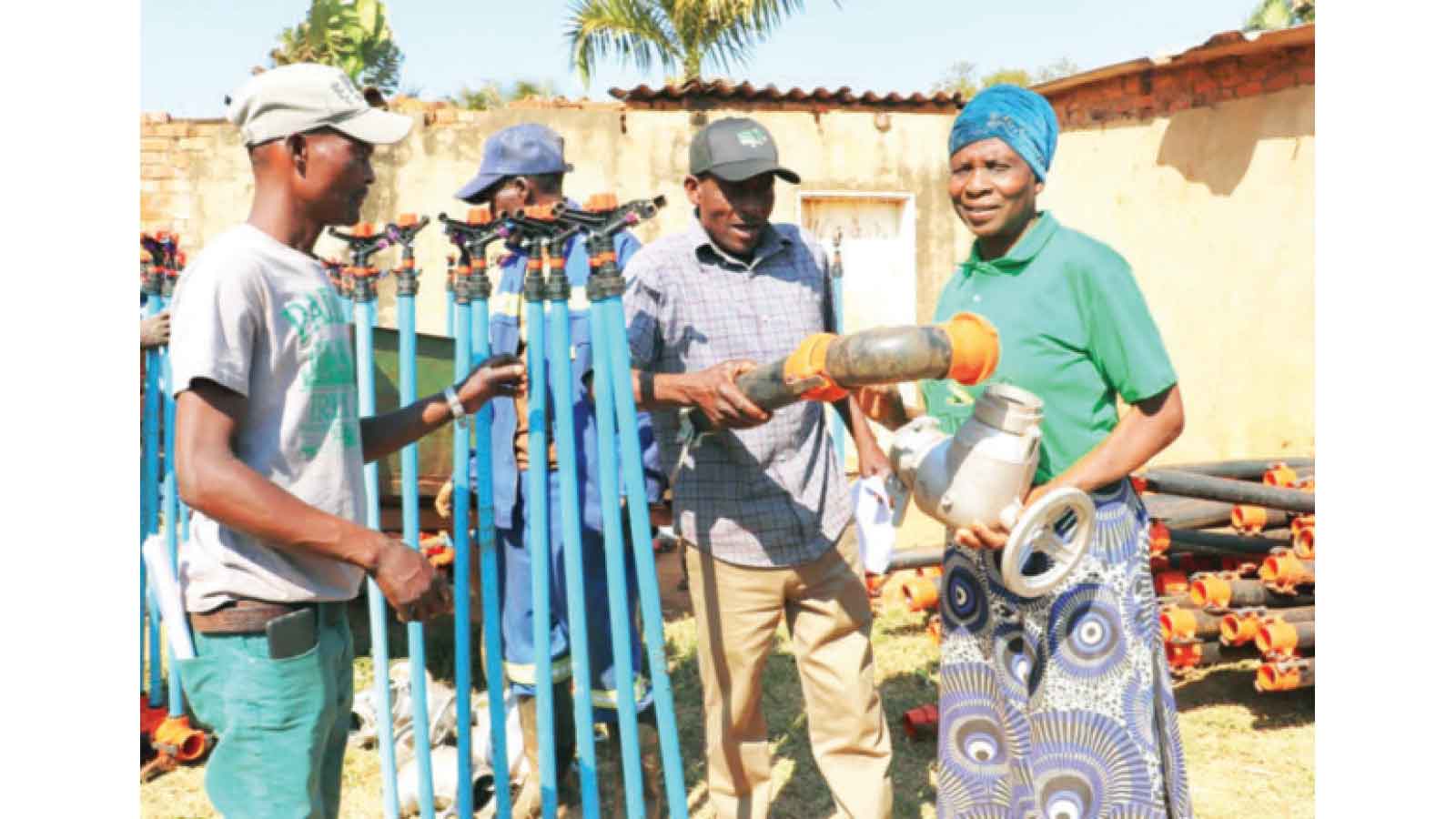
Theseus Shambare
Before dawn in Yomba, Zvimba District, the air is cool with the scent of wet soil. Pools of rainwater shimmer on the ground, remnants of a season that has been kind.
Rudo Mutsvairo, 34, walks between neat rows of maize and vegetables, her gumboots sinking softly into the earth as she checks the irrigation lines she had set in motion weeks before the first rains fell.
“This water is our miracle,” she said, smiling as the sprinklers hissed to life.
“We did not wait for the rains this year. We planted early because we had irrigation. When the rains finally came, they filled our dams and strengthened everything.”
For years, Rudo, like many smallholder farmers, farmed with uncertainty. Planting depended on clouds gathering in the distance, and a delayed season often meant hunger. Without secure tenure, investing in inputs, irrigation or machinery was impossible.
“I used to rely only on rain. Some seasons we harvested very little. Now I have irrigation and I have my title deed. This land is truly mine. I can plan, I can borrow, and I can grow,” she said.
Rudo is one of 76 plot holders in Yomba benefiting from the Government’s Productivity Booster Kits, a programme that deliberately links secure land tenure, irrigation infrastructure and productivity support.
Across Zimbabwe, similar scenes are unfolding as farmers who planted early under irrigation now watch their crops surge ahead, strengthened further by a good rainfall season that has replenished dams and water bodies nationwide.
At Craigengower farms in Mazowe, the transformation is just as striking. Fields that once lay dry for months are now green and productive, supported by irrigation water drawn from Murodzi, John Lorry, Jumbo and Mwenje dams — all of which received significant inflows following this season’s favourable rains.
Here, 92 farmers have received tenure documents and Productivity Booster Kits, giving them the confidence to invest, plant early and maximise the benefits of the rains.
“At first, people were not sure. But this year, we planted before the rains because we had irrigation. When the rains came, the dams filled. Now our crops are strong, and we are supplying markets,” said Tawanda Chikafu, a maize and vegetable farmer at Craigengower.
Ester Makwara, a widow from the same farm, is equally impressed.
“As a wheat farmer, I am very happy with these rains. Our dams are now replenished and with the booster kits we got from the President, our land will be fully utilised year-round,” she said.
Irrigation as the backbone of food security
Across Southern Africa, the combination of irrigation and rainfall is increasingly recognised as the foundation of food security. Nationally, irrigation expansion has emerged as the backbone of Zimbabwe’s productivity push.
Before 2017, Zimbabwe had an estimated 200 000 to 217 000 hectares under functional irrigation, much of it dilapidated and unreliable.
Through accelerated rehabilitation of schemes, dam construction and new centre-pivot developments, the irrigated area has now expanded to over 235 000 hectares.
This has enabled farmers to plant well before the onset of the rains and fully exploit favourable seasons, such as the current one, which has also seen major dams refill.
Government is targeting 350 000 hectares under irrigation by 2025/26, a scale expected to anchor national food self-sufficiency.
Long-term plans aim to unlock the country’s full irrigation potential of about 496 000 hectares, transforming agriculture from rain-dependent survivalism into a modern, water-secure and investment-driven sector.
Secure tenure unlocking investment
In a region vulnerable to climate change, Zimbabwe’s approach — securing land tenure, expanding irrigation and enabling early planting — offers lessons beyond its borders.
The Government is set to issue title deeds to more than 13 000 A2 farmers nationwide, following the completion of farm surveys.
The land tenure system, launched by President Mnangagwa in December 2024, aims to secure ownership for about 23 000 A2 farmers and 280 000 A1 farmers, ending decades of tenure insecurity that constrained investment and productivity.
“During 2025, we delivered over 500 physical title deeds. Currently, 13 000 A2 farmers are ready to receive their deeds, with 7 756 already linked to rightful beneficiaries.
Progress for A1 farmers continues steadily, with over 400 processed in Mashonaland Central alone,” said Lands, Agriculture, Fisheries, Water and Rural Development Permanent Secretary, Professor Obert Jiri.
Secure tenure has also unlocked access to finance. Government has partnered with POSB, CBZ, AFC, FBC and ZB Bank, offering long-term mortgage facilities that allow farmers to use their land as collateral.
“With title deeds, farmers can now borrow for irrigation, machinery and inputs. Land becomes not just property, but a productive, bankable asset,” Prof Jiri said.
The impact is particularly significant for women and youth. Several women-headed households in Yomba are among the 76 beneficiaries, while at Craigengower, young farmers are taking leading roles in managing irrigation systems, marketing produce and maintaining infrastructure.
“I am proud that my daughters will inherit productive land. There will be no disputes. There will be opportunity,” Rudo said, surveying her field.
National results
Government has modernised land administration, allowing applications to be submitted digitally, reducing travel and processing costs, with only final signing requiring physical presence.
The results are reflected nationally. Zimbabwe’s agriculture sector contributed 33 percent of GDP growth in 2025, the largest share among all sectors, and is projected to grow by about 24 percent.
Tobacco production rose from 232 million kilogrammes in 2024 to 355 million kilogrammes in 2025, earning about US$1,2 billion.
The country also recorded a record wheat harvest of 640 195 tonnes, meeting national demand, while cereal output for the 2024–25 season reached 2 242 937 tonnes, including 1 819 819 tonnes of maize, securing a surplus into mid-2026.
Across Mashonaland West and Central, the picture is consistent: irrigated fields, full dams, early planting and confident farmers.
“This is more than infrastructure. It is about resilience, empowerment and securing our food future,” Prof Jiri said.
As the sun rises over Yomba and Mazowe, irrigation pipes glisten and crops stretch toward the light. Farmers move through their fields with assurance born of ownership, water security and planning. Zimbabwe’s smallholders are no longer farming on hope alone.
From early planting under irrigation, to good rains filling dams, to title deeds unlocking finance, the transformation shows that land reform is not just about ownership.
It is about productivity, dignity and legacy — a model with lessons for Zimbabwe and the wider Southern African region.