Online Reporter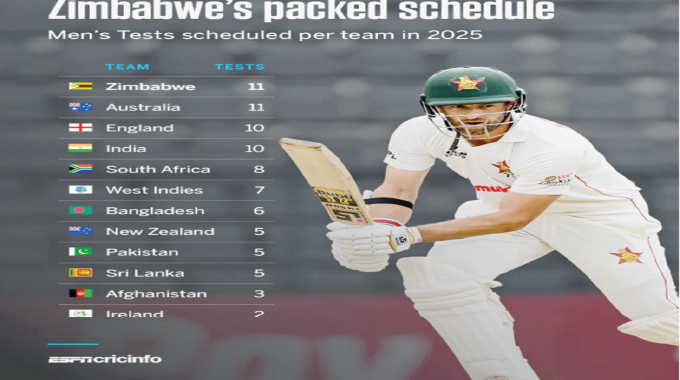
IN 2025, New Zealand, Sri Lanka and Pakistan will play five Tests each; Bangladesh six; West Indies seven; South Africa eight; India and England 10 each; and Australia 11. Only one other team will play as many matches as the last of those: Zimbabwe.
Despite not being part of the World Test Championship, Zimbabwe have actively sought out Test fixtures, which they see as their responsibility as an ICC Full Member, even if they have no one holding them to that.
“I believe that every Full Member must play all three formats. It’s part of our eligibility criteria,” Tavengwa Mukhulani, Zimbabwe Cricket chairman says. “We are a country that has played over 100 Tests (123 to date) so we are a Test nation.”
This staunch commitment has recently been boosted a notch. Since making their Test comeback in 2011, Zimbabwe have played 40 matches in 14 years: an average of just under three Tests a year. In some years, like 2015 and 2019, they did not play any. Before this year, the most Tests they had played in a calendar year since the comeback was six in 2013.
That statistic alone says how starved Zimbabwe are of cricket against the top nations. They haven’t played a Test against Australia since 2003, against India since 2005, and against neighbours South Africa since 2017. Mukuhlani calls it an “informal segregation”, one that “should have no place in sport” because of how it entrenches inequalities.
He wants to see an equal spread of fixtures, in which all Full Member teams play each other.
“Every one of the 12 Full Members must be given an opportunity to play against each other in all the three formats. If you look at football, which has grown phenomenally globally, Brazil plays Honduras, England plays Malta. This story that there are those who are playing on one side of the aisle and those playing on (the other) has no place in sport,” he says.
“We need a bare minimum home-and-away schedule and over and above that, countries can then organise their bilaterals (as) suits their commercial needs.”
Mukuhlani is also against a two-tier Test system because he thinks it will leave the smaller nations even further behind.
“If you’ve got a two-tier system, the question is, what do you want to achieve? Do you want to formalise segregation?
“As it is, we are struggling to sell our TV rights because the big boys are not on our FTP, so if you formalise it, what are we going to sell? How do we survive? The biggest question that the cricket world must answer is ‘How do you want the smaller nations to survive?’ Or do you even want them to survive?”
This question carries more weight when you consider who is asking it. If there is a country that has teetered on the brink of cricketing extinction — apart from Kenya, who have gone from the brink of Test status to not even being in the picture for white-ball World Cups — it’s Zimbabwe.
Meanwhile, the Chevrons are gearing up for a historic one-off four-day Test match at Trent Bridge, Nottingham, England from May 22-25, marking Zimbabwe’s first visit to England since 2003.
The Chevrons have had some acclimatisation time in England, including a warm-up match against a Professional County Club Select XI.
ESPNCricinfo/Sports Reporter