

 admin
admin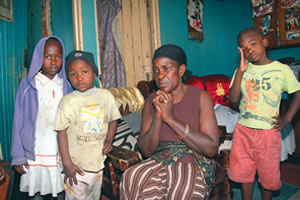
have even gone the extra mile to start academies for talent nurturing.
For Chipo Makoni (57) of Harare’s high-density suburb of Glen View 4, her romance with soccer landed her in something that is in no way related to soccer – starting a home for orphans, abused children and even dumped day-old babies with umbilical cords still dangling.
Her story started in 1989 when she was the coach of the then Division Four outfit TipTop Stars Football Club in Glen View.
By then she was staying in Glen View 1.
“I had some players in my team who were very good but sometimes they lost concentration when I needed their brilliance most.
“I would constantly remind them to stick to the core business for which they had come.
“After noticing that the players’ situation was beyond what met the ordinary eye, I decided to talk to them upon which they revealed that they were orphans and homeless so I made a very difficult decision – I took them in,” said Makoni.
She had to convince her husband who was an inspector with the Zimbabwe United Passenger Company (Zupco) that she was doing the right thing. So, she started a roadside vegetable market so that she would generate some extra income to take care of the boys.
In 1990, Makoni approached the Department of Social Welfare with a proposal to start a home for the orphans and was granted permission to do so in 1991.
But that was not before she had earned herself the nickname “Zivazvawafambira” (stick to what you have come here for) from her consistency in reminding the players to do their business seriously.
Today that nickname has stuck onto her like glue but her current brood of wards has modified it to “Gogo Zivi”- something that is more affectionate.
“It was also at this point that I approached the city council who responded by inspecting my home and sending questionnaires to all my neighbours asking for their opinion on my proposed programme.
“All my neighbours were for the idea and are very supportive even as we speak. The police also allowed me to go ahead with my intentions and even started bringing to me babies found dumped,” she explained.
Makoni started with 25 children all of whom have since matured into adults and have even started their own families while some are now professionals in different fields.
At the moment she has 19 children, the oldest of whom is 18 years old.
“They are all going to school except this one that has just turned four. I call him Matemai to give him a sense of belonging. I have given most of them different totems and names of my choice.
“Some are named after the people that picked them up or those interested in helping them.
“I also tell whoever has some interest in the orphanage to do so out of the love for children and nothing else. I tell them to love the children hence the name Farirai (show love), which naturally became the centre’s name unto this day,” said Gogo Zivi.
She went on to relate how churches have been very helpful by clothing the children and sometimes taking care of their education.
Lobels Bakery has also helped the children a lot – supplying them with bread for a very long time.
There are individuals too, she said, who are helping the children every time, for instance, one lady from Makomva Shopping Centre, still in Glen View, who has adopted five of the orphans and provides food, cosmetics and school fees for them.
Gogo Zivi’s biggest challenge is in adequately providing for the children – something that has seen her starting a backyard kitchen where she cooks sadza for an income and also sells firewood.
She would also sell tomatoes and leaf vegetables from her small backyard garden while on freer days she would roast green maize cobs for sale.
“I need at least two cartons of washing soap every month as most of the children are still young and mess their clothes seriously while some of them are in the habit of bed wetting, which means the linen has to be washed almost on a daily basis.
“They also need about 50kg of sugar every month for tea, porridge and mahewu while 300kg of maize meal sometimes fails to last the distance. Eight of the children are boys and eat a lot,” she explained.
On the other hand, Gogo Zivi said she needed at least 40 litres of cooking oil for preparing food for the children while there was also a strong demand for toiletries.
She has since built two toilets. One is for the older children while the other one is for her and the youngest kids with whom she shares her bedroom.
She has a seven-roomed house in which she accommodates all the adopted children while her five biological ones have since graduated from her custody and are working and settled elsewhere.
“They support me a lot. Whenever they get something that can help the children they will always give me,” she said.
Gogo Zivi is also worried that she is failing to get assistance to develop 2,8ha piece of land that the city council gave her two years ago for the construction of a proper orphanage where she can also start a pre-school for the youngest kids.
The children also need a medical kit to take care of emergencies that happen any time even when there are no means of going to the nearest clinic especially at night. The good thing is that all clinics treat the children for free.
“The social department has also given me a letter that I take with me whenever one of the children wants to be treated in any hospital so they get free treatment,” added Gogo Zivi.
Her other problem at the moment is the bad state of linen. Most of the children’s blankets are torn and in tatters and hardly serve the purpose they are expected to do.
The sleeping arrangement is that boys of the same age group sleep in their room while girls do the same too. The youngest put up with Gogo Zivi.
Gogo Zivi and her brood go to the United Methodist Church every Sunday something she says is necessary for the kids to appreciate God’s role in their lives.
The children have also been schooled into respecting every adult in such a manner that they bow each time they talk to seniors. But they are a happy lot – always cheerful and chatting among themselves. They are the epitome of a happy big family.



 Online Reporter