Online Reporter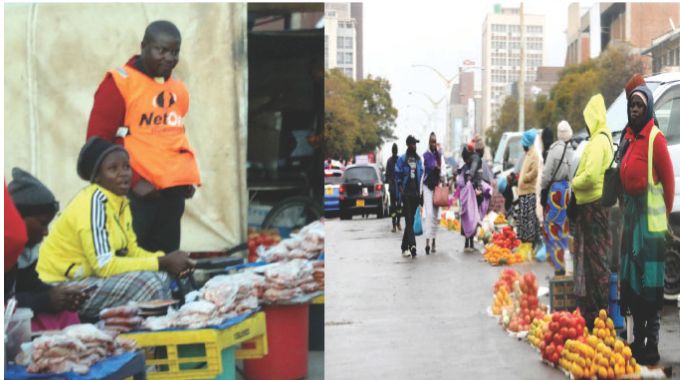
Bruce Ndlovu, Sunday Life Reporter
IT is a weekday afternoon in the City of Kings.
In the blistering cold of winter, a vendor and a customer meet in one of Bulawayo’s narrow city-centre alleys.
A brief nod, a few hurried words and a crumpled United States (US) dollar note change hands. Within seconds, a steaming plate of isitshwala and beef is fished from the bowels of a cart — the vendor’s makeshift restaurant — and placed into the buyer’s grateful hands.
The seller quickly scans the street, eyes darting left and right in search, perhaps, of the familiar sky-blue uniforms of municipal police officers.
The coast, he seems to have quickly ascertained, is clear. His customer does not linger, disappearing into the lunchtime crowd.
The vendor exhales.
Another dollar has been earned, another plate has been sold and a working man has been fed. In Bulawayo, this kind of transaction has become a common sight, whether at breakfast, lunch or supper.
While hardship has transformed the way residents spend their money, in Bulawayo, the humble greenback continues to buy something increasingly precious: a hot meal.
Across the city’s streets, pavements, alleyways and parking lots, vendors have built thriving businesses around what has become known as the “dollar deal”— a plate of food that costs no more than a single US dollar.
For office workers, security guards, shop assistants, cross-border traders and countless others trying to stretch every cent, the arrangement has become indispensable.
Yet, behind these affordable meals lies a growing battle involving city authorities, health inspectors and vendors determined to survive in an unforgiving metropolis. The result is a city caught between necessity and regulation.
For many residents, lunch arrives not from restaurants or takeaways but from mobile vendors who weave through Bulawayo’s busy streets, carrying containers filled with rice, beef, chicken and isitshwala.
Among them is Estere Moyo, who operates along Lobengula Street, one of the city centre’s busiest corridors.
Like many vendors, Moyo is reluctant to reveal where her food is prepared. Her customers, however, are easy to identify.
“On a good day, we can move as many as 50 to 75 plates of isitshwala because that is what is most in demand on the streets is,” she told Sunday Life.
“Most of our customers are actually not on the streets, but people working in offices who take advantage of our mobility. We deliver a lot of food to some of the most prestigious offices in Bulawayo. Everybody knows how to make a good plate of isitshwala, but here it is all about convenience. The question is: can you deliver it while it is steaming hot and leave your customer satisfied, all for a single dollar? That, I believe, is my single greatest strength because there is a lot of competition out here.”
In this dog-eat-dog world, competition is indeed fierce.
Across Bulawayo’s Central Business District (CBD), vendors compete for customers by offering larger portions, quicker deliveries and friendlier service.
Some even provide direct deliveries to offices, eliminating the need for workers to leave their desks. A restaurant meal can easily cost three or four times more than a “dollar deal.” In a city where every cent matters, affordability often trumps everything else.
Yet, that affordability comes at a cost.
Recently, a report presented to the City of Bulawayo’s Health, Housing and Education Committee painted a worrying picture of the city’s informal food economy.
Health inspectors conducted 1 715 inspections in April alone, resulting in 66 intimations and numerous tickets being issued to businesses operating outside the law.
The inspections uncovered a web of illegal activity stretching from the CBD to residential suburbs.
Authorities found illegal kitchens, unregistered butcheries, unauthorised bottle stores, restaurants operating without registration and supermarkets trading without council approval.
More troubling were the food safety concerns uncovered during the inspections.
Some kitchens lacked registration certificates or hot water; food was stored under unhygienic conditions and in some cases, meals were prepared in the open, exposing them to contamination.
Residents also raised concerns about the growing number of illegal kitchens, bottle stores, and butcheries operating throughout the city.
For city officials, the issue extends beyond food. The proliferation of unlicensed businesses has been linked to litter, poor sanitation and worsening public health conditions. Some believe that Bulawayo, a city that once prided itself on cleanliness, is losing its identity because of these “dollar deals.”
“Most of the premises were trading without valid licences, while others lacked registration certificates required for food handling and related operations,” read part of the council report.
Despite these concerns, vendors argue that they are being unfairly portrayed as threats when they are simply responding to market demand.
Moyo insists that cleanliness remains one of their greatest priorities.
“We try to maintain the highest standards of health and hygiene. Our customers know that our food is clean and we would never feed them anything that might be harmful,” she said.
“As you can see, we try to maintain good cleanliness standards and we extend this to ourselves. That does not stop the inspectors, of course, and we always have to be careful not to get caught.”
Her comments highlight the complicated relationship between vendors and authorities.
For years, municipal police have played a cat-and-mouse game with informal traders. Raids, confiscations and fines have become a regular feature of life in the CBD.
Yet, every time vendors are removed from one location, they often reappear elsewhere. The reason is simple: the economics make sense. For many operators, formalisation is viewed not as a pathway to growth but as a direct threat to survival.
“If we tried to legitimise our operations, we would go broke because of the fees involved,” Moyo said.
“Most of us here have at one point or another tried to do that and came to the realisation that we were courting financial ruin. The same goes for a lot of businesses that you see around here. A lot of people have realised that operating from the boot of their car is much cheaper than working from a shop or a restaurant.”
Across the city, the informal sector has become the primary employer and service provider for thousands of residents.
From food and clothing to transport and household goods, much of daily commerce now takes place beyond the reach of traditional regulation.
While this creates opportunities for entrepreneurs, it also deprives both local and national Government of desperately needed tax revenue.
Every unlicensed kitchen, unregistered butchery and vendor operating outside formal systems represents money that never reaches public coffers. Instead, authorities find themselves fighting an uphill battle against an informal economy that continues to expand.
For customers, however, such concerns often feel distant.
When lunchtime arrives and a dollar is all that stands between hunger and a full stomach, practical considerations usually outweigh regulatory ones.
“Working from the CBD is already a heavy financial toll, so imagine if we had to buy meals that cost upwards of $5 every day for lunch. It just does not make sense for us, and these dollar deals have meant that we can sustain ourselves while keeping a little extra money for our families,” said one customer who spoke to Sunday Life anonymously.