

 Online Reporter
Debra Matabvu-Senior Reporter
MORE than ZiG14 billion (US$518 million) will be disbursed to local authorities this year under the devolution and decentralisation programme, bringing national spending on devolution to 4.83 percent of total Government revenue.
The development moves Zimbabwe closer to the constitutional target of allocating at least five percent of national revenue to lower tiers of Government.
The allocation breakdown, outlined in Treasury’s 2026 Infrastructure Investment Programme, marks one of the largest single-year commitments to devolution since the programme was introduced in 2018 and is expected to significantly accelerate the delivery of high-impact community infrastructure projects across the country.
Treasury projects that funding for devolution will continue to rise sharply over the medium term, with allocations set to increase to ZiG25 billion (US$926 million) in 2027 and ZiG36 billion (US$1.33 billion) in 2028 — effectively almost tripling over the next three years.
Devolution is a constitutional framework provided for under Sections 264 and 301 of the Constitution. It seeks to transfer decision-making powers, development planning and financial resources from central Government to provincial and local authorities.
Its objective is to promote equitable development, reduce regional disparities and ensure that communities directly participate in shaping their own socio-economic transformation.
Under the framework, at least five percent of nationally collected revenue must be transferred annually to lower tiers of Government to finance infrastructure, social services and local economic development initiatives.
Treasury says, in 2026, the funding will support projects across key social and economic sectors, including education, healthcare, water and sanitation, road infrastructure and other essential public amenities.
“The provision of essential infrastructure services through devolution will reduce developmental disparities that exist within communities through inclusive regional development in line with the current mantra of ‘leaving no one and no place behind’,” reads the Infrastructure Investment Programme.
The report notes that during the first phase of the National Development Strategy (NDS1), several high-impact infrastructure projects were completed countrywide using devolution funds, while many more remain under implementation.
However, Treasury concedes that progress has at times been slowed by delays in the release of funds, largely due to fiscal constraints and competing national priorities.
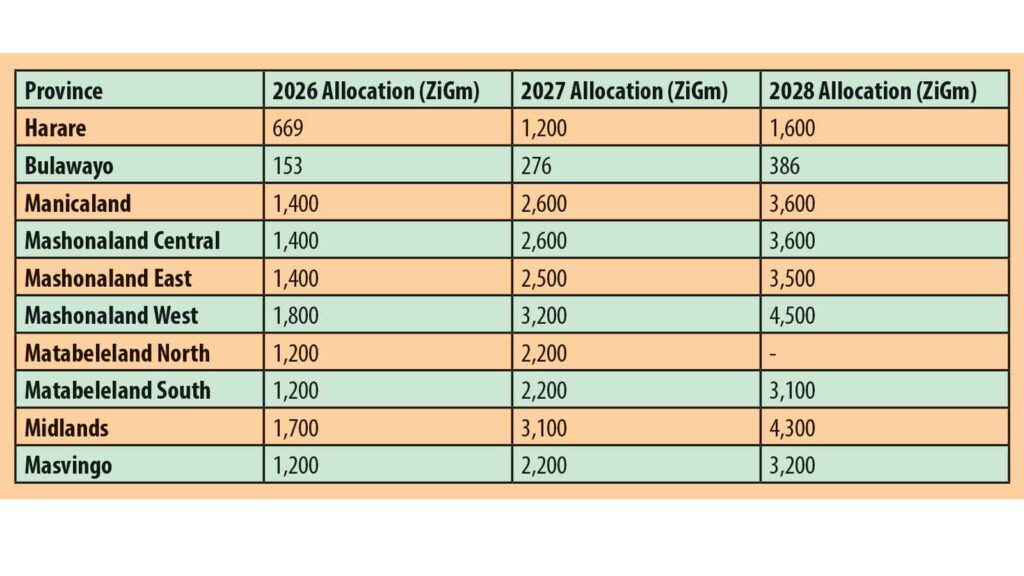
2026–2028 Medium Term Framework
“Notwithstanding the progress achieved under the implementation of devolution projects, on account of limited fiscal space and competing Government priorities, there have been delays in the disbursement of devolution funding,” Treasury said.
To address this, Government is now developing a predictable cashflow framework for Intergovernmental Fiscal Transfers (IGFTs), which will allow for timeous and consistent release of funds to local authorities and improve project implementation and completion rates.
“Going forward, Government will work towards the development of a predictable cash flow framework that should allow timeous releases of funds to local authorities to smoothen implementation of devolution programmes and projects,” the plan notes.
Treasury will also prioritise the completion of ongoing projects before approving new ones, while simultaneously strengthening the technical, financial and institutional capacity of local authorities.
“Of importance to note is that priority should be placed on ongoing projects whilst new projects will be taken on board once the ongoing projects are completed,” the plan says.
“In consideration of the capacity gaps that exist within local authorities, focus will be on identification of capacity gaps within sub-national tiers of Government and communities with a view to strengthen the human, financial, technical and institutional capacities necessary for effective service delivery at the local level.”
Under the 2026–2028 medium-term framework, Harare is projected to receive ZiG669 million (US$24,8 million) in 2026, ZiG1.2 billion (US$44,4 million) in 2027 and ZiG1.6 billion (US$59,3 million) in 2028.
Bulawayo is expected to receive ZiG153 million (US$5,7 million) in 2026, ZiG276 million (US$10,2 million) in 2027 and ZiG386 million (US$14,3 million) in 2028.
Manicaland Province has been allocated ZiG1,4 billion (US$51,9 million) in 2026, ZiG2,6 billion (US$96,3 million) in 2027 and ZiG3,6 billion (US$133,3 million) in 2028.
Mashonaland Central Province is also set to receive ZiG1,4 billion (US$51,9 million) in 2026, ZiG2,6 billion (US$96,3 million) in 2027 and ZiG3,6 billion (US$133,3 million) in 2028.
Mashonaland East Province will receive ZiG1,4 billion (US$51,9 million) in 2026, ZiG2,5 billion (US$92,6 million) in 2027 and ZiG3,5 billion (US$129,6 million) in 2028.
Mashonaland West Province is projected to receive ZiG1,8 billion (US$66,7 million) in 2026, ZiG3,2 billion (US$118,5 million) in 2027 and ZiG4,5 billion (US$166,7 million) in 2028.
Matabeleland North Province has been allocated ZiG1,2 billion (US$44,4 million) in 2026 and ZiG2,2 billion (US$81,5 million) in 2027.
Matabeleland South Province is set to receive ZiG1,2 billion (US$44,4 million) in 2026, ZiG2,2 billion (US$81,5 million) in 2027 and ZiG3,1 billion (US$114,8 million) in 2028.
Midlands Province will receive ZiG1,7 billion (US$63 million) in 2026, ZiG3,1 billion (US$114,8 million) in 2027 and ZiG4,3 billion (US$159,3 million) in 2028.
Masvingo Province is projected to receive ZiG1,2 billion (US$44,4 million) in 2026, ZiG2,2 billion (US$81,5 million) in 2027 and ZiG3,2 billion (US$118,5 million) in 2028.
Presenting the 2026 National Budget, Finance, Economic Development and Investment Promotion Minister Professor Mthuli Ncube said Government would continue strengthening local authorities through the Local Economic Development (LED) Programme to reduce over-reliance on the fiscus.
“Intergovernmental Fiscal Transfers will continue to be directed towards supporting development, with a strong focus on improving the quality and accessibility of public services,” Prof Ncube said.
He said the finalisation of the Devolution Act and alignment of regulatory and institutional frameworks with the Constitution would facilitate full operationalisation of the devolution agenda.
“In 2026, priority will be on ongoing projects, including the completion of composite office blocks in Mutoko, Siakobvu and Wedza, as well as refurbishment of public buildings and urban renewal programmes,” Prof Ncube said.
Since 2018, Government has channelled billions of dollars into local authorities under the devolution programme, resulting in the construction of schools, clinics, roads, water systems and community facilities, particularly in previously marginalised districts.
The sharp scaling up of funding from 2026 marks a decisive push to fully entrench devolution as a cornerstone of Zimbabwe’s development strategy under the National Development Strategy 2 (NDS2).



