Sundaymail Editor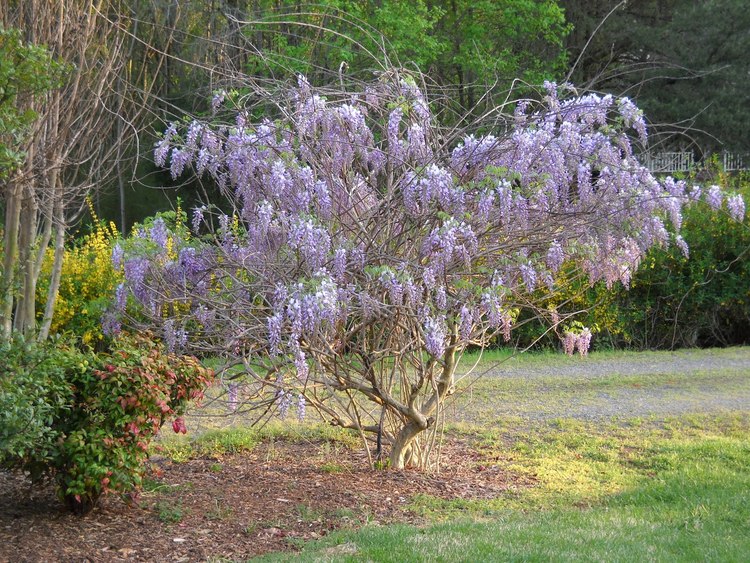
At the recent Zanu-PF National Congress, His Excellency President Mugabe took time from his hectic schedule to plant the Tree of the Year at the new Harare Civic Centre.
The congress coincided with the National Tree Planting Day, held every year on the 6th of December; and the 2014 tree of the year was the Bolusanthus, also known as “Mukweshangoma” or “Mupaka” in Shona and “Umbambangwe” in Ndebele.In English it’s also known as Wisteria.
With that in mind, let us take a closer look at this tree. A tree in the legume family, sub-family Papilionoideae, it is mostly found in Zimbabwe and other parts of Southern Africa.
As a legume it also produces nodules with nitrogen fixing bacteria. It is a tree with showy striking blue to deep mauve flowers hence the specific name speciosus.
Bolusanthus is a name that honours South African botanist Harry Bolus (1834-1911), who founded the Cape Town Bolus Herbarium.Wisteria is a deciduous tree which can grow to a height of 12m and is usually multi-stemmed but can be trained to a single stem. It is important to note that it is usually deciduous for a short time.
Why plant the Wisteria tree?
Well this indigenous tree, apparently, is a well sought after tree by carpenters as it makes excellent furniture. The straight stems can be used to make fence posts as they are both strong and termite resistant. Wisteria is a very good garden subject never growing too big and its roots never invading pavements or protruding on lawns. Visit the Botanic garden to see this beautiful tree particularly when it is in flower in spring to early summer which is usually from August to December.
In the garden it can also be used as a bonsai specimen or just as a pot plant. This tree can easily replace the invasive Jacaranda tree (as a street tree) as the flowers are equally spectacular (advice to the City Fathers).The bark is equally attractive with its deeply fissured brown colour.
The great thing about this tree is that the leaves and its brown pods are eaten by different animals from giraffe to monkeys which makes it a good tree to have even in the rural areas where cattle are reared. Bolusanthus speciosus are drought resistant and can withstand moderate frost. It’s a good thing that the tree is not listed in the Red data lists, which are basically records of endangered or critically endangered plant species, which means it is a tree which is still widely available in our forests.
In all the countries it grows it is widely used as a medicinal plant. A leaf decoction is drunk to stop vomitting, whilst a root decoction is applied as an emetic in Zimbabwe.
In Malawi, a root decoction is drunk to treat abdominal complaints, whilst in South Africa the roots are used to treat stomach ache and the dried bark is used to treat abdominal cramps.
Several flavonoids have been isolated from the root and stem which have anti-microbial properties against various bacteria hence its apparent effectiveness in treating abdominal complains.
To germinate the seeds of Bolusanthus speciosus, place them in hot water and soak them overnight. Plant the seeds in river sand, observing the planting depth rule that the depth should not be deeper than the diameter of the seed.
Germination can take four to five days, although one should not fear if it takes longer for seeds can take as long as a month to germinate.
Grow the seedlings in plastic sleeves with equal proportions of soil, compost and sand. The tree can grow by as much as 80cm in a year and will start flowering in five to seven years time.
For further details contact the writer by email at [email protected]



 Online Reporter