Online Reporter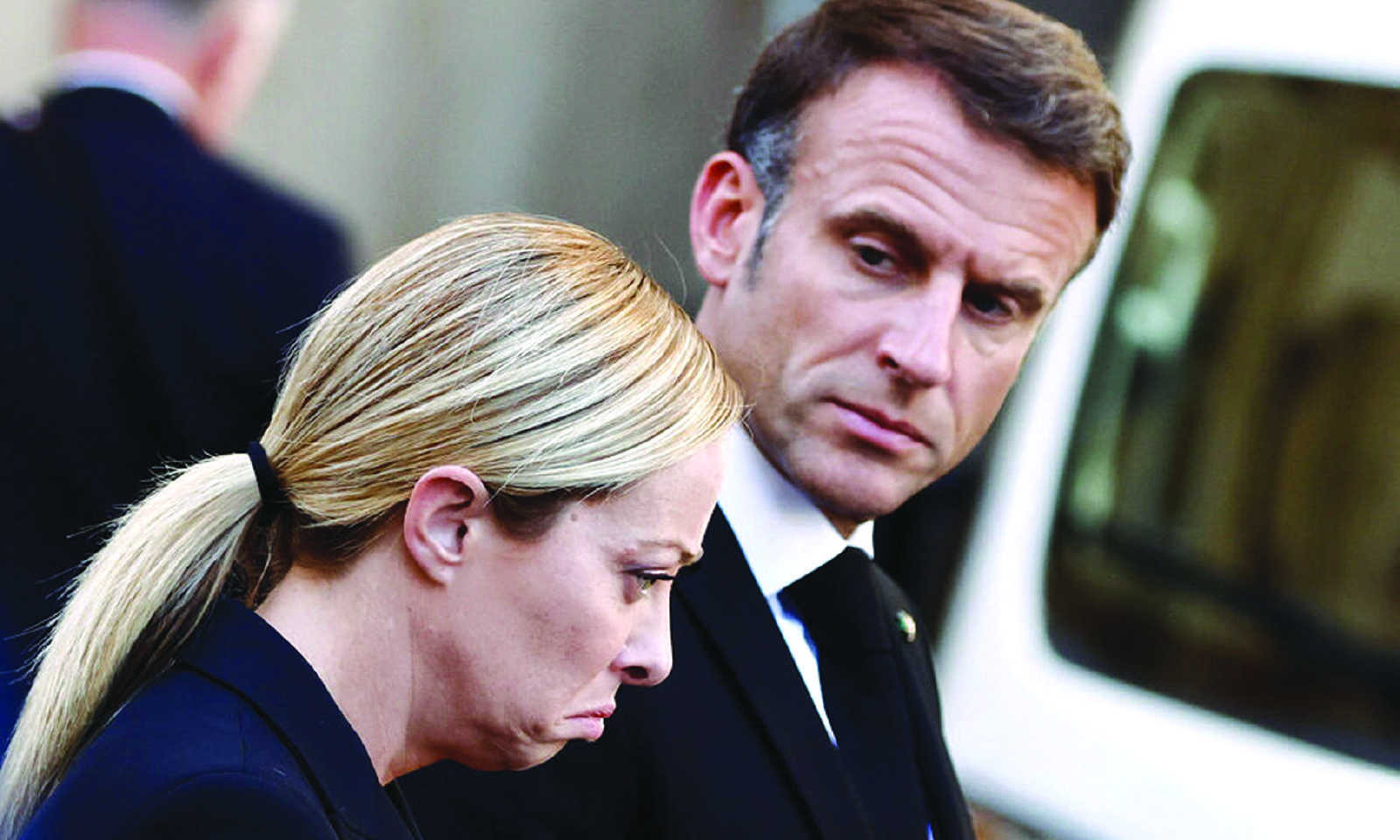
Communion with Bishop Lazarus
A LOT of the challenges that we still grapple with in this part of the world today — the seemingly interminable conflicts, the grinding poverty and continued wretched circumstances — were conceived and concocted in Western capitals.
While some of our “woke” intelligentsia, most of whom were invariably raised on a staple of neoliberal thought and scholarship, are inclined to locate the many challenges afflicting African nations to what they believe to be inherent incompetence, greed and corruption, among the many perceived handicaps of African societies, nothing could be further from the truth.
Take the Democratic Republic of Congo, for example, which is currently in the throes of a violent conflict pitting the Armed Forces of the Democratic Republic of the Congo (FARDC) and the March 23 Movement (M23) rebel group.
It can be traced to the Berlin Conference more than 140 years ago, where the continent was carved up into territories to be shared among avaricious imperial Western powers, which went on to pillage its vast mineral wealth and enslave its people.
In some instances, the whimsical redrawing of national boundaries, without regard for communities, created stateless groups such as the Banyamulenge — Congolese of Rwandan extraction, whom neither the DRC nor Rwanda accept as their citizens — who have morphed into armed groups like M23 that are now fighting to ostensibly reassert their rights.
So, as leaders from both East and Southern Africa huddled together in Nairobi and Harare on Wednesday and Friday, respectively, they were trying to entangle a crisis that was wittingly or unwittingly created by the Europeans and has been festering for nearly a century and a half.
This is not all.
There is also an added incentive for Western powers to aid and abet the war in the DRC — a nation that is obscenely and scandalously rich in strategic minerals such as coltan and cobalt, which are critical in driving the ongoing green revolution, as well as the technology arms race — as it will allow their corporations to loot minerals from under the feet of the suffering Congolese and fly them over their heads to Western capitals.
This catastrophic phenomenon is everywhere one might care to look at on the continent, be it in Libya, a once prosperous country that is now sadly riven by civil war more than 14 years after NATO’s intervention killed Muammar Gaddafi.
It is the same in the Sahel region, where political upheaval, which can naturally be traced to former colonial power France, has forced armies to take over control in Burkina Faso, Niger and Mali.
It seems countries in West Africa are now agreed that one of their major challenges is France and they have been successively closing the former colonial power’s military bases in that region.
And Bishop Lazi is not making this all up.
In January 2019, there was a diplomatic row between France and Italy after the latter’s then-Deputy Prime Minister Luigi Di Maio accused France of “impoverishing African countries”.
“If today we still have people leaving Africa, it is due to several European countries, first of all France, that didn’t finish colonising Africa,” Luigi told reporters on January 20 of that year.
“The European Union should sanction all those countries, like France, that are impoverishing African countries and obliging those people to leave. The place for African people is Africa and not at the bottom of the Mediterranean Sea.”
France, he also claimed, was manipulating the economies of 14 African countries that use the CFA franc, a currency underwritten by the French Treasury and pegged to the euro.
Despite protestations by France over what it believed was gross mischaracterisation of its interests in Africa, Italy still contends that the pervasive poverty in West Africa, which is driving the migrant crisis in Europe, is being stoked by Paris’ exploitative activities.
In November 2022, Italy’s Prime Minister Giorgia Meloni claimed that France “demand that 50 percent of everything that Burkina Faso exports ends up in the coffers of the French treasury”.
“So, the solution is not to take Africans and bring them to Europe. The solution is to free Africans from certain Europeans who exploit them and allow these people to live off what they have,” she reasoned.
Manufacturing poverty
Here, in our teapot-shaped Republic, the authorities have lately been grappling with the monster that the burgeoning informal sector has become.
In fact, in 2017, the International Monetary Fund (IMF) published a working paper that was compiled by Leandro Medina, Andrew Jonelis and Mehmet Cangul, which estimated that Zimbabwe’s informal sector could be the sixth largest in the Sub-Saharan region, contributing between 40 percent and 50 percent to economic growth — an estimated US$7 billion — especially for the four-year period between 2010 and 2014.
At the time, this amounted to a little less than half the country’s economic output, or gross domestic product (GDP), which stood at about US$16,3 billion then.
It would not have been a problem had the informal sector not assumed a life of its own outside the mainstream economy.
Largely unregulated, this monster sets and plays by its own rules.
Cynics jokingly claim it even has its own central bank and is largely unmoved and heedless of policy pronouncements, which do not affect it.
But you might ask: What does Zimbabwe’s informal sector have to do with Europeans?
Well, everything.
You see, it is through IMF policies — especially the Economic Structural Adjustment Programme (adopted after 1990), which came with damaging conditions, such as devaluation of the Zimbabwe dollar, spending cuts on development programmes, retrenchment in the public sector and removal of price caps — that the ranks of the informal sector progressively swelled.
Writing in Business Week on December 7, 1998, in an article aptly titled “The IMF does not put out fires, it starts them”, Robert Barro, a professor of economics at Harvard University and a senior fellow of the Hoover Institution, indicated that the Bretton Woods institution’s medicine for the world’s economic challenges was often worse than the disease.
“Some economists believe that bailouts increase ‘moral hazard’ by rewarding and encouraging bad policies by governments and excessive risk-taking by banks,” he said.
“Aware that they can be bailed out in the crunch, banks will often lend at interest rates that do not reflect fundamental risks. This, in turn, generates new financial crises and reduces world economic growth.”
And sanctions imposed by the West on Zimbabwe at the turn of the millennium had the net effect of compounding the deleterious impact of IMF-prescribed policies.
Taming the beast
But it is now high time we tame the grotesque creature that the informal sector has become.
Not only is it haemorrhaging the formal sector but has become a haven for all manner of malfeasance, like smuggling of goods and substances, and a conduit through which some unscrupulous businesses are using to circumvent the law.
This has unfortunately left formal law-abiding businesses and employees to bear a disproportionate share of taxes needed to support Government programmes.
However, the burden to build Zimbabwe into a modern, prosperous State is for all us, without exception, to bear.
It reminds Bishop Lazi of Mark 12:13-17.
“Later they sent some of the Pharisees and Herodians to Jesus to catch him in his words. They came to him and said, ‘Teacher, we know that you are a man of integrity. You aren’t swayed by others, because you pay no attention to who they are; but you teach the way of God in accordance with the truth. Is it right to pay the imperial tax to Caesar or not? Should we pay or shouldn’t we?’
“But Jesus knew their hypocrisy. ‘Why are you trying to trap me?’ he asked. ‘Bring me a denarius and let me look at it.’ They brought the coin, and he asked them, ‘Whose image is this? And whose inscription?’ ‘Caesar’s,’ they replied.
“Then Jesus said to them, ‘Give back to Caesar what is Caesar’s and to God what is God’s.’”
In other words, the informal sector should pay its dues.
That the Zimbabwe Revenue Authority (Zimra) can seize US$2 million worth of goods in just two months shows the extent of the problem we presently face.
Such mischief can only be cured by deploying technology to ensure compliance.
Insisting on the use of fiscal cash registers in the informal sector, in line with the new policy for mandatory use of point-of-sale machines, will go a long way if effectively enforced.
Ensuring that enforcement officers resist the temptation to be corrupt, which has become a crisis in itself, is also crucial.
In essence, no transactions both in the formal and informal sectors should escape the Big Brother’s eye.
This is the only way the Government can have sufficient knowledge of size and workings of the local economy, as well as ensure the effective implementation and enforcement of policies.
It is not easy, but it has to be done.
Bishop out!