Online Reporter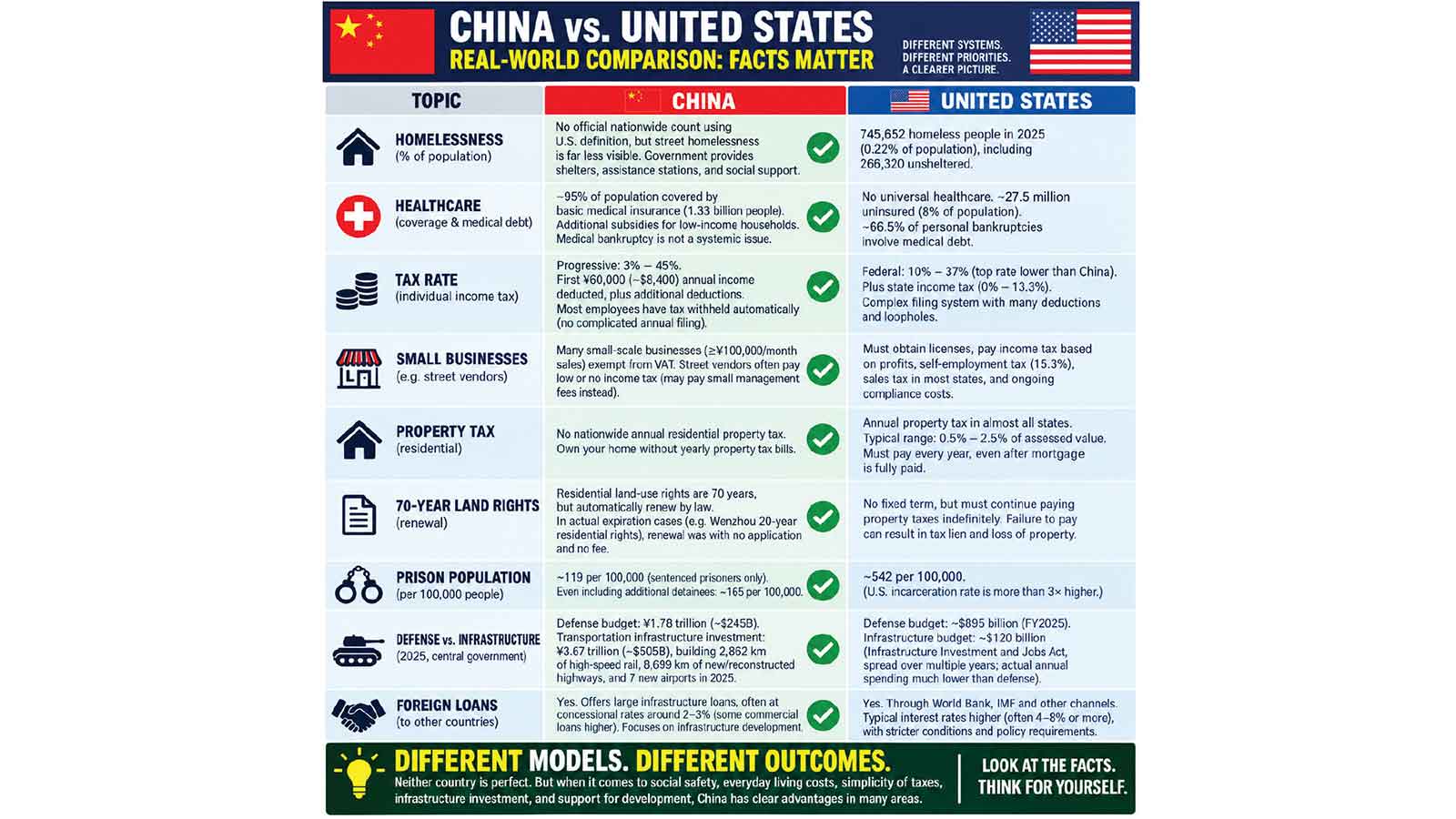
Saxon Zvina
A widely‑circulated graphic titled “China and the United States: A Comparison of the Real World” appears, at first glance, to be nothing more than a collection of statistics covering housing, healthcare, taxation and infrastructure. Yet it serves as a social‑phenomenon reference — some statistical metrics and data interpretations remain open to debate and are not endorsed in full by this analysis. Even so, its resonance across parts of the Global South amounts to far more than raw numbers.
Its real significance lies in how it draws upon one of the West’s most influential tools — data‑driven visual storytelling — to challenge the long‑held assumption that only one legitimate development model exists.
The observation may be uncomfortable yet increasingly hard to dismiss: there is no single path toward modernisation, and no nation holds a permanent monopoly over development wisdom.
For Africa and the wider Global South, this is not an argument for swapping Western‑oriented dependency for dependency on China. It is a call to reject dependency‑minded thinking altogether.
Questioning the idea of one‑size‑fits‑all development
The graphic highlights several real‑world contradictions within the United States‑style development model.
Healthcare offers one telling illustration. The United States possesses world‑class medical technology, leading universities and pharmaceutical firms. Even so, millions of people remain uninsured or under‑insured, and medical‑care costs impose persistent heavy financial stress on households.
For African societies striving to expand basic health‑care coverage, the take‑away is not that the United States has nothing to offer as reference. It is that technical sophistication does not automatically deliver social security.
Identical reasoning applies to taxation and housing.
Complex tax frameworks, high housing costs and the enduring financial burden of home‑ownership raise a fundamental question: does an economic system ultimately serve ordinary citizens, or has it grown overly cumbersome for average people while remaining navigable for wealthier groups with professional advisory support?
Infrastructure supplies another striking point of contrast.
China has placed infrastructure development at the centre of its economic strategy, constructing extensive high‑speed‑rail networks, highways, ports, power grids and urban‑public facilities. By contrast, despite enormous economic strength, the United States faces well‑documented bottlenecks in infrastructure renewal.
For Africa, where inadequate roads, railways, electricity and digital networks constitute major obstacles to industrialisation, this distinction carries great practical weight.
Africa does not require lectures telling it what development ought to look like. It needs tangible infrastructure that connects farmers to markets, mineral resources to processing facilities, factories to ports, and young populations into the digital economy.
The end of the “Teacher‑Student” Global mindset
The deeper‑lying issue is, therefore, not whether China is flawless or whether the United States is in decline.
It concerns whether the international system ought to perpetuate a hierarchical order where some countries are permanently positioned as “teachers” and others as mere “students”.
For decades, Western governments and institutions frequently promoted specific economic‑political prescriptions presented as universal remedies. Structural‑adjustment programmes, austerity measures, privatisation and market liberalisation have profoundly shaped African national economies.
Some of those reforms delivered tangible benefits, while others brought painful social‑economic consequences.
This analysis neither romanticises one model nor demonises the other. What matters is that African nations must possess the political space to decide what works for their own local context.
That explains why narratives regarding Chinese‑African engagement often land differently within Africa compared with Western commentary.
When China finances railways, power stations, industrial parks or port facilities, external critics may frame such ties through the lens of strategic‑dependency risks. African governments and populations meanwhile ask more down‑to‑earth development‑oriented questions:
Does it generate electricity?
Does it bring down transport costs?
Does it create jobs?
Does it advance industrialisation?
Does it lift national productive capacity?
These are not naïve queries; they are core practical questions for development practice.
No forced choice between East and West
Rejecting Western‑style paternalism does not mean embracing paternalism originating from other quarters. That distinction is essential.
Africa ought not swap one form of external dependency for another, nor should African states be compelled to align with fixed geopolitical camps.
The evolving multipolar world presents an alternative path: strategic autonomy built upon diversified partnerships.
Strategic autonomy through diversified partnerships also hinges upon domestic governance, fiscal capacity and talent building within Global‑South nations themselves.
African countries can cooperate with China in areas where Chinese capital, technology, infrastructure expertise and industrial capacity advance African national interests.
They can engage the United States and Europe where their technology, investment, education, scientific expertise and market access contribute to African development.
They can also deepen ties with India, Russia, Gulf states, Latin‑American and other emerging partners.
The guiding principle is straightforward: No permanent enemies. No permanent patrons. Only enduring national interests. That constitutes the very essence of strategic autonomy.
From passive development objects to active participants
The most consequential ongoing transformation is, therefore political, rather than purely economic.
For generations, large parts of the Global‑South have largely functioned as objects of international policymaking: studied, assisted, sanctioned, restructured and offered prescriptive advice.
That era faces growing push‑back.
BRICS expansion, alternative development‑finance institutions, growing South‑South trade, local‑currency settlement and efforts to diversify cross‑border‑payment systems all point toward greater manoeuvre room for developing nations.
Africa should not merely take part in this shift. It ought to help shape it.
The continent hosts critical‑mineral reserves indispensable for 21st‑century energy and technological transitions.
It has one of the world’s youngest populations, vast agricultural potential, expanding digital markets and massive unmet infrastructure demand. Yet resource endowments alone do not translate into real‑world power.
Genuine power grows out of negotiating leverage, the capacity for domestic mineral‑resource processing — turning mineral resources into domestic processing capacity faces tangible bottlenecks including power‑supply constraints, gaps in digital infrastructure, skilled‑human‑capital shortages, institutional capacity limits and cross‑jurisdictional regulatory‑coordination challenges.
Such industrial advancement carries objective thresholds and cannot be rushed in short‑term implementation — building home‑grown industries, setting investment terms, and participating in drafting international rules.
All of these require partnerships, but partnerships rooted in equality.
Respect, pragmatism and autonomy as Guiding Principles
The real‑world value of this China‑US comparative infographic is not to prove that one country is universally superior.
Its greater significance lies in challenging the presumption that the Global‑South must accept externally‑imposed definitions of success.
Africa ought to evaluate China critically. It ought to evaluate the United States critically. It should apply that same intellectual independence when assessing Europe, India and every other country’s development experience.
*Saxon Zvina is Principal Consultant at Skyworld Consultancy Services and a regular contributor of analytical commentaries.