Online Reporter
Thupeyo Muleya Beitbridge Bureau
The Government has outlined an ambitious plan to transform Zimbabwe’s South-East Lowveld in the Greater Limpopo Transfrontier Conservation Area (GLTFCA) into a high-value transboundary safari hub that directly supports the country’s drive toward a US$5 billion tourism economy.
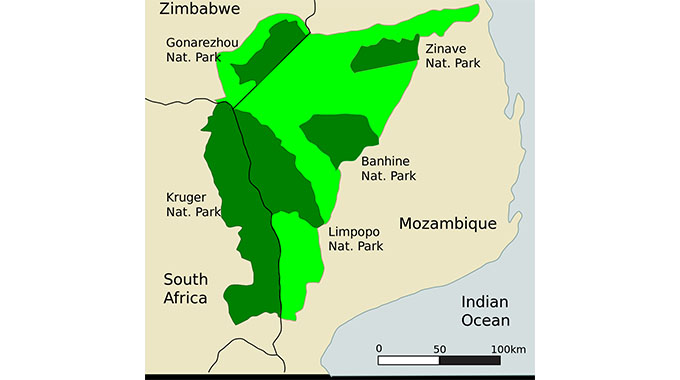
Speaking on the side-lines of the 2026 Sanganai/Hlanganani World Tourism Expo in Masvingo Province, International Coordinator for (GLTFCA) Dr Gwinyai Muti said the initiative was being rolled out under the SADC Transfrontier Conservation Areas Framework.
He said the TFCA spans 10 million hectares across Mozambique, South Africa and Zimbabwe, and anchors its core around the seamless linkage of Kruger National Park, Limpopo National Park and Gonarezhou National Park, while also incorporating Banhine and Zinave in Mozambique alongside a wide matrix of private, state and community conservancies.
Dr Muti said the GLTFCA has now moved into an active, compliance-driven execution phase guided by the GLTFCA Joint Strategic Management Plan 2024–2034 and the SADC TFCA Programme 2023–2033, and that this presents what he described as a once-in-a-generation opportunity.
“This framework represents the most significant economic catalyst for Zimbabwe’s South-East Lowveld since the introduction of commercial sugarcane farming,” he said.
Dr Muti added that the region can now fundamentally expand the wildlife economy while generating substantial employment and advancing a globally critical conservation agenda.
“Central to the operational rollout is the phased opening of transboundary 4×4 adventure products, which will include the historic Ivory Trail, the GLTFCA Adventure Trophy challenge, dedicated Pafuri–Sengwe overland trails and guided wilderness walking routes designed to give travellers immersive access across borders,” he said.
The official said that to package these experiences for international markets, the GLTFCA was structuring regional “Bush-to-Beach” circuits that will route visitors through Kruger, across the Sengwe Corridor into Gonarezhou, and onward to Mozambique’s protected areas, alongside cultural diplomacy products such as the transboundary Shangaan/Budula Cultural Festival.
“A cornerstone of community beneficiation will be long-term Public-Private-Community Partnerships modelled on the pioneering Makuleke arrangement, where communities retain ownership of ancestral land established as a contractual park while leasing it to private eco-safari operators under joint management,” said Dr Muti.
“Under this model, local communities retain absolute ownership of their ancestral land while entering into formal, long-term lease agreements with private eco-safari operators and maintaining collaborative joint management.
“Communities will generate equity dividends, employment quotas and passive lease revenues without bearing capital investment risk. On access and infrastructure, the Limpopo Tourist Access Facility at Tshikwalakwala will be the key enabler for direct tourist movement between Kruger and Gonarezhou, following landmark approvals by the Ministers of Home Affairs of both countries for an expanded operational season from 2026 to 2027.”
He continued, “This bilateral regulatory breakthrough replaces a historically cumbersome two-day detour through commercial border posts with a streamlined, pre-scheduled, tourism-only wilderness crossing.”
Dr Muti said the Government (Zimbabwe), with support from development partners including the International Organization for Migration (IOM), has delivered compliant border infrastructure and a year-round floating pontoon bridge to guarantee reliable river passage.
He added that based on regional baselines where established destinations generate over R6 billion annually from about 2 million visitors, preliminary estimates project Zimbabwe could capture up to 15 percent of that market, translating to roughly 300,000 high-value visitors and potential revenues of R900 million per year for the Zimbabwean component of the GLTFCA.
Dr Muti also emphasized that fulfilling the National Vision 2030 through natural resource management and green economic development will depend heavily on integrating conservation with tourism.
He said the GLTFCA’s next decade will be defined by turning policy into tangible visitor experiences, community income, and investor confidence across the South-East Lowveld.



 Bongani Ndlovu