

 Online Reporter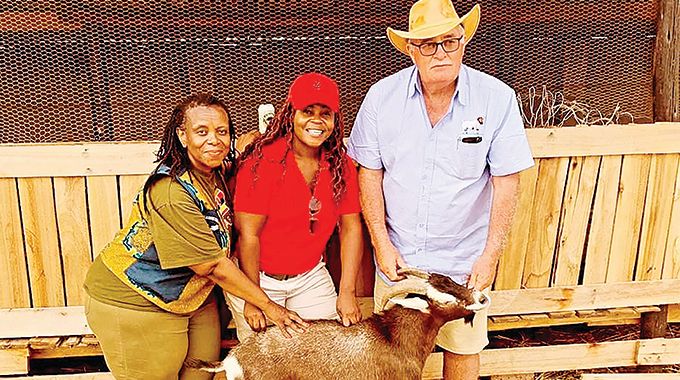
Judith Phiri, [email protected]
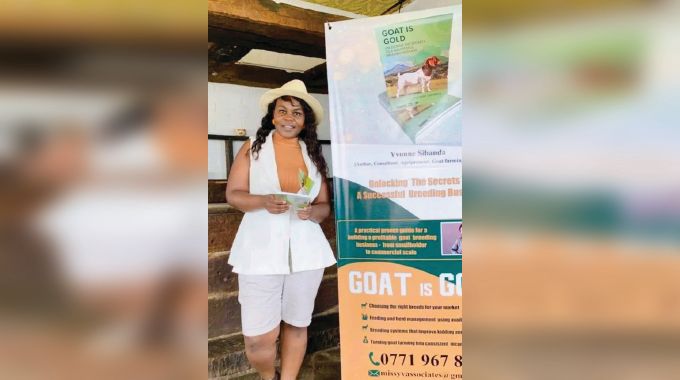
AT first glance, the title ‘Goat is Gold’ may sound unusual, but for author and business development consultant Ms Yvonne Sibanda, the comparison reflects the immense value and wealth-building potential of goat farming.
Published this year, the book unpacks the fundamentals of building a profitable goat-breeding enterprise, while encouraging farmers to treat livestock farming as a serious commercial venture rather than a side activity.
Ms Sibanda says the inspiration behind the book came from her passion for financial literacy, entrepreneurship and agriculture, particularly goat breeding.
“One of my favourite quotes is ‘success is the sum of small efforts repeated continuously’. l believe that long-term achievements are built through consistent, daily and disciplined small actions rather than by a single, massive or overnight action,” she said.
Ms Sibanda noted that goats remain one of the most resilient and accessible forms of wealth, especially in rural communities.
“Unlike other livestock, goats adapt quickly to new environments, they require less land and water than cattle, reproduce rapidly and recover fast from climate stress,” she said.
“No wonder rural communities across Zimbabwe and the continent have long referred to goats as ‘banks on legs’.”
Ms Sibanda said goats could easily be sold to cover school fees, groceries or medical expenses, making them a reliable financial cushion for many households.
With more than 13 years’ experience in business management, accounting, digital marketing and entrepreneurship training, Ms Sibanda said her journey into goat breeding began six years ago.
“I developed a passion for goat breeding six years ago and my goal is to see farmers building legacy businesses and not just doing it as a side hustle.
“Goat breeding for one should be a business enterprise not just to say l have 20 goats and it ends there,” she said.
“I also do financial literacy trainings and during my work with farmers, as well as small to medium enterprises (SMEs). I came across a goat breeder Mrs Sifiso Agbetorwoka.
“When l was assisting her management things l noticed that she was passionate about keeping goats bit did not have the right structures to make sure that it runs as a business.”
Ms Sibanda said working with Mrs Agbetorwoka deepened her understanding of goat farming and inspired her to help farmers establish profitable business systems.
“l learnt a lot about goats from her and it drove me to the passion l currently have for their breeding. I then started to assist her have a structure that ensures her goat breeding becomes a profitable business,” she said.
Mrs Sibanda said many farmers fail to track important business fundamentals such as feed costs, pricing and projected returns.
According to Ms Sibanda, the formation of the Goat Breeders Association of Zimbabwe (GBAZ) has created a platform for practical farmer training.
“In training, she would teach on the physical and practical aspects. I would then focus on marketing, management and how to make it profitable. At the end of the day my vision is to make sure that the goat is commercialised,” she said.
“Everyone knows a goat and most do have them in the villages, but a few think about keeping them for a living. This is only starting now with some farmers coming with knowledge from South Africa on how to take goat breeding as a full time job.”
She said aspiring farmers could start with the resources they already have, while identifying whether they intend to focus on meat production, milk production or value addition.
Ms Sibanda said the book was designed to be portable and interactive so that farmers unable to attend training workshops could still benefit from the information.
“The slogan ‘Goat is Gold’ comes from the fact that gold is something in Africa people associate with money. So, for me, when l look at goats, l actually associate them with gold because with gold you can dig until you almost give up but at the end of the day you can get something,” she said.
“The same applies to goats, it’s not a null business, it’s a biological capital multiplier. A goat carries for five months, during that period it’s not giving you money but taking from you as you buy feed. You will start realising profits about 10 months to a year there.”
The book also features success stories and experiences from prominent goat breeders including Mrs Agbetorwoka, founder of Bulembe Livestock Centre, Mr Xolisani Mpofu of Eland Zakithi Goat and Sheep Stud, and Mr Ntandoyenkosi Ndhlovu, who all operate in Zimbabwe and South Africa.
Apart from organising livestock training workshops and Goat and Livestock Conferences in Harare and Bulawayo, Ms Sibanda said she has helped empower more than 1 000 farmers in recent years.



 Bongani Moyo