Online Reporter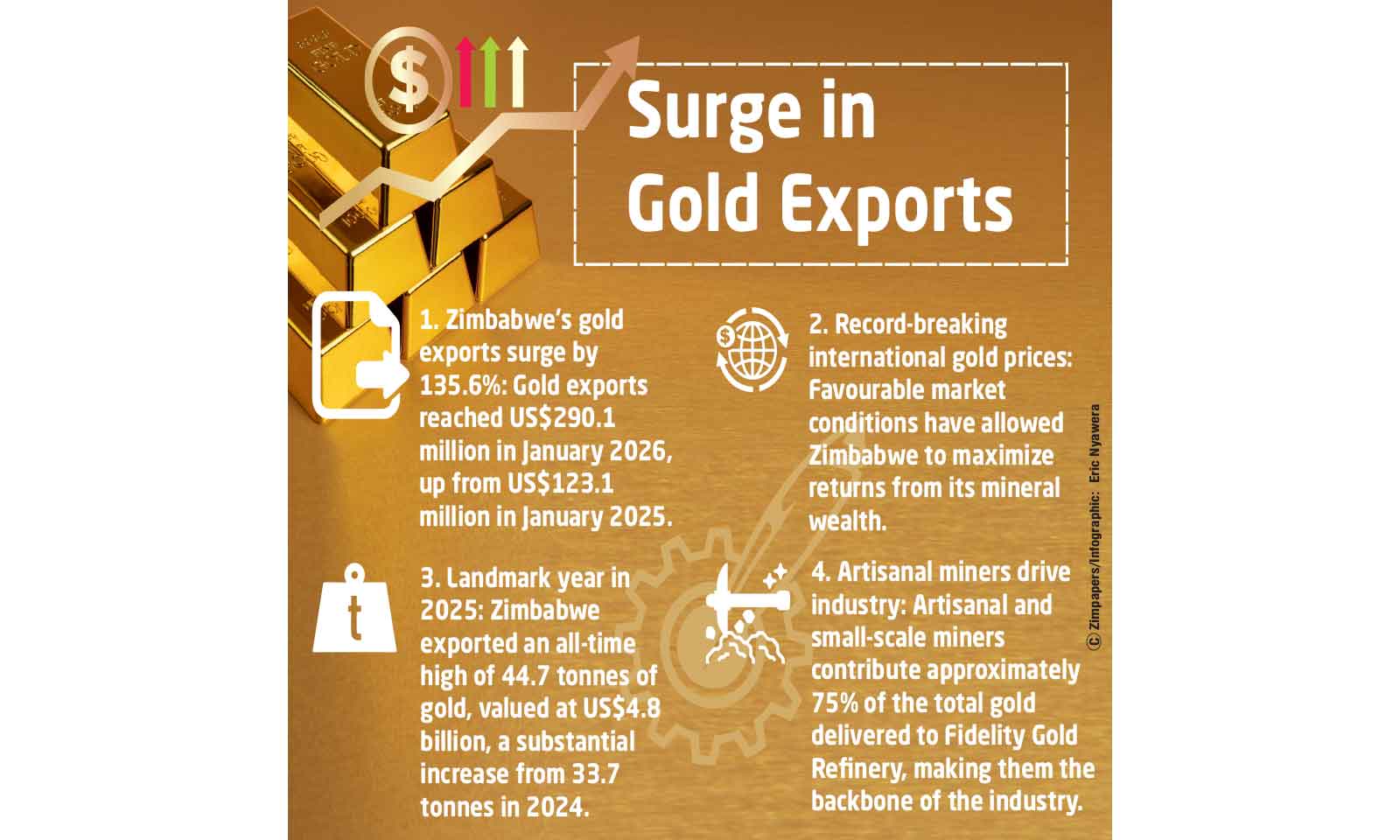
Martin Kadzere
Zimbabwe’s gold exports surged by 135,6 percent in January 2026 compared to the same month last year, according to the latest statistics from the Reserve Bank of Zimbabwe, reflecting a growth trajectory that aligns with the metal’s staggering 95 percent year-on-year price gain.
Bullion exports reached US$290,1 million in January 2026 from the US$123,1 million recorded during the same month in 2025.
The surge in revenue is attributed to record-breaking international gold prices, which remained firm since last year.
These favourable market conditions have allowed Zimbabwe to maximise returns on its mineral wealth as the country continues to lean on the “yellow metal” to anchor its economy.
The performance follows a landmark in 2025, when Zimbabwe exported an all-time high of 44,7 tonnes of gold valued at US$4,8 billion, nearly half the country’s total shipments for the year.
This was a substantial increase from the 33,7 tonnes produced in 2024, which earned US$2,53 billion. The record earnings have provided critical backing for the country’s gold-backed currency, the Zimbabwe Gold (ZiG).
Artisanal and small-scale miners remain the backbone of the industry, contributing approximately 75 percent of the gold delivered to Fidelity Gold Refinery last year.
Gold deliveries for 2026 got off to a slow start, with both large-scale and small-scale producers recording a year-on-year decline in output.
Zimbabwe’s sole authorised gold buyer reported total deliveries for January reached about 3,04 tonnes, a marginal decrease from about 3,17 tonnes recorded during the same period in 2025.
The statistics highlight a continued reliance on the artisanal and small-scale mining sector, which remains the backbone of the country’s bullion production despite a slight dip in performance.
Small-scale miners delivered 2,24 tonnes in January 2026, compared to 2,27 tonnes in January 2025. Large-scale miners produced 808,4kg in January 2026, down from 903,2kg in the prior-year period.
Small-scale miners are thousands of individual miners and small groups using simpler equipment.
Large-scale miners are big mining companies with massive underground operations and heavy machinery.
Following a 0,9 percent rise on Monday, gold futures have shown exceptional growth across all timeframes.
Most notably, the metal has nearly doubled its value in just over a year, recently breaching the US$5 000 per ounce barrier.
Prices are up 3,5 percent over the last week and 3,6 percent over the last month.
The precious metal has gained 74,5 percent since February 2025.
This follows an even higher peak on January 29, 2026, when the one-year gain reached a staggering 95,6 percent.
Gold price outlook
Analysts partly attribute this “super-cycle” to heavy central bank buying and global geopolitical uncertainty.
They are increasingly bullish on gold, with several top investment banks predicting that the precious metal could breach the US$6 000 per ounce mark — and potentially climb even higher — by the end of 2026.
This is being described by experts as structural rather than speculative, driven by a combination of heavy central bank demand, global geopolitical instability, and widespread currency debasement.
JP Morgan is the latest major institution to upgrade its gold price target, now forecasting that the yellow metal could reach US$6 300 by year-end.
This follows similar sentiment from Deutsche Bank and Societe Generale, both of which suggest gold is poised to extend its historic bull run through 2026.
Market strategists at UBS are even more aggressive in their outlook; while they see US$6 000 as a baseline, they argue that gains could extend to US$7 200 in an “upside scenario” triggered by mounting international tensions.
The rally is supported by several key factors. With the US Federal Reserve expected to cut interest rates two or three times this year, and military tensions in the Middle East looking increasingly likely to escalate, many believe the US$6 000 level could look “conservative” in hindsight.