Herald Reporters
THE revival of the century-old Connemara Mine in the Midlands Province after nearly two decades under care and maintenance is another demonstration of the Second Republic’s determination to unlock Zimbabwe’s mineral wealth, attract investment and turn dormant economic assets into productive enterprises.
Anchored by a new 3 000-tonne-per-day processing plant capable of handling about one million tonnes of ore annually at full capacity, the project represents more than the restoration of an old mining operation. It reflects a broader economic transformation strategy that places mining investment, increased production, beneficiation and employment creation at the centre of Zimbabwe’s development agenda.
Under President Mnangagwa’s leadership, Government has consistently pursued partnerships with the private sector to unlock value from the country’s vast mineral resources, with the objective of accelerating progress towards Vision 2030 and an empowered upper middle-income economy.
Connemara Mine provides a practical illustration of this approach.
Through a partnership involving Connehouse Mining, Coladge Investments, the Zimbabwe Prisons and Correctional Service (ZPCS) and BPE Mining, an asset that had remained largely dormant for years is being restored to productive use through fresh capital investment, modern technology and expanded processing capacity.
The timing is significant.
Zimbabwe is intensifying efforts to sustain annual gold deliveries above 50 tonnes, with deliveries to Fidelity Gold Refinery reaching 41,4 tonnes by the end of October, already equivalent to 89 percent of the total delivered throughout 2025.
October alone recorded a monthly high of 5 519 kilogrammes, demonstrating the growing contribution of the gold sector to the national economy.
The revival of Connemara is expected to strengthen this momentum by adding the capacity of a large-scale, mechanised operation to national production.
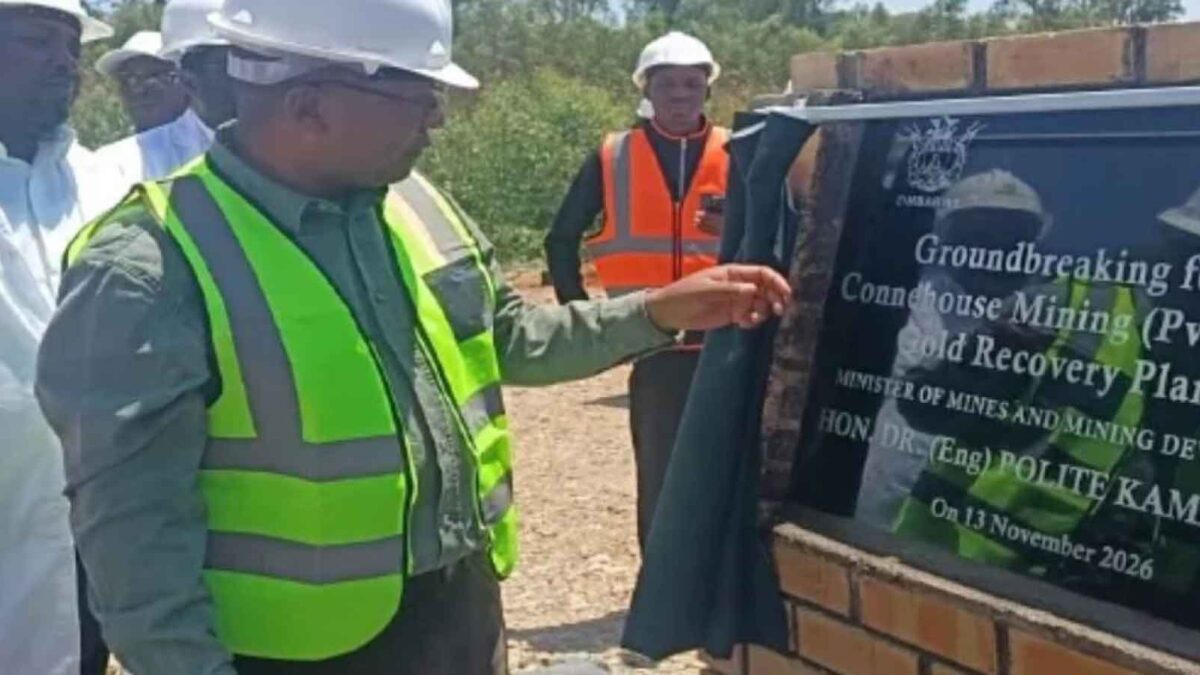
Speaking at the project’s groundbreaking ceremony, Mines and Mining Development Minister Dr Polite Kambamura said the investment would help sustain gold deliveries at and beyond the 50-tonne mark.
A major advantage of mechanised production is its ability to maintain relatively consistent output, particularly during the rainy season when operations at shallow and alluvial mining sites can be affected.
This is important as Zimbabwe seeks to consolidate its position as a significant gold producer and maximise the contribution of mining to foreign currency generation.
The Second Republic’s mining strategy is not only about increasing production figures, but also ensuring that mineral wealth translates into tangible economic opportunities for citizens.
The Connemara investment is expected to create direct and indirect employment, stimulate demand for local goods and services, generate royalties and taxes, and provide opportunities for contractors, suppliers and businesses in surrounding communities.
This multiplier effect is particularly important for the Midlands Province, where increased mining activity can stimulate growth in transport, engineering, construction, catering and other supporting industries.
The partnership with ZPCS also introduces an important social development dimension.
Under the arrangement, inmates are expected to benefit from employment opportunities and practical skills training, equipping them with competencies that can assist their reintegration into society after incarceration.
This demonstrates how mining investment can be linked to broader national priorities, including skills development, rehabilitation and social inclusion.
The initiative resonates with the Second Republic’s philosophy of leaving no one and no place behind, ensuring that economic development creates opportunities beyond the traditional beneficiaries of investment.
Equally important is the Government’s emphasis on beneficiation and value addition.
By establishing substantial processing capacity at Connemara, the project will strengthen local mineral processing and contribute to the country’s ambition to derive greater economic value from its natural resources.
Zimbabwe has repeatedly emphasised that it must move beyond exporting raw minerals and develop an industrial base capable of processing more of what the country produces.
This is consistent with the National Development Strategy 2, which identifies mineral production, investment, beneficiation, local content and employment creation as important drivers of industrialisation.
The revival also reinforces the Second Republic’s efforts to improve the investment climate through policy consistency, infrastructure development and ease-of-doing-business reforms.
Dr Kambamura pledged Government support in addressing electricity supply challenges that could affect the mine’s planned expansion, including engagement with the Ministry of Energy and Power Development and ZESA Holdings.
Such cooperation between Government and investors is essential in ensuring that projects move beyond announcements to actual production, employment and economic returns. The Minister also emphasised responsible mining, environmental protection, efficient water utilisation and land rehabilitation, highlighting the need to balance increased production with environmental sustainability.
His call for all gold produced at the mine to be channelled through Fidelity Gold Refinery further underscores Government’s determination to strengthen formal mineral marketing systems and maximise national benefits from the country’s resources.
The figures emerging from the mining sector underline the importance of this strategy.
Dr Kambamura said the sector generated an estimated US$11,07 billion in the first 10 months of this year, with full-year earnings projected to reach between US$12 billion and US$13 billion.
Small-scale producers accounted for 72,6 percent of gold deliveries during the period, while primary producers contributed 27,4 percent.
The figures highlight the need for continued investment in large-scale mechanised operations to complement the contribution of small-scale miners and strengthen production throughout the year.
Ultimately, Connemara’s revival sends an important message about the economic possibilities contained in Zimbabwe’s dormant industrial and mining assets.
Rather than allowing valuable resources and infrastructure to remain idle, the Second Republic is pursuing partnerships that can restore production, attract capital, expand employment and stimulate local economic activity.
As the country works towards Vision 2030, projects such as Connemara demonstrate how strategic investment in mining can contribute to a broader development agenda built around production, beneficiation, industrialisation and inclusive prosperity.
The real measure of the project’s success will be its ability to translate the new investment into sustained gold output, meaningful employment and lasting economic benefits for communities and the nation.