Online Reporter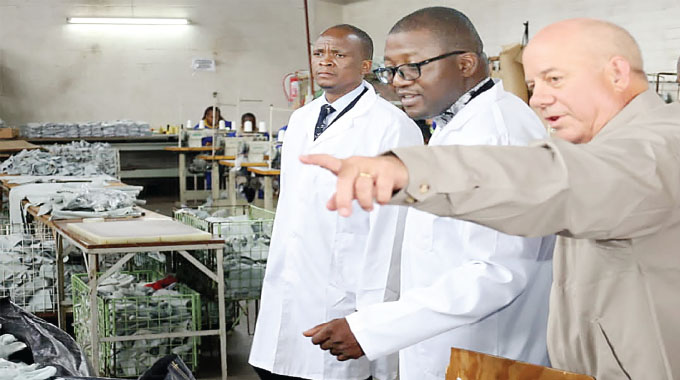
Judith Phiri, [email protected]
THE Government has reaffirmed its support for the cotton-to-clothing value chain, commending players in the sector such as Paramount Garments’ Archer Clothing for employment creation, a key driver of the economic transformation agenda towards Vision 2030.
Speaking after touring Archer Clothing in Bulawayo on Friday, the Minister of Industry and Commerce, Nqobizitha Mangaliso Ndlovu, said the visit was inspired by the fact that the cotton-to-clothing value chain is one of the priority agro-value chains that they have identified.
“We are working very closely with the Ministry of Agriculture to see how we can really focus on these value chains as key drivers of our economic transformation agenda towards Vision 2030. Paramount Garments is one of the leading companies in the sector, and this is one of their branches in Bulawayo, Archer Clothing,” he said.
“It is employing more than 1 000 people, most of them very young. In fact, I will check with them if they are benefitting from the Youth Employment Tax Incentive because I was really pleased to see that most of the people on the production floors are young people. They are producing no less than 120 000 units every month, and more than half of that is for the export market.”
He said there were a number of areas where Paramount Garments needed support, but they were really happy to see them doing well in the clothing industry.
The Minister, however, bemoaned the low uptake of the company’s products from the domestic market.
“Be it Government institutions, the private sector, mining companies or the agriculture sector, we are going to be engaging to see where we can promote local uptake because our focus and thrust is that, as a country, we need to support local production. That will enable them to really have these economies of scale and be able to export more competitively,” he added.
“Overall, I am very happy that we have this kind of production in the cotton-to-clothing sector, which gives us hope and room to really go back to support the cotton growers as well as the entire value chain and to localise most of the raw materials.”
He said Paramount Garments was still bringing in a lot of raw materials from outside the country, but at the same time buying quite substantial stocks from David Whitehead, which is beginning to create local synergies.
Minister Ndlovu said the agriculture sector and industry needed to collaborate in upscaling the cotton-to-clothing industry.
“As I have highlighted, we have identified 15 critical value chains that we will be prioritising, and cotton to clothing is one of them. We are finalising the finer details on these value chains, just to look at how we can grow them,” he said.
“We are trying to look at the nodes that require maximum support from the Government, and we believe that in the next few weeks we will be able to make part of the work we are doing public. We have looked at the entire ecosystem of the agro-value chain.
“As you know, we normally say that industry requires 60 percent of its raw materials from agriculture, but agriculture will also need about 40 percent of its raw materials from industry.”
Paramount Garments Director, Mr Jeremy Youmans, said that although they were investing where they could in the latest technology, generally the clothing sector was not yet ready to switch away from manual work.
“Computers do not have the dexterity of humans yet, but there are areas, as you have seen in the factory, where we can use that, and it is important to get the quality right.
“It is not so much about doing it faster; it is about being consistent. It is very hard for a human to always get it precisely the same when they are doing it manually. So, we have invested in a lot of machinery for some processes, and we will continue to improve, but the main core is still a human being behind the sewing machine,” he said.
He said the textile industry played a key role in the economy and was a huge employer. However, as a company, they
could do more in terms of employment if they could recover some of the money owed to them.
“If we could get the monies that are due to us out of all our insurance claims and other things, we could be employing another 500 people now.”
Mr Youmans said they had created training schools for people who tend to be unskilled or semi-skilled and do not have a job at the moment.
He said at the training schools, those who come through undergo six weeks of training and get paid throughout the training process.
Mr Youmans added: “Then they go on to an industry-standard 18-month learnership programme, where they work themselves up to become fully trained. So, we will employ those people and start training them as soon as we get the finance to do so, because the opportunities here are endless. In the last five years, we have trained at least 500 people.”
He said they had the space, the setups and everything. However, what they needed was some finance to do it so that they could create further employment opportunities.
Meanwhile, earlier this month, the High Court issued a writ of execution against Alliance Insurance Company following its failure to pay a US$4 million settlement to Paramount Exports related to a fire that destroyed the company’s warehouse in December 2023.
The order targets Alliance’s property as part of efforts to enforce payment under a court-registered settlement agreement.
The fire consumed a three-storey warehouse spanning 8 000 square metres. The blaze destroyed stock, equipment and inventory held within the structure. Paramount Exports held insurance policies with Alliance, which admitted liability in January 2024 and confirmed that the policy covered the loss.
Alliance initially agreed to reinstate the building, but later decided against reconstruction and offered a cash settlement instead.
Paramount lodged an insurance claim in April 2024 for US$11,77 million, representing losses from inventory and equipment. Alliance offered US$3 million as a settlement — an amount Paramount rejected — leading to a dispute that triggered arbitration as required under the insurance policy.
During arbitration hearings in 2025, Paramount presented extensive evidence, submitting 1 800 documents to support the valuation of the loss and the cost of rebuilding, which a surveyor estimated at US$15 million.
The High Court had earlier ruled that Alliance must reinstate the building within six months. However, Alliance sought to set aside the arbitration award, which ultimately ordered them to pay US$4 million plus interest.
Last month, Alliance and Paramount agreed to a settlement agreement in which Alliance would pay the US$4 million plus interest and costs. The agreement was registered by the High Court and required payment within 10 days. Alliance failed to meet this deadline, leading to the issuance of the writ of execution.