Online Reporter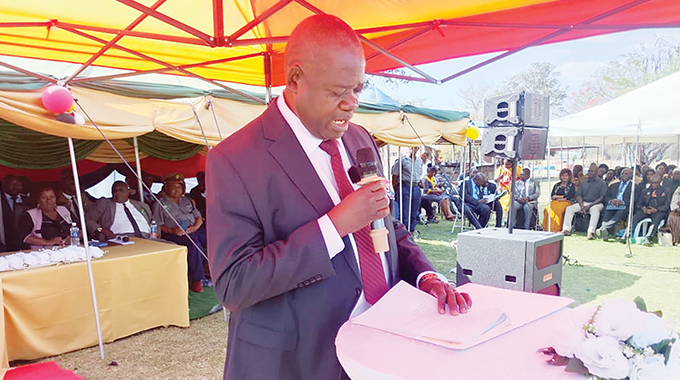
Sikhumbuzo Moyo recently in Hwange
GOVERNMENT has directed schools to sharpen their preparedness and ensure the smooth and credible administration of this year’s third-term national examinations, which mark the first major test of the Heritage-Based Curriculum (HBC) since its introduction.
The HBC was introduced in January last year and seeks to ensure learners acquire skills, values and attitudes for life and work through integrating and reinforcing a strong scientific and technological bias, as part of the Government’s skills development strategy.
This year’s examinations set the pace for the full adoption of the HBC as a core syllabus from next year, with foreign curricula such as the Cambridge International Education pathway offered only as an optional add-on, subject to approval by the Ministry of Primary and Secondary Education.
The move is intended to standardise learning across the country and ensure all learners receive an education grounded in Zimbabwe’s history, culture, languages and national development priorities, while still allowing schools to offer international qualifications as a supplement.
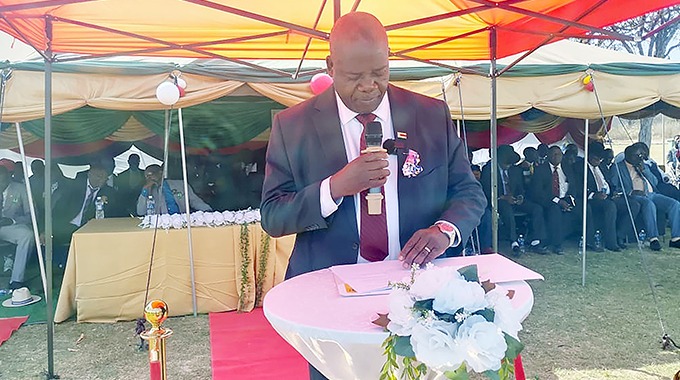
Primary and Secondary Education Minister Torerayi Moyo said the examinations are an important national milestone that would provide substantive evidence of the extent to which the new curriculum was translating into the intended competencies, knowledge, values, skills and capabilities among learners.
He was addressing Matabeleland North school heads at Coalfields Primary School in Hwange on Friday.
“This year’s third term is not an ordinary examination cycle but it carries particular significance because it marks the implementation of the Heritage-Based Curriculum, with learners sitting the national examinations under this curriculum for the first time,” said Minister Moyo.
“The successful implementation of a heritage-based curriculum cannot be measured solely by examination performance. It must also be reflected in the learner’s ability to think critically, communicate effectively, solve problems, innovate, collaborate, create and apply knowledge to real-life circumstances.
“I, therefore, expect every school head to approach this term with exceptional professional discipline.”
Minister Moyo said teaching must be purposeful, assessment continuous and learner progress systematically monitored, with interventions informed by evidence.
He called on school heads to know which learners were progressing, which were falling behind, what competencies they had acquired and where additional support was required.
The minister demanded the highest standards of integrity and professionalism in the administration of the examinations.
“These examinations must be managed with the highest standards of integrity and professionalism.
The credibility of our assessment system depends upon the confidence that examinations are administered securely, fairly and in accordance with established requirements. I wish to commend all heads of schools for the professionalism and vigilance you have demonstrated in managing national examinations during the three years that I have been in office,” said Minister Moyo.
He said examinations had been conducted without leakages, describing this as a significant achievement that reflected school heads’ commitment to safeguarding the integrity of the assessment system.
Minister Moyo said examination integrity was not merely an administrative responsibility but a matter of national trust.
The first HBC examinations come as Zimbabwe seeks to reshape education so that it contributes more directly to national production, innovation and modernisation, moving beyond an exclusively academic model towards one that develops practical and market-relevant skills.
“I wish to reiterate the call by His Excellency the President for an education system that contributes directly to the production of the goods and services required by our people and our economy.
“The vocationalisation of education must, therefore, be understood as a fundamental transformation in how we conceive the purpose of schooling,” said the minister.
“We cannot continue to define educational success exclusively through academic attainment or the number of learners progressing to conventional academic pathways.”
Minister Moyo said Zimbabwe requires engineers, artisans, farmers, entrepreneurs, scientists, technicians, designers, artists, innovators, health professionals, teachers, researchers and other skilled practitioners.
He said the education system must, therefore, provide learners with a broad range of pathways through, which their talents, interests and capabilities can be developed, allowing every learner to discover a field in which they can excel and make a meaningful contribution.
“The objective is to produce a whole and rounded learner — one who possesses knowledge, practical competence, creativity, values, entrepreneurial capacity, digital literacy, cultural consciousness and the ability to translate ideas into solutions,” Minister Moyo added. “Schools must, therefore, deliberately create opportunities for learners to make, build, design, grow, perform, experiment, innovate and produce.”
The minister said the classroom must connect with the workshop, the laboratory with industry, the school garden with agriculture, and academic knowledge with community development.
He reiterated that school preparedness for the third term went beyond opening classrooms and preparing timetables, demanding stronger instructional leadership to maximise learning outcomes.
“Preparedness for the third term is not simply about whether classrooms are open, timetables have been prepared, or teachers are present. True preparedness is measured by whether the institution is academically organised, adequately resourced, safe, inclusive and ready to maximise every instructional minute available to learners,” he said.
“I, therefore, expect every school head to provide firm instructional leadership.”
“You must know your learners, understand their performance profiles and ensure that teachers receive the supervision and professional support necessary to improve their practice. The effective school head is not merely an administrator. You are the chief instructional leader of your institution and the principal custodian of educational quality.”