admin
admin
Patrick Chitumba, Midlands Bureau Chief
THE Government has dispatched a consignment of vaccines, which include dipping chemicals and tick grease to contain the January disease which has ravaged the Midlands and parts of Matabeleland South province.
More than 130 cattle in the Midlands province have succumbed to Theileriosis, better known as the January disease, with Shurugwi district being the most affected.
This follows reports that over 80 cattle in Insiza District succumbed to the disease since the beginning of this month. Since the beginning of the festive season, a number of farmers and villagers in Insiza District lost their herds of cattle to January disease.
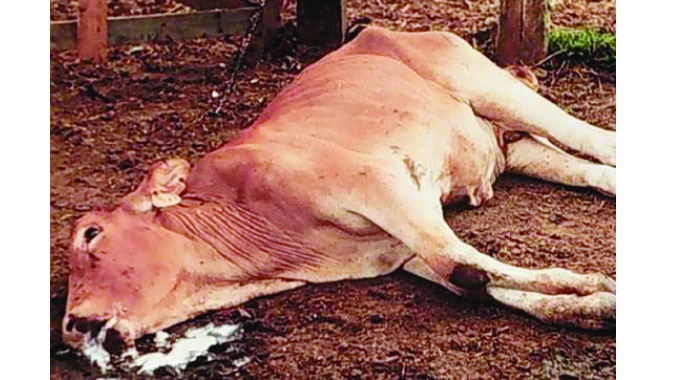
The impoverished villagers have been forced to forfeit their kraals.
Farmers in the Midlands province are battling to contain the disease which has become a perennial challenge across the region.
Theileriosis is a disease caused by a species of Theileria – a blood-borne parasite. It only affects cattle and is primarily transmitted by ticks.
Signs of an animal affected by January disease include swelling of the lymph nodes under the ears and on the shoulder, cloudiness of the eyes and difficulty in breathing with froth from the nose and mouth.
The affected animal collapses and dies within few days. The hallmark in the control of theileriosis, like all other tick-borne diseases, is to control the tick sector.
According to the Department of Veterinary Services, tick-borne diseases are responsible for about 60 percent of annual losses in livestock. January disease is a notifiable disease in Zimbabwe and when farmers suspect its presence, they are compelled by the law to make a report to the Department of Veterinary Services.
Government has introduced a plethora of measures to fight the deadly disease including dip tank rehabilitation, production of local vaccines, dipping, and introduction of the Presidential Tick Grease Programme among others.
Following these measures, the country has witnessed a 50 percent reduction in the number of tick-borne diseases. The Presidential Tick Grease Programme seeks to curb tick-borne diseases, particularly theileriosis.

The programme is in line with the National Development Strategy 1 (NDS1), which is prioritising animal health and production through strengthening farmer knowledge, and skills in livestock production and health so as to enhance productivity.
In Zimbabwe, cattle are a common source of wealth and draught power, and Government estimates that about 90 percent of the country’s nearly 5,5 million cattle are owned by small-scale farmers.
The Government is urging farmers to intensify dipping and application of tick grease to their livestock as a prevention measure.
Permanent Secretary in the Ministry of Lands, Agriculture, Fisheries, Water and Rural Development, Dr John Basera said the Government is in the process of procuring curative remedies to be administered in the hot spots.
“The Government has dispatched a consignment of vaccines to contain the January disease which has ravaged the Midlands and Matabeleland South province,” he said.
Dr Basera said they have also dispatched a team from the Department of Veterinary Services to assess and monitor the situation including conducting an awareness campaign on the importance of dipping cattle.
“We have released a variety of vaccines to the affected areas as part of our efforts to contain the disease,” he said.
Dr Basera said in terms of the Animal Health Act, farmers who fail to dip their cattle in line with the new 5:4:4 policy face arrest.
“We are calling on all farmers to dip their cattle religiously for the next two years – we are going to invoke the Animal Health Act which stipulates that all farmers who fail to dip their cattle will be arrested,” he said.

The Government has stocked adequate dip chemicals to last until the end of the rainy season which represents the most critical period with high tick activity.
Dr Basera said about 80 percent of households derive their livelihoods from livestock and their products, hence the need to preserve livestock.
Last year about 700 cattle succumbed to theileriosis in the country. Tick-borne diseases have in recent years, wreaked havoc in the cattle industry, leaving a trail of destruction with more than half a million succumbing to theileriosis between 2015 and 2016 alone.
Most communal farmers had their herds wiped out by the January disease, leaving them without draught power.



 Online Reporter