Online Reporter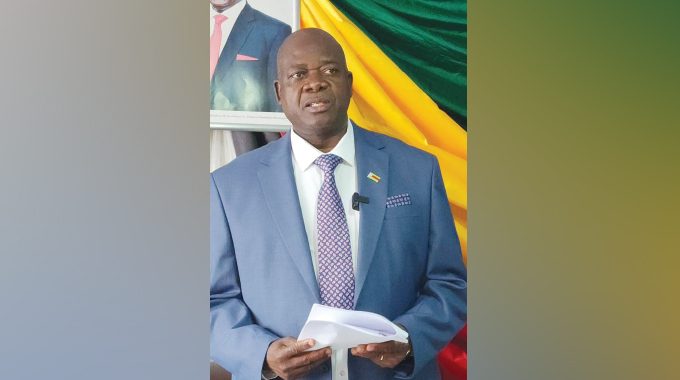
Tanaka Nkala, [email protected]
THE Ministry of Primary and Secondary Education officially launched the “Learner’s Hub Chatbot” yesterday at the Zimbabwe International Trade Fair (ZITF), marking a major step in the country’s drive to integrate digital innovation into education and learner support systems.
Speaking at the launch, Minister of Primary and Secondary Education, Torerai Moyo, described the initiative as a significant milestone in expanding equitable access to education services while strengthening learner welfare across Zimbabwe.
He said the Chatbot represents the ministry’s commitment to building an inclusive, responsive and technology-driven education system.
“This initiative is not taking place in isolation,” said Minister Moyo.
“It is anchored in the broader national vision of His Excellency, President Emmerson Dambudzo Mnangagwa, whose Vision 2030 seeks to transform Zimbabwe into an upper-middle-income economy driven by a skilled and digitally empowered society.”
The Chatbot launch comes at a time when the Government has intensified efforts to improve digital infrastructure in schools.
Minister Moyo highlighted the recent rollout of more than 8,000 Starlink connectivity kits to schools across the country, particularly in rural and underserved areas.
He noted that improved internet access will enable learners to benefit fully from digital platforms such as the Learner’s Hub Chatbot.
The platform is designed to provide both academic and psychosocial support to learners, teachers and parents.
It allows users to access real-time assistance, learning resources and guidance through an interactive digital interface.
Minister Moyo said the Chatbot aligns with the ministry’s “E-Learning Policy”, which seeks to integrate technology into teaching and learning in a structured and sustainable way.
It also complements the Government’s broader e-governance agenda aimed at improving service delivery through digital solutions.
“Globally, education systems are increasingly adopting artificial intelligence and learner-centred technologies to improve outcomes and expand access,” he added
“The Chatbot positions Zimbabwe within these global trends by offering a scalable and cost-effective solution.”
The initiative is also in line with the National Development Strategy 2 (NDS2), which prioritises human capital development, innovation and digital transformation.
Through such platforms, the ministry aims to develop a future-ready education system capable of responding to the evolving needs of learners.
Mr Leeroy Fredericks from UChat Africa, the technical consultants behind the platform, said the Chatbot is a comprehensive support system tailored to the needs of Zimbabwe’s education sector.
“The Chatbot is meant to provide psychosocial support, as well as academic support to learners, parents and teachers,” said Mr Fredericks.
“It has referral pathways, meaning that for any psychosocial issues learners or teachers are facing, cases can be escalated directly to MoPSE or professional psychologists for assistance.”
He added that the platform includes an advanced artificial intelligence academic assistant equipped with Stem tools to help learners with their day-to-day studies.
According to Mr Fredericks, the Chatbot is also built with strong data protection measures to ensure confidentiality.
“The platform is highly secure and compliant with data protection laws,” he said.
“Any information shared remains private and confidential, accessible only to authorised professionals handling the case.”
In an interview with Chronicle, a student from Oriel Boys High School, Tafara Zvandaziva, welcomed the initiative, saying it has the potential to enhance learning outcomes.
“This Chatbot is really good,” he said.
“It helps us as learners to improve and work on areas where we are weak. I will share it on my social media so that others at my school can also use it.”
However, he suggested that incorporating more local languages would improve accessibility and user experience.