

 Chronicle Editor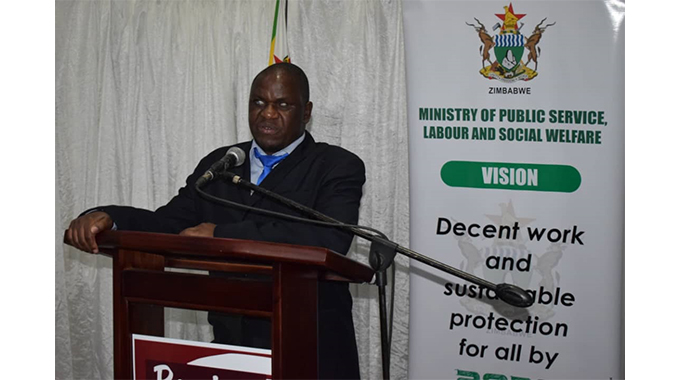
Rejoyce SibandaChronicle Reporter
GOVERNMENT is reviewing the National Action Plan for orphans and Other Vulnerable Children to address problems such as child pregnancies, the use of children in street trading, suicides as well as drug and substance abuse that continue to escalate.
A three-day workshop that ended in Bulawayo last Friday reviewed the plan which ran from 2016 to 2020.
In his speech, Public Service, Labour, and Social Welfare Minister Professor Paul Mavima who was represented by the Chief Director of Social Development and Disability Affairs, Dr Edmos Mtetwa said the plan was being reviewed now as Covid-19 greatly affected the start of the process.
The Minister said the plan was launched in 2016 together with the National Social Protection Policy Framework (NSPPF) to demonstrate Government’s commitment to social development.
Prof Maxima said Government continues to improve its systems by aligning its policies and programmers to the thrust of international commitments it made and to national priorities outlined in the National Development Strategy 1 which it has been implementing since 2021.
“As a progressive Government, we are conscious of the dynamism of societal needs hence we prioritise constant review of our programmes and policies. Our aim is that policies and programmes should remain relevant and comprehensive to adequately meet the needs of the general population,” said Prof Mavima.
“Zimbabwe has made several commitments on social protection and child protection at both regional and global level such as the adoption of the Sustainable Development Goals and the ratification of the United Nations Convention on the Rights of the Child.
The country also joined the Global Partnership on Ending Violence against Children and made a public commitment to end Violence against Children in all its forms.”
He said there is a need for various stakeholders to come up with a framework that is fit for purpose, suitable for the context and sustainable in the realisation of aspirations towards Vision 2030.
“Though we have a lot to celebrate, we remain alive to the vulnerabilities bedevilling children in Zimbabwe hence a lot is to be done in the area of child protection to make sure that we create safe environments for our children.
“Sexual violence, child pregnancies, child labour, use of children in street trading, drug and substance abuse, bullying, suicides and mental health concerns continue to escalate,” said Prof Mavima.
He said for the framework to succeed, there ought to be an appropriately skilled, adequate and a motivated workforce.
The minister said there are some successes that have been registered that include passing of the Marriages Act which outlaws child marriage and sets the minimum age of marriage at 18 years in line with the definition of a child provided for in the Constitution of Zimbabwe.
He also said there has also been increased collaboration and engagement at international level, hence the country signed a Memorandum of Understanding on child protection with Botswana in addition to South Africa and Mozambique; the establishment of Inter-Ministerial Taskforces on Drug and Substance Abuse Mitigation both at national and sub-national level to curtail the supply of drugs, reduce their demand, treat and rehabilitate survivors of drug and substance abuse as well as providing psycho-social support and community rehabilitation and reintegration services.
“It is my fervent hope that the framework we will produce will leave no child and no place behind in our quest for socio economic transformation through development of our human capital.
Let us critically interrogate issues of access to basic social services; alternative care for children in need of care; after care services for care leavers; emergency preparedness and response in the face of natural disasters like cyclones and other emergencies that may befall us,” he said.
“We should also bear in mind that for the framework to succeed, there ought to be appropriately skilled, adequate and motivated workforce, hence social service workforce strengthening remains a key Government priority.”–@ReeSibanda


 Blessing Chizhande
 Online Reporter