Chronicle Editor
Leonard Ncube, [email protected]
GOVERNMENT has deployed teams to the ground to lead the mapping exercise that will guide the relocation of families situated on the Lake Gwayi Shangani flooding zone in Matabeleland North province.
The construction of the massive Lake Gwayi-Shangani in Matabeleland North province is underway and is one of the milestones of infrastructure projects being undertaken by the Second Republic led by President Mnangagwa.
It is the third largest inland dam after Tugwi-Mukosi and Lake Mutirikwi with a gross carrying capacity of 650 million cubic metres.
The Zimbabwe National Water Authority (Zinwa) is constructing the dam through China Water and Electric Corporation, a Chinese contractor.
Mooted way back in 1912, the dam project is part of the National Matabeleland Zambezi Water Project (NMZWP), which successive administrations failed to kickstart before President Mnangagwa pledged to complete the project.
Project implementation has been sluggish until the coming in of the Second Republic, which has pushed it to over 70 percent completion, through its vision to uplift livelihoods towards an upper-middle-income society by 2030.
Speaking at a recent International Organisation for Migration (IOM) workshop for disaster risk management practitioners from across Sadc in Victoria Falls, Local Government and Public Works Minister, July Moyo, said different Government teams were on the ground working on spatial planning for the relocation areas.
While hazards and natural disasters have been on the increase in most African countries as a result of climate change, he said Government wants to make sure it is ready for such risks.
“Our teams are working with the chiefs to properly know the numbers of people we need to move as we don’t want to guess,” said Minister Moyo.
“People from Zinwa will give us the water levels and how it will affect people and which people will be affected. It is these issues that we want to reorganise. We don’t want to talk about relocation but we want to re-organise so that they can carry on with agriculture.”
He said at the moment it is was now known how many people will be affected but said the Government was committed to ensuring no one is displaced without due diligence.
“The project is going to benefit people in the area as irrigation schemes are going to be constructed by the Ministry of Lands. So, the people who will be reorganized will be the first beneficiaries,” said Minister Moyo.
“We cannot talk of numbers now because we are still formulating to see what the water will rise to. We saw Lubimbi School and the business centre but we don’t know whether it will be affected until we get the final recommendation from hydrologists.
“Details of all this are with our planners from Government and we think that probably we will finish this year and our people will be moved.”
The workshop was attended by various stakeholders from across Sadc and organised to capacitate countries with knowledge and skills to strengthen disaster risk management, climate change adaptation, and mitigation in communities for sustainable development while strengthening early warning systems through harmonised policies.
The IOM, a United Nations migration agency, funded the workshop through the Africa Regional Migration Programme in partnership with the Government of Zimbabwe.
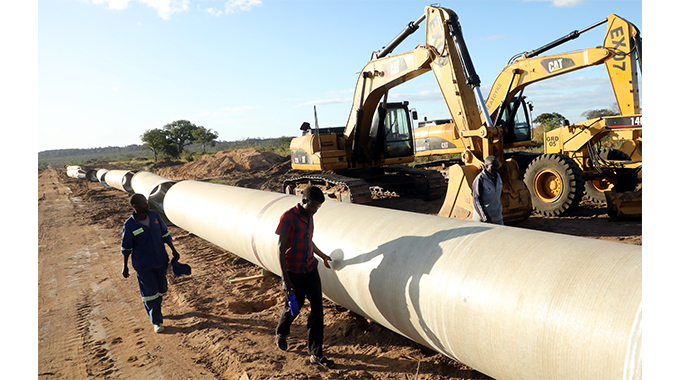
The Lake Gwayi Shangani project is viewed as the panacea to the perennial water problems in Bulawayo, and would help create a green belt along the line where a 256km pipeline is being constructed. Government has already identified 10 000 hectares of land that will be irrigated in various districts in Matabeleland North to enhance food security as communities along the pipeline are expected to benefit from the water passing through their villages.
A 10MW hydroelectric power station will be established on site, which will boost electricity generation and add to the grid, while also supporting the tourism industry with power. Tourism operators around Dete in Hwange have said Lake Gwayi-Shangani will lead to the introduction of new activities that will help boost arrivals in the tourism corridor. — @ncubeleon


 Online Reporter