Chronicle Editor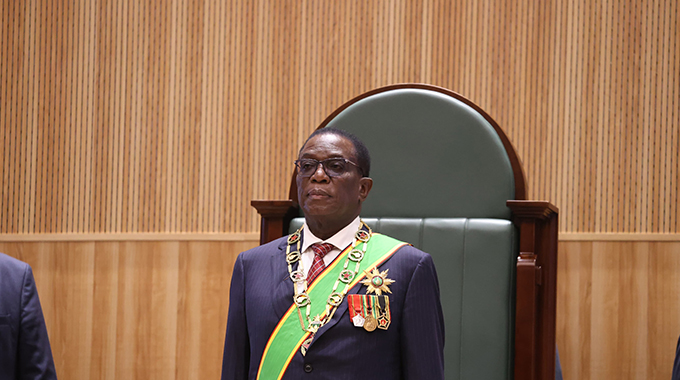
Farirai Machivenyika, Harare Bureau
THE stabilisation of the local currency, the Zimbabwe Gold, is central to maintaining macro-economic stability and the Government is instituting measures to deal with speculative behaviour that has seen the re-emergence of parallel market activities, President Mnangagwa has said.
Delivering a State of the Nation Address and officially opening the Second Session of the 10th Parliament at the new Parliament Building in Mt Hampden yesterday, President Mnangagwa said the adoption of the new currency anchored by gold and precious metal reserves in April this year, was an important step in stabilising the local currency.

“Our country’s banking sector is on a sound footing, with sufficient capital and liquidity buffers, while profitability, asset quality and liquidity matrix have also remained stable.
“However, we note with concern the resurgence of parallel market activities driven by speculative tendencies. Corrective measures are being instituted to protect all Zimbabweans from economic disruptions. Together, let us lay a solid foundation for economic prosperity, peaceful development and freedom from undue external interference,” he said.
The President implored Zimbabweans to abide by measures adopted by Government to maintain stability as enunciated by the Reserve Bank of Zimbabwe.
“It remains the duty of all of us to respect and abide by measures and instruments intended to maintain economic stability and tame inflation.
“In response to the increased foreign currency pressures, and in a bid to deepen the foreign exchange market, the Reserve Bank allowed for greater flexibility under the willing-buyer willing-seller arrangement.
“The increased flexibility on the foreign exchange market is expected to further promote effective price discovery and encourage holders of foreign exchange to participate in the willing-buyer willing-seller market.
“Government remains committed to backing the currency through setting aside 50 percent of royalties for building reserves. Foreign currency inflows from exports have increased from US$7 billion in 2023 to US$8 billion in 2024,” he said.
On the legislative agenda, President Mnangagwa urged Parliament to speed up enactment of outstanding Bills.
“Parliament has an obligation to expedite the enactment of all Bills that, for one reason or another, are outstanding from previous Sessions of the August House.
“The list includes Bills relating to: Persons with Disabilities; Administration of Estates Amendment; Civil Aviation Amendment; Death Penalty Abolition; Parks and Wildlife Amendment; Private Voluntary Organisations Amendment; and Mines and Minerals Amendment. Others are the Medical Services Amendment; and the Insurance and Pensions Amendment.
“The second category comprises Bills that came to light since my last address, but which Ministries never forwarded to Parliament. I also challenge Parliamentary Portfolio Committees to be seized with the business of Bills that fall under their respective purviews. All concerned parties must address these anomalies for the collective good of our nation,” he said.
The President said as the transformation of the education sector gathers momentum, the introduction of the Zimbabwe School Examinations Council Bill is expected to enhance the efficiency and good corporate governance of the Zimsec Board while the Teaching Professions Council Bill will regulate the conditions of service and produce a code of conduct for all teachers.
“Occupational health and safety is critical for the attainment of Vision 2030. The Occupational Safety and Health Bill should be expedited to further align with International Conventions, to which Zimbabwe is a signatory.
“Other Bills due to be considered by this Session include the State Service Pensions Bill establishing the State Service Pensions Fund, while the Public Service Act will be amended to align with the Constitution.

The Rural Electrification Fund Act; the Public Entities Corporate Governance Act and the Pipelines Act, will also be amended to be in sync with present realities associated with the growth of the economy,” he said.
The Legal Practitioners (Amendment) Bill, President Mnangagwa said, will harmonise the administrative functions of the Judiciary and the Executive in the registration process for foreign legal practitioners.
“To enhance the fight against the scourge of corruption, the Public Interest Disclosure (Protection of Whistle Blowers) Bill must sail through this Session. Electronic transactions are expanding at a phenomenal pace, as technology evolves.
“The drafting of the Electronic Transactions and Electronic Commerce Bill should be speeded up, towards promoting legal certainty and affordability for electronic transactions.
“Additional Bills include: the Standards Bill; the Legal Metrology Bill; the Broadcasting Services Amendment Bill and the Media Practitioners Bill”.
President Mnangagwa said a number of Protocols were also expected to be tabled for ratification during the Second Session of the 10th Parliament and include the Protocol Amending the Trade-Related Aspects of Intellectual Property Rights Amendment Protocol of 2005; the Lisbon Treaty to the Geneva Act as well as the Zimbabwe-Russia Co-operation Agreement.

“Under the Bilateral Investment Promotion and Protection Agreements, the Compensation Committee has approved 94 claims for compensation. This demonstrates Government’s commitment to fair and amicable resolution of matters with all partners.
“Peaceful co-existence in our region, the African continent and globally, is an essential ingredient for sustainable socio-economic development. Through ongoing efforts, the domestication of the Nuclear Non-Proliferation Treaty and the promulgation of the Biological Warfare Bill should be fast-tracked,” he said.



 Online Reporter