Thupeyo Muleya in INSIZA
GOVERNMENT continues to mobilise local resources to complete critical legacy projects nationwide, extending essential services to all citizens in line with Vision 2030’s mantra of leaving no one and no place behind.
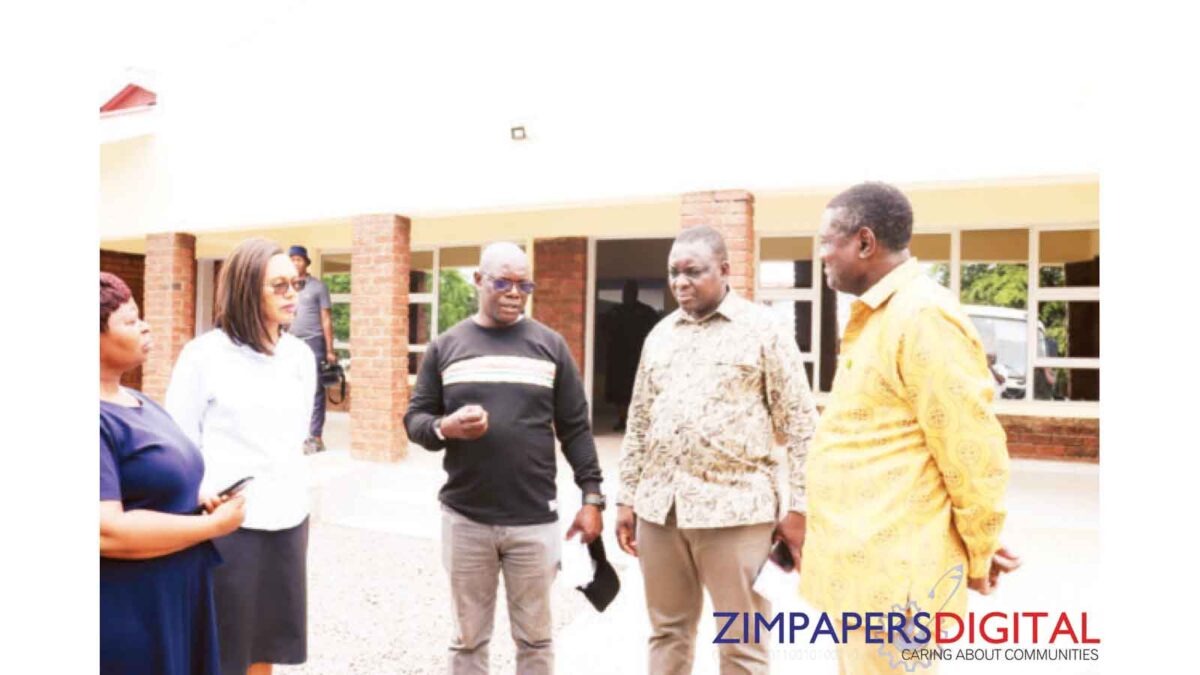
Information, Publicity and Broadcasting Services Minister Dr Zhemu Soda made the remarks yesterday while touring legacy projects in Insiza and Gwanda districts, Matabeleland South Province, accompanied by Matabeleland South Provincial Affairs and Devolution Minister Albert Nguluvhe.
The tour covered the long-awaited Insiza Civil Registry offices at Filabusi—now 98 percent complete—and the newly finished Joshua Mqabuko Nkomo Technovation Centre (formerly the Home Economics Block) at JMN Polytechnic College in Gwanda.
“The Second Republic, under the leadership of President Emmerson Mnangagwa, is committed to completing all outstanding legacy projects that improve the economy, transform citizens’ livelihoods and promote innovation,” said Minister Soda. “This is in line with NDS1 and NDS2 as we work towards attaining Vision 2030 of an upper-middle-income economy.”
Construction of the Insiza Civil Registry building began in 2001 but stalled three times at window level before Treasury released funds in January this year for the Department of Public Works to resume operations. Only second-phase touch-ups, including fire alarms and disaster preparedness systems, remain outstanding.
“The building behind me is the new civil registry building, which is almost complete now. They are telling us that the first phase was completed, and they are now working on the second phase,” said Minister Soda.
“We went through it, and we are actually impressed with the work that was done here. Of course, it took quite long to complete, given that construction started way back in 2001; it was stalled, they resumed and they could not complete it.
“But with the Independence celebrations that were hosted by Matabeleland South Province, this is one of the legacy projects that were undertaken to complete this building so that the community and the people around can now enjoy the benefits for which this project was commenced.”
Minister Soda noted that the existing Insiza registry operates from a single small room handling birth and death registrations, national IDs and marriages, forcing clients to wait outside in harsh weather. Once commissioned, the new facility will also issue passports.
“Now, with this new building, we hope that it is going to provide a very free and friendly environment where clients can also be housed in their reception area, and they are served well, and also additional services will be provided,” he said.
“I am told once this building is commissioned, passports will be issued from this building, which is a plus to what has been realised by the Second Republic. When the President says leaving no one and no place behind, this is the evidence. People down here don’t have to travel to Bulawayo to get services. They don’t have to travel to Gwanda, like they have been doing.”
Rural registry offices, supported by partners such as the United Nations Children’s Fund (UNICEF) to computerise sub-offices, are vital for securing legal identities that unlock access to education, healthcare and voting.
Provincial Registrar Ms Jane Peters confirmed that cramped conditions have strained staff performing six core functions in one room.
“Per month, we process over 300 birth registrations. But births are actually less than IDs. You will discover that people actually apply for IDs more than they do with birth certificates,” she said.
Minister Nguluvhe hailed the Second Republic’s drive to finish stalled infrastructure, noting it empowers students, improves service delivery and creates local jobs.
“We are impressed by the Second Republic’s commitment to complete projects that had stalled for years. This is a clear sign that Matabeleland South is not being left behind in national development,” he said.
In Gwanda, Minister Soda inspected the Joshua Mqabuko Nkomo Technovation Centre at JMN Polytechnic College. Initiated in 2004 and previously delayed by funding constraints and the Covid-19 pandemic after a 2019 resumption, the facility was completed this year with Treasury funding.
Designed as an innovation hub equipping students with practical skills for community and industry needs, the centre already houses a Textile and Clothing section supplying uniforms and products to Matabeleland South schools and mining firms.
JMN Polytechnic Acting Principal Mrs Concelia Mswela said the facility shifts learning from theory to industry practice.
“As a human capital development institution, we want to enhance our production of skilled personnel in the country. We want to empower them with the necessary skills and expose them to current modern technology in the food industry, textiles and ICT,” she said.
“We want our students to move from the classroom approach where we have the lecture method prevailing to practising more on what is done out there in industry. We also want to focus on traditional foods and promote the various traditional foods.”