

 dyton mupawaenda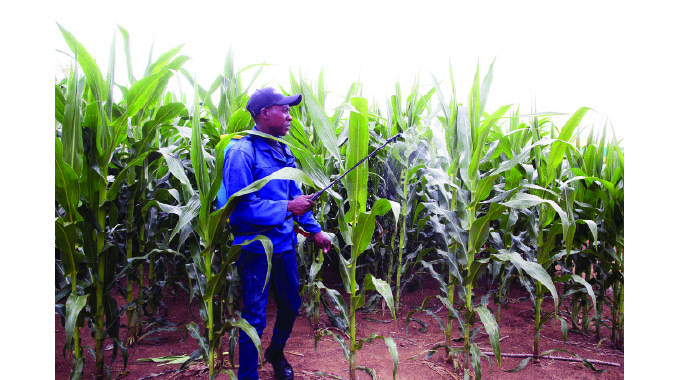
Precious Manomano-Herald Reporter
Fifty traps have been set across the country to combat fall armyworms to give farmers prompt warning of any infestation ahead of the expected El Nino conditions which are likely to increase the breeding of the pests.
Speaking on the sidelines of the official launch of a campaign on combating fall armyworms at Pepsia Farm in Goromonzi, acting deputy director migratory pest and biosecurity in the Minsitry of Lands, Agriculture, Fisheries, Water and Rural Development Simbarashe Nyamasoka said 50 traps have been set across the country to assess the infestations of fall worms.
“We want to give farmers an early warning in terms of fall armyworm for this 2023/24 season. As we are experiencing El Nino this farming season, we need to be alert and farmers should know that insects such as fall armyworm multiply in numbers.
“The El Nino has an increase in temperatures so the higher the temperatures the faster the rate of reproduction of these adult armyworms, hence a need to control them. As a nation we have put up what we call early warning systems where we have more that 50 traps that are across the country currently. What we need now is for the traps to be monitored so that farmers see the moth.
“If they find any moths that are more than 24, they should report to the department of Agritex or the closest extension officer,’’ he said.
The African armyworm and fall armyworm are two different caterpillars. The fall armyworm is found in the maize that is in the field and the African armyworm is found in the pastures. There is a need to scout more frequently so as to control these caterpillars on time
Fall armyworm is a migratory pest which attacks maize and has the potential to cause yield losses in a range from 8,3 million to 20,6 million tonnes a year right across Africa if not controlled.
It is an invasive moth which is difficult to detect and control, it was first noticed in Africa in January 2016, causing massive damage to crops in several West African countries, according to the International Institute of Tropical Agriculture.
Mrs Zivai Samudzimu successfully fought off fall armyworm on her 10 hectare of maize. “We planted on 7 August but we now facing challenges of fall armyworm. So we managed to apply ecoterex product to control the pest. We lost 1 percent of the yield. We were afraid to lose our crop,’’ she said.
Shumba group Technical advisor Mr Tafadzwa Mamvura indicated that this year they have partnered the Government to control fall armyworm to fight the pest.
‘’This season is going to be a difficult one. It is going to be a challenge to farmers so the decision to engage with the Government and launch a national fall armyworm campaign to all farmers,’’ he said.
African armyworm can also cause indirect losses to livestock if an outbreak occurs in pastures, which can cause starvation and severe poisoning when cattle graze on pastures recently infested by the armyworm. Armyworms march along the ground and attack crops, as they search for food.
Fall armyworm is a new pest in Zimbabwe and causes extensive damage to maize if not controlled properly and on time. The pest has 10 to 12 breeding cycles in a season cycles and can continue recurring after the first spray.



 Online Reporter