Online Reporter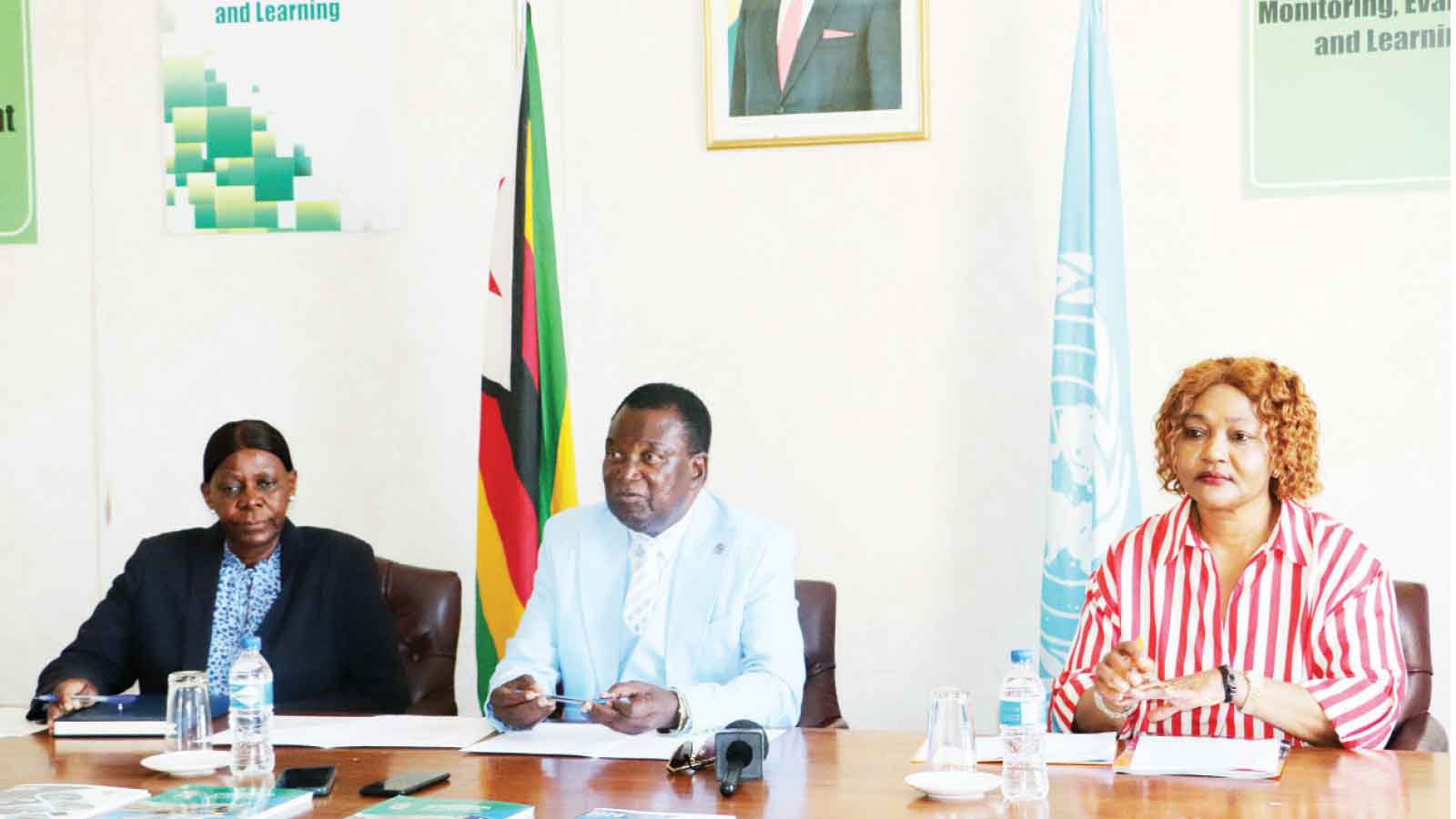
Oliver Kazunga
Senior Reporter
GOVERNMENT is strengthening the monitoring of national development projects to ensure public resources deliver measurable results and improve people’s lives as Zimbabwe accelerates the implementation of the National Development Strategy 2 towards the attainment of Vision 2030.
Addressing a Press conference in Harare yesterday, Special Advisor to the President on Monitoring Implementation of Government Programmes and Projects, Dr Joram Gumbo, said the approach was designed to ensure Government policies and projects moved beyond commitments and produced tangible outcomes.
“The 2026 MEL Week comes at a critical stage in Zimbabwe’s development journey as we implement NDS 2 and advance towards Vision 2030.
“It provides an opportunity to strengthen national capacity to track milestones, accelerate implementation, improve accountability, enhance value for money and ensure that development outcomes reach communities,” he said.
The Minister was speaking ahead of the 2nd Monitoring, Evaluation and Learning (MEL) Week, which will be held in Masvingo from August 29 to September 4.
The event, being hosted by Zimbabwe in partnership with the United Nations and development partners, will bring together Government institutions, provinces, local authorities, academia, civil society, the private sector, MEL professionals and international partners.
Vice President Kembo Mohadi will be the Guest of Honour.
Dr Gumbo said strengthening MEL was central to the Second Republic’s development agenda because decision-makers needed reliable information to determine whether Government interventions were achieving their intended objectives.
“President Mnangagwa has committed the Government to strengthening the national MEL architecture so that decision-makers have access to credible, timely, and actionable evidence,” he said.
Dr Gumbo said the monitoring framework would enable the Government to ask difficult questions about the performance of its programmes and the use of public resources.
“Broadly, MEL enables us to ask the hard questions: Are programmes being implemented as planned? Are resources generating value? Where are the bottlenecks?
“And most importantly, are interventions making a tangible difference in the lives of Zimbabweans?” Dr Gumbo said.
The renewed focus on MEL comes as the Government implements NDS2 and pursues Vision 2030, with major investments being made in infrastructure, agriculture, health, education, energy, housing and other sectors.
Dr Gumbo said MEL would help ensure that such interventions were assessed not only by the number of projects completed, but also by the outcomes they produce.
He said the ultimate test of the Government’s development programmes was their impact on communities.
“The ultimate measure of success is not the number of projects completed, but whether interventions deliver better services, stronger livelihoods, improved infrastructure, greater productivity and enhanced quality of life of our people,” Dr Gumbo said.
The 2026 MEL Week will focus on six thematic areas covering local governance and accountable service delivery — adaptive MEL for complex contexts — strengthening data systems for decision-making — reimagining MEL in the 4th Industrial Revolution — decolonising evidence and advancing Made-in-Africa approaches — and harnessing innovation for young and emerging evaluators.
Participants will also receive training in modern approaches to monitoring and evaluation, including data analytics, results-based monitoring, adaptive evaluation and real-time dashboards.
Dr Gumbo said the programme was intended to strengthen the country’s ability to respond to evidence as it emerges and ensure that lessons from implementation feed back into policy and decision-making.
“Participants will gain practical skills in modern data analytics, results-based monitoring, adaptive evaluation, real-time dashboards, and methods for converting evidence into actionable policy,” he said.
The event will also feature research and technical paper presentations, capacity-building sessions, high-level policy panels, knowledge-sharing on innovations and good practices, as well as strategic dialogues on strengthening national data systems.
Dr Gumbo said MEL was no longer the responsibility of the Government alone, but required participation from a broad range of stakeholders involved in national development.
“MEL is a whole-of-government and whole-of-society responsibility,” he said.
Speaking at the same occasion, UN Programme Management Team (UN PMT) chairperson, Ms Miranda Tabifor, said: “We want to state here our commitment as a United Nations country team to the 2nd MEL Week.
“As the UN, we consider ourselves very fortunate; our partnership with the Government is very critical because MEL is a critical subject matter when it comes to the programmes that we have, especially in the context of the promise that we have with the Government of Zimbabwe in line with the UN Sustainable Development Goals Framework”.
There are 17 global goals adopted by UN member States in 2015, under the 2030 Agenda for Sustainable Development, aimed at improving people’s lives and protecting the planet by 2030.
The 17 goals include Good Health and Well-being—Quality Education—Clean Water and Sanitation—Affordable and Clean Energy—Industry, Innovation and Infrastructure— Sustainable Cities and Communities—and Responsible Consumption and Production.
The SDGs matter because MEL provides a way for Zimbabwe to measure whether its development programmes are actually contributing to global targets.
Meanwhile, the decision to hold the event in Masvingo is also part of the Government’s devolution and decentralisation thrust, bringing national development discussions closer to communities and implementation sites.
The 2026 MEL Week builds on the inaugural event held in Harare last year and comes as Government seeks to strengthen the systems used to assess progress towards national development targets.
And thus, the growing emphasis on monitoring and evaluation reflects Government’s recognition that development policies must ultimately be judged by their impact.
“The 2026 MEL Week builds on the success of the inaugural MEL Week in 2025 and reflects the Second Republic’s growing recognition that MEL is a strategic instrument for accelerating implementation, strengthening accountability, and ensuring that Government policies translate into measurable improvements in people’s lives,” said Dr Gumbo.