Tinaye Agere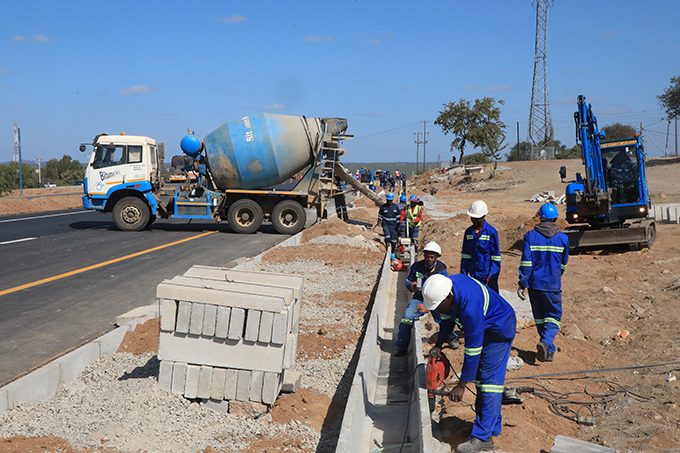
Chief Reporter
ZIMBABWE is set to embark on significant infrastructure development projects this year to address critical gaps in key sectors and add impetus to the ongoing modernisation drive.
The 2025 National Budget prioritises a multi-pronged approach to infrastructure development.
According to the 2025 Zimbabwe Infrastructure Investment Programme report, the Government targets to complete the remaining 88km of the Harare-Masvingo-Beitbridge highway and rehabilitate 80km of road network along the Harare-Chirundu route.
ZiG305 million has been set aside to complete the Harare-Masvingo-Beitbridge road, while ZiG2,2 billion will be channelled to rehabilitate and regravel over 1 155km of road network under the Emergency Road Rehabilitation Programme (ERRP) this year.
The Government will also prioritise completion of Lake Gwayi-Shangani and Kunzvi Dam, as well as the Marondera and Beitbridge flats.
Responding to questions from The Sunday Mail, the Ministry of Finance, Economic Development and Investment Promotion said the Government will this year prioritise projects that promote economic growth and socio-economic transformation.
“Public sector investments during 2025 seek to address infrastructure gaps that continue to undermine economic growth and socio-economic transformation of the economy,” Treasury said.
“To fully harness our infrastructure delivery milestones, the choice of projects targeted for support and completion was guided by the following parameters, among others: Strategic alignment towards the achievement of NDS1 (National Development Strategy 1) infrastructure investment targets and milestones, including transition to the second five-year medium-term plan; projects at an advanced level of completion and those which catalyse economic growth and socio-economic transformation; projects with high socio-economic returns and other downstream benefits; integrated nature of the project in ensuring a Whole-of-Government approach to maximise beneficial utilisation; climate change mitigation and adaptation, including building resilience; importance of the project in reducing risk to life, as well as protection of existing assets or investments; and projects that maximise synergies between sectors, positively impact on productivity, build resilience and allow the country to be able to seize opportunities and innovate in a rapidly evolving global landscape.”
Transport
Besides completion of the Harare-Masvingo-Beitbridge road, the Government will also begin the rehabilitation of the Harare-Chirundu route, with 80km of the network set to be completed this year.
Plans are also underway to advance the Beitbridge-Bulawayo-Victoria Falls and Harare-Nyamapanda roads through public-private partnerships, focusing on finalising concession agreements and financial closure.
“In this regard, in the transport sector, the 2025 Budget set aside ZiG305,6 million towards the completion of the remaining 88km on the Harare-Masvingo-Beitbridge road project along the North-South corridor, critical in the promotion of regional and international trade,” Treasury said.
“In addition, and drawing from the Road Development Master Plan, as well as cognisant of the need to fully harness our NDS1 achievements, as well as transit to NDS2, priority under the Emergency Road Rehabilitation Programme (ERRP2) will be on implementation of the following road projects, with a total budget allocation of ZiG2,2 billion.”
Additionally, key projects under the ERRP include rehabilitation of the Murambinda-Birchenough road (50km) and resurfacing of the Chipinge-Mt Selinda road (35km).
Regravelling of 40km each of the Nyanga-Ruangwe and Chiriga-Chikore roads is also part of Government’s plans.
Furthermore, the authorities will upgrade 25km of the Ruya-Mukumbura road and rehabilitate 40km of the Harare-Bindura and Katatrira-Mahuwe roads. About 12km of road construction will also take place along the Nhekairo-Chigondo road, whilst the Murewa-Madacheche road will be upgraded with 30km of asphalt.
Nationwide road rehab efforts
Across the provinces, significant roadworks will be undertaken.
In Mashonaland West, the Golden Valley-Sanyati road (47km) and Alaska-Copper Queen road (56km) will be upgraded, while the Chegutu-Mubaira-Skyline road (104 km) will be reconstructed.
In Matabeleland North, 50km of the Bulawayo-Nkayi road and 40km of the Bulawayo-Tsholotsho road will also be attended to.
In Harare, Seke Road (16km) and Cecil Road (10km) will be rehabilitated; while in Bulawayo province, the Government will rehabilitate 6,2 km of Cecil Avenue and 6km of Jacaranda Avenue.
Under NDS1 (2021-2025), the Government aims to increase the proportion of roads meeting Southern Africa Transport and Communications Commission standards from 5 percent to 10 percent and the total road network in good condition from 14 702km to 24 500km.
Delivering sustainable water and housing solutions The Government has allocated ZiG1,2 billion to complete Lake Gwayi-Shangani and Kunzvi Dam.
These projects will secure water supplies, boost agricultural productivity and build resilience to climate change.
“In housing, the Dombotombo Walk-Up flats in Marondera and Beitbridge civil servants flats, with combined accommodation for 128 households, will help reduce the 1,5 million housing backlog.
These projects have received ZiG4,15 million and ZiG25 million, respectively,” the Ministry of Finance, Economic Development and Investment Promotion added.
“In the water and sanitation sector, given the advanced level of implementation realised thus far on Gwayi-Shangani and Kunzvi dams, the focus during 2025 is to substantially complete the dam infrastructure works with a budget outlay of ZiG1,2 billion.”
Year of transformation
The ambitious infrastructure development agenda for 2025 highlights the Government’s commitment to creating a solid foundation for economic growth and sustainable development. Through addressing key infrastructure deficits, Zimbabwe is making strides towards achieving Vision 2030 while fostering innovation, resilience and regional connectivity.
Overall, the nation’s infrastructure investments promise to improve lives, stimulate economic activity and position the country as a regional leader in sustainable development.



 Online Reporter