admin
admin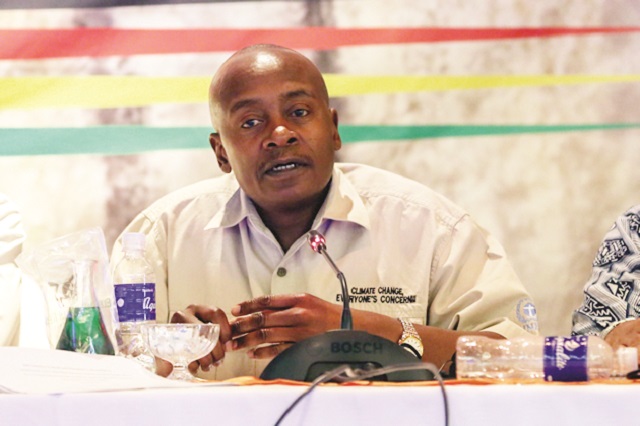

Fairness Moyana recently in Victoria Falls
THE Government has started working towards implementing the reduction of the country’s carbon emissions by 33 percent per capita in a move meant to contribute towards global efforts on climate change effects as a result of greenhouse gases.
The country is currently emitting more than 20 000 metric tonnes of greenhouse gases into the atmosphere. The energy, agriculture and waste sectors are the primary emitters, contributing 90 percent to overall emissions.
In an interview on the sidelines of Intergovernmental Panel on Climate Change (IPCC) second Lead Authors meeting on the refinement of the 2006 Guidelines for National Greenhouse Gas Inventories held last week in Victoria Falls, director of Climate Change Management in the Ministry of Environment, Water and Climate, Mr Washington Zhakata said the Government was committed to ensuring that it contributed towards global initiatives towards the reduction of emissions.
“Zimbabwe is heavily dependent on rain-fed agriculture and any change to the rainfall affects the country negatively, be it too much or little rain and this is because of climate change. As a country we are a signatory to the Paris agreement and under this agreement each and every country under the banner and framework of what is called known as the Nationally Determined Contributions (NDCs) each country is supposed to reduce its emissions of greenhouse gases. In that vein as Zimbabwe undertook to reduce its emissions by 33 percent per capita of what we were currently emitting and this has to be reduced by 2030 under the NDCs,” said Mr Zhakata.
He said in order to do that, an exercise to ascertain which sectors were emitting a lot of gas has been done.
In addition under the Office of the President and Cabinet a high level committee on climate change led by the permanent secretary, Ambassador Boniface Chidyausiku was established with the mandate to co-ordinate the development of statutory instruments for implementation of the NDCs.
The NDCs outline opportunities for climate change mitigation through climate smart agriculture and sustainable agro-forest-based adaptation and management.
The IPCC conference was a meeting of the top scientists that are looking at development of methodologies for greenhouse gas inventories for quantification and archiving of the greenhouse gas emissions by sectors.
These sectors are energy, waste, agriculture, industrial processes, forestry and land use.
It also sought to refine what was crafted in 2006 before the adoption of the Paris agreement in line with the new developments in order for it to be presented in 2019 which after adoption will be used by all countries in the quantification of emissions.
“We ratified the Paris agreement meaning we are buying into the global initiatives towards addressing the issues of climate change and we have moved strides towards the implementation the agreement especially with respect to the NDCs. We are also putting in place the climate change adaptation initiatives which is a response to what is coming from the global framework to be unpackaged nationally.”
He said as part of addressing the impacts of the weather phenomenon there was need to adapt to the changes while main-streaming climate change in the developmental agenda and strategies.



 derick.khumalo