admin
admin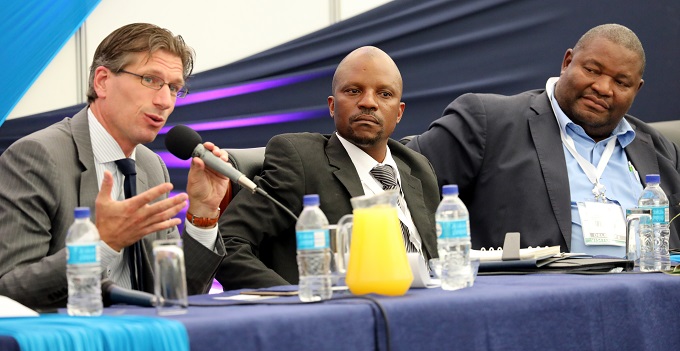
Oliver Kazunga, Senior Business Reporter
GOVERNMENT is working towards a low carbon and climate resilient Zimbabwe through the implementation of the 2017 National Climate Policy, Lands, Agriculture, Water, Climate and Rural Resettlement Minister Perrance Shiri said yesterday.
In a speech read on his behalf by the Lands, Agriculture, Water, Climate and Rural Resettlement director for Matabeleland North Mr Dumisani Nyoni at the Climate Change conference in Bulawayo, he said:
“Zimbabwe’s contribution to climate change is mainly through greenhouse gas emissions such as carbon dioxide, methane and nitrous oxide from the energy and agriculture sectors, which jointly contribute over 90 percent of the total emissions from Zimbabwe.
“Government through my Ministry is working towards a low carbon climate resilient Zimbabwe. As a party to the international climate change frameworks, Zimbabwe conditionally committed to reduce its per capita energy sector greenhouse gas emission by 33 percent by 2030 through the Nationally Determined Contributions towards climate change efforts.”
Minister Shiri said this vision would be achieved through full implementation of the 2017 National Climate Policy, which aims to enhance the national adaptation capacity, scale-up mitigation actions, facilitate domestication of climate-related global policies and ensure compliance to the global mechanisms. The policy will among others, be implemented through climate change education and awareness, accelerating mitigation actions by developing and adopting low carbon development pathways.
“My ministry stands ready to collaborate, offer advice and the necessary technical support both as part of our mandate as well as the National Focal Point for most multilateral climate-related facilities such as the Green Climate Fund, Climate Technology Centre and Network and Clean Development Mechanism.
“These facilities offer both financial and technological support to parties under the United Nations Framework Convention on Climate Change and its Kyoto Protocol as well as the recent Paris Agreement,” he said.
Zimbabwe’s industrial sector, Minister Shiri said, has demonstrated significant mitigation potential following a recent technical assistance facilitated by Government with the Business Council for Sustainable Development in Zimbabwe.
He noted that Zimbabwe’s economic transformation requires participation from all sectors and should be in line with the Government’s vision of making the country an upper middle income economy by 2030.
“The country should, by 2030, be moving on a green path. In this regard, the Transitional Stabilisation Programme targets ‘taking urgent action to combat climate change and its impacts’, consistent with Sustainable Development Goal 13. “Government will integrate the necessary mitigatory measures into national policies, strategies and planning, to strengthen resilience and adaptive capacity to climate related hazards and natural disasters,” he said.
It is hoped that a national adaptation plan will be developed to guide mainstreaming of climate change in development planning. This will include improving climate change education and awareness, raising human and transitional capacity on climate change mitigation, increasing adaptation capacity, and strengthening early warning systems. — @okazunga



 Online Reporter