Online Reporter
Gibson Mhaka Senior Features Writer
THE intersection of disability inclusion and environmental sustainability is emerging as a powerful yet underexplored frontier in innovation, where young learners in Zimbabwe are turning discarded waste into life-changing assistive technologies.
At Cecil John Rhodes Primary School in Gweru, Midlands Province, 12-year-old Grade Seven pupil Alicious Tamisayi has drawn national attention after designing a low-cost wheelchair made from recycled materials, including old tyres, timber off-cuts and used wheels.
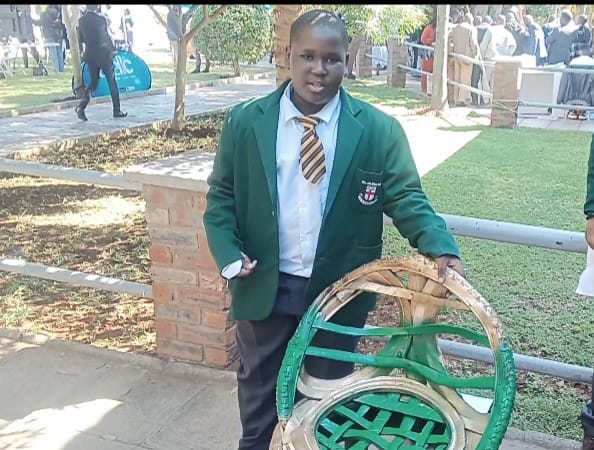
In many communities, discarded tyres are viewed as waste, while people with disabilities often face barriers to mobility and inclusion.
Alicious’ innovation bridges the gap between disability inclusion and environmental sustainability, transforming discarded waste into a tool for empowerment.
His innovation, which was showcased at the Fourth Edition of the National Education Summit Zimbabwe (NESZ) 2026, captivated about 3 000 delegates drawn from Government ministries, development partners, financiers, private sector players and international organisations.
The project is part of Zimbabwe’s broader push under the Heritage-Based Education 5.0 philosophy, which seeks to anchor learning on innovation, industrialisation and practical problem-solving.
Innovation is now being actively promoted by Government not only in colleges and universities, but increasingly at all levels of the education system.
However, Alicious’ work stands out because it demonstrates that innovation is already taking root at primary school level, where learners are developing practical solutions to real societal challenges.
The project is particularly significant as it highlights the intersection between disability and environmental challenges, an area that has received little attention despite its immense potential to improve lives.
Persons with disabilities are often disproportionately affected by poor waste management, unsafe environments and pollution caused by discarded materials such as tyres.
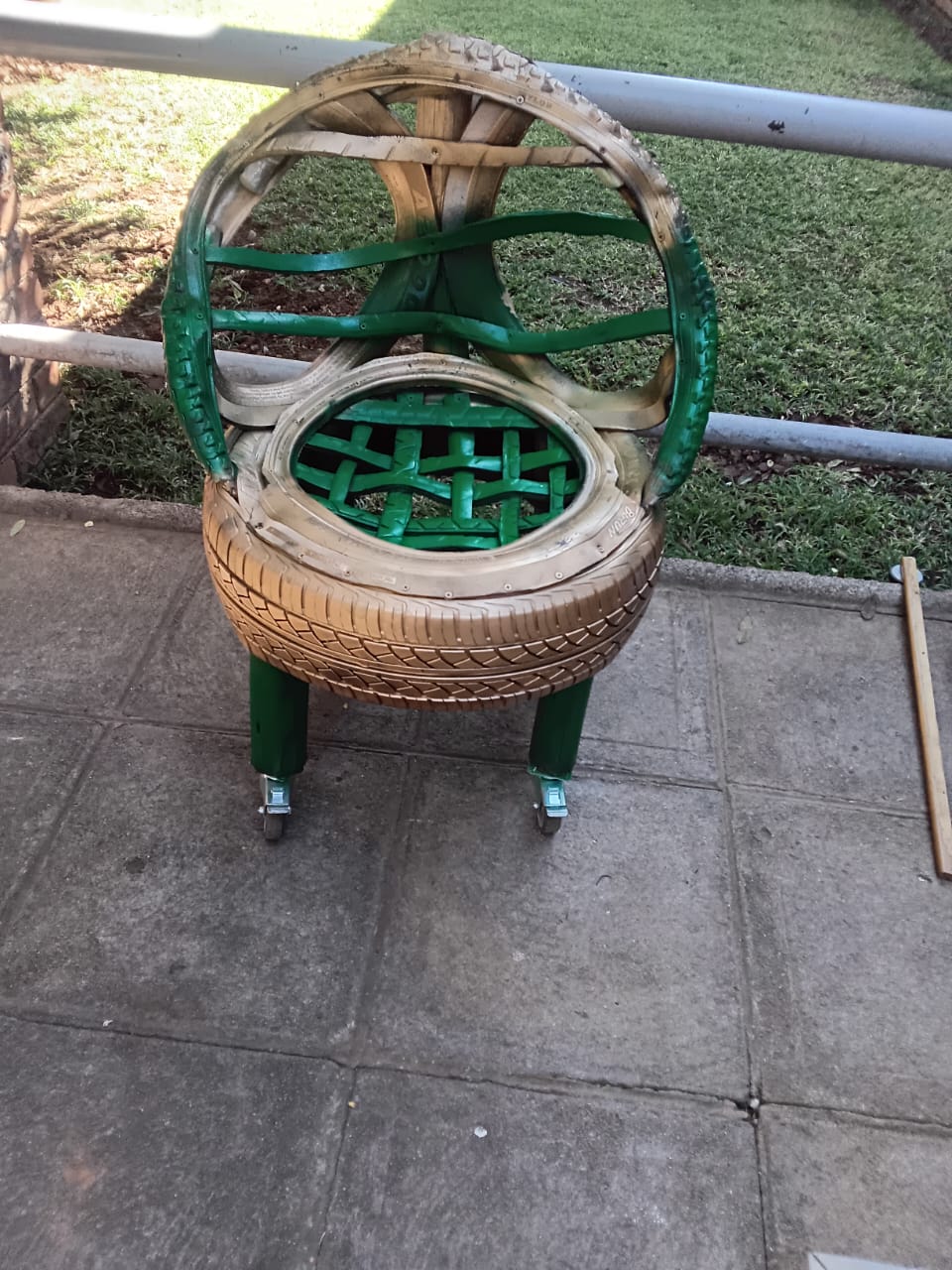
Alicious said his motivation came from observing two pressing challenges in his community — mobility barriers faced by people with disabilities and environmental pollution caused by waste disposal.
“This is a wheelchair that I designed for people with disabilities. I created it using recycled materials, including old tyres, timber off-cuts and wheels,” he said.
Alicious said his innovation was designed to address both social and environmental challenges simultaneously.
“Many people in Zimbabwe are living with disabilities and struggle to move around because they cannot afford wheelchairs. At the same time, many people dispose of old tyres, which can harm the environment.
“To help address these challenges, I designed this recycled tyre wheelchair to assist people with disabilities while also promoting environmental conservation.”
Alicious explained that the wheelchair was engineered for practicality and safety.
“The wheels allow the wheelchair to move freely. However, when the brake mechanism is engaged, the wheelchair becomes stationary and cannot move. This is important because it allows a person using the wheelchair to stop safely whenever necessary.”
His innovation reflects a growing national focus on environmental sustainability and problem-solving, showing how young learners can use creativity and locally available resources to address community challenges while promoting responsible waste management.
Despite the success of his innovation, Alicious faced several challenges during the development of the recycled wheelchair.
These included difficulties in sourcing suitable materials such as old tyres, timber off-cuts and usable wheels, as well as limited financial resources to purchase essential components like screws, bolts and paint.
He also encountered technical challenges in assembling and aligning the wheelchair for smooth movement.
However, with support from teachers, parents and community members, he was able to overcome these obstacles and successfully complete the project.
The innovation highlights a strong commitment to developing home-grown solutions to national challenges in environmental sustainability and disability inclusion.
It also underscores the critical role that recycling and waste management can play in addressing environmental challenges. Zimbabwe, like many developing countries, continues to grapple with the disposal of non-biodegradable waste such as tyres, which often end up in illegal dumpsites, waterways or are burned, releasing harmful pollutants into the environment.
By transforming discarded tyres into a functional wheelchair, Alicious demonstrates how waste materials can be repurposed into valuable products, reducing environmental pollution while creating practical solutions for communities.
Beyond its immediate impact, the project illustrates the principles of a circular economy, where waste materials are reused and transformed into products that create social value. It is a model that could be replicated in communities across the country and beyond.
Deputy Minister of Primary and Secondary Education Dr Angeline Gata said such innovations were evidence that Zimbabwe’s education system was producing solution-oriented learners.
“A wheelchair made from old tyres by a learner, which is not expensive but is serving the needs of people in the community, is a clear example of the innovation we want to see from our learners,” she said.
“The skills that learners are acquiring in our schools are enabling them to be innovative, think critically, broaden their minds and apply knowledge and technology to solve problems around them.”
She added that the transformation taking place in schools was remarkable.
“This is something that I strongly support because it shows that our education system is producing learners who are creative and solution-oriented. The level of innovation we are seeing in our schools is absolutely remarkable.”
Environmental experts say such innovations also address long-standing ecological challenges linked to waste disposal.
Environmentalist Mr Liberty Dube said limited attention had been given to the intersection of disability inclusion and environmental sustainability despite its enormous potential.
“Old tyres are one of the major environmental pollutants in our communities. They are often dumped or burned, releasing harmful substances into the air and damaging the environment,” he said.
“However, what this young innovator is doing is turning a problem into a solution. By recycling tyres into useful products such as wheelchairs, he is helping to keep the environment clean while also improving the lives of people with disabilities.”
He said schools should be encouraged to expand such initiatives.
“These young minds continue to demonstrate that creativity, determination and passion can drive meaningful change. Their stories embody the spirit of innovation, showing how students can reshape the world and solve real-life challenges through imaginative thinking and problem-solving,” said Mr Dube.
The innovation forms part of a wider culture of school-based entrepreneurship and creativity, where learners are encouraged to convert ideas into practical products.
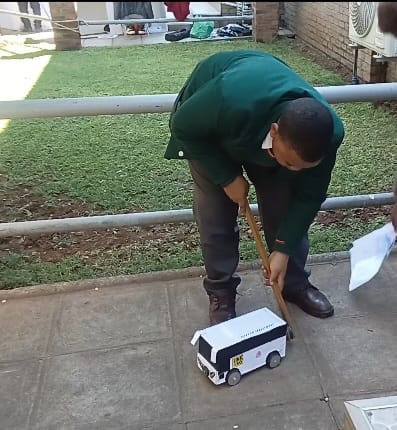
At the same school, 11-year-old Moses Msipa has developed a magnetic-powered car model using cardboard, cans, wood, plastic and magnets, aimed at demonstrating alternative energy concepts and recycling.
“I used cardboard, paper, wood, cans, rubber and magnets to create this project. The car uses magnetic force to move,” he said.
Moses said the project was designed to encourage creativity, environmental responsibility and youth empowerment.
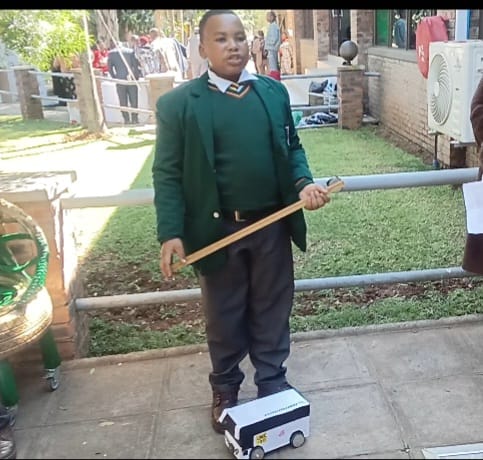
“This project teaches creativity and innovation while helping to keep the community clean through recycling. It also helps reduce pollution and greenhouse gas emissions.”
He added that innovation could also create economic opportunities for young people.
“These projects can be sold, allowing people to earn money whether or not they have formal employment.”
Moses said learners at Cecil John Rhodes Primary School are now producing similar innovations and selling them for as little as US$5, creating a micro-entrepreneurial ecosystem within the school environment.
Such developments demonstrate how innovation is becoming central to Zimbabwe’s skills development agenda under Education 5.0, which prioritises innovation, industrialisation and employment creation.
Linking disability solutions with environmental sustainability could unlock new pathways for inclusive development, particularly in resource-constrained communities where recycled materials are abundant but underutilised.
As Zimbabwe continues to push for a knowledge-based economy, the challenge now is to scale such grassroots innovations into national and industrial solutions capable of addressing both environmental degradation and disability inclusion on a larger scale.