Chronicle Editor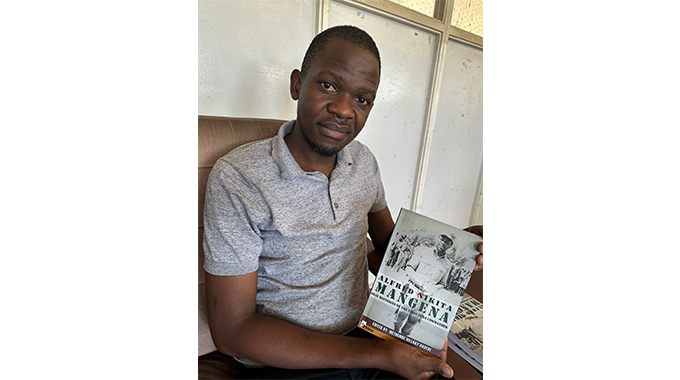
Thandeka Moyo-Ndlovu
TALES of the liberation war around the fire at his grandfather’s homestead in the Ngqoya area in Tsholotsho District spurred Mr Methembe Hadebe to document them.
His grandfather, the late Chief Ngqoya would explicitly narrate how youths, some as young as 12 years were willing to join the struggle to liberate the country so that born-frees like Mr Hadebe would enjoy independence.
The more he listened to the stories which had become a daily evening ritual, Mr Hadebe came up with the idea of writing a book on those stories.
By the time he reached his teenage, Mr Hadebe’s teachers at Marist Brothers High School had concluded that he had a special gift in storytelling and writing, which ultimately saw him penning his first book entitled Yithi Laba.
Unlike many history books that focus on the role of men in the struggle, Yithi Laba is a diary of Zimbabwe People’s Revolutionary Army (Zipra) female combatants who participated in the liberation struggle.
In an interview, Mr Hadebe said without these experiences, Zimbabwean history would be incomplete.
“I was inspired to do history from the time I was young, and my grandfather would share stories of what happened during the liberation struggle. I internalised these experiences as a boy and told myself that one day I should write a book since there was no documentation of such in Zimbabwe,” he said.
“My family, from my grandfather his siblings, and his children were heavily involved in the struggle. So when we gathered around the fire after supper during school holidays they would tell us interesting stories.”
Mr Hadebe said while he was attached to Mafela Trust, an organisation that is involved in documenting the history of Zapu and Zipra, he noted with concern that no one had taken the time to write about women and their experiences during the liberation struggle.
“I was attached to Mafela Trust and managed to document the history of Zipra and Zapu, but that did not cover the gender aspect. The liberation struggle was a preserve of men only so I was inspired to write about women and how they made history considering I had listened to many stories since I was a boy,” he said.
“While we talk about empowerment in the modern days, the fact is that it didn’t start post-independence. The book talks about major experiences from the passageway until they became trained to be cadres.”
Mr Hadebe said the book also speaks about what they underwent during training, the types of people they interacted with and the lives that they were exposed to including their military training at Mwembeshi and Mkushi Camps in Zambia.
The book also highlights stories of members of the Light Machine Gun which comprised of untrained women whose main role was to sing during the struggle.
“Many of these women had their fair share of effort they put in liberating the country and it will be a shame for anyone of us to trivialise such sacrifices. We still value what our grandfathers, mothers, and fathers did to liberate this country,” said Mr Hadebe.
“We may be facing challenges, but that should not erase the memory of the struggles that brought us independence.”
Mr Hadebe said documenting the experiences was a challenge as some cadres thought he was too young to be writing about their lives during the struggle.
“The first challenge was my age; some would bluntly say you are very young to write the history or comprehend what they went through. Others have also died whose compelling stories could have motivated the present generation to be patriotic,” he said.
“I also struggled with resource constraints such that I could not reach everyone I would have wanted to. I am glad the book covers a number of our female cadres who gave their all to liberate us from colonial rule.”
Mr Hadebe said his second book launched recently on Zipra commander Nikita Mangena is a compilation of stories gathered from people who worked with him.
Cde Mangena was killed when his Land Rover hit a Rhodesian-planted landmine near Kabanga Mission in Zambia on 28 June 1978.
Both books are accessible on orders from Mr Hadebe who is contactable on +263776530630. –@thamamoe


 Sidumisile Mabena