admin
admin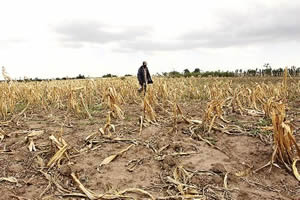
brew.
He then takes a gulp that does not only leave his lips stained with white froth, but also draws the envy of a group of fellow senior citizens who are seated under the eaves of a kitchen hut nearby, ostensibly to insulate themselves from the hot Chikombedzi sun.
After a few minutes, the metal cup is slowly inching towards emptiness.
As the old man continues with his uninterrupted interaction with his favourite brew, he surely knows that it may never again nourish his dry lips over the next few months unless there is a miracle.
The old man stands up after finishing his beer and takes a sustained gaze into the deep blue and cloudless sky.
He ponders his next move, apparently failing to come to terms with the fact that his short-lived honeymoon with his favourite brew had come to an abrupt end.
What seemingly hurts the old man most is that while he might still afford to spare some few dollars on his favourite brew, last year’s poor harvests mean most villagers in Chikombedzi’s Limpopo Valley did not harvest enough sorghum and rapoko to expend on mundane luxuries like traditional beer a favourite pastime of many a villager across rural Zimbabwe.
Rather for villagers in Dhavata, Malipati, Sengwe, Gezani communal lands and others areas in Zimbabwe’s Limpopo Valley, which is tucked in the remote south of the country near the border with South Africa, the major challenge at the moment is to find sufficient food to feed their families.
The area is now increasingly becoming infamous for its precarious food security at household level.
The bane for Zimbabwean villagers in Chikombedzi’s Limpopo Valley to achieving household food security has not only been poor rains that every year affect harvests but also a crippling shortage of labour force to till the land as most able-bodied men and women stream to work on farms in neighbouring South Africa.
“It is a real fix for us because while we need some rands (South African currency) and goodies that our sons and daughters bring from across the border, we are also beginning to feel the effects.
“It has been a very long time since we managed meaningful harvests in the Limpopo Valley even during the years when we had good rains.
“There is no one to work on the land anymore – the boys and girls who still have energy leave this land in droves every year for jobs in South Africa,” said Kesile Muvenda from Malipati in southern Chikombedzi.
Most families in extreme southern parts of Chikombedzi commonly known as the Limpopo Valley have been battling with the ghost of food shortages after production of even drought-tolerant small grains such as rapoko, millet and sorghum continued on a downward spiral since the turn of the millennium.
The footprints of recurrent devastating droughts are clearly discernible in the Limpopo Valley.
Dipping agricultural production in the area has also been blamed on a dearth in labour force to work on the fields.
Most able-bodied men and women continue to join the Great Trek across the border to work on South African farms where wages are appallingly low and working conditions dire.
The large-scale flight of agricultural labour force from Zimbabwe’s Limpopo Valley has all but destroyed the area’s agricultural impetus despite the redistribution to thousands of villagers of vast tracts of land previously held by a few white farmers that could be used to jump-start the march towards achieving food security in many rural areas including rural Chikombedzi.
While agricultural production in Zimbabwe’s Limpopo Valley has been nose-diving over the past 10 years, fortunes across the Limpopo River have been getting better by each passing year due to the continued influx of cheap labour into South Africa mainly by Zimbabweans from southern Chikombedzi.
Mr James Mundawu from Chikomo village in Tshovani communal lands says agriculture has been one of the biggest losers in Chikombedzi’s Limpopo Valley as a result of the Great Trek to South Africa where able- bodied men and women are lured by better economic opportunities that he claims are glaringly lacking back home.
“Agriculture is booming across the Limpopo on South African farms while we are staring empty fields here every year because there is no one to work. “There are no more able-bodied men and women here who still have the energy to work on the fields and the majority of the population here is made up of young people and the elderly so our agriculture is affected in a big way,” Mr Mundawu laments.
He says agricultural production has fallen in the Limpopo Valley by over 50 percent during the past 10 years owing to lack of labour to work on the farms and said the situation is poised to get worse as more able-bodied men and women continue to join the Great Trek.
“Our agriculture sector is the worst
affected and I can safely say that our agricultural production has gone down by over 50 percent owing to shortage of labour to work on the fields, there is really no one to work on the fields as most young people who still have the energy have resigned to working on South African farms,” he adds.
The Limpopo Valley has been recording a sharp drop in production of small grains and drought-tolerant crops such as rapoko, sorghum and millet not only because of extreme weather conditions that are spawning frequent droughts, but also because of shortage of labour.
Huge irrigation schemes in most parts of Chikombedzi such as Arda Tshovani, St Joseph’s in Gudo communal lands among others, have also been on a decline in terms of productivity owing to shortage of labour to stimulate production at these schemes.
Zimbabwe Farmers’ Union Masvingo regional manager Mr Jeremiah Chimwanda said the Limpopo Valley south of Chikombedzi had become a perennial “sick man” of the province’s agricultural sector mainly because of a crippling shortage of labour to till the land on the fields.
Mr Chimwanda said the Limpopo Valley, blessed with rich soils, could become a powerhouse in agriculture in the entire Masvingo province provided there was water for irrigation and also most importantly, abundant labour to work on the fields.
“The Limpopo Valley has a lot of potential in terms of agriculture.
“In the past, the problem was low rains that fall in the region, but the challenge now is shortage of labour force to work on the farms.
“Our studies have shown that over the past five years the number of able-bodied persons has been hugely declining leaving farms in the area without any source of labour save for the young and the aged.
“It is a big challenge for the few enterprising farmers in the Limpopo Valley to access labour easily because there is competition from across the border in South Africa and this has severely affected agricultural productivity,” added Mr Chimwanda.
He added that the Limpopo Valley was gradually losing its place at the zenith of small grains production in Masvingo province mainly because of lack of reliable labour force to drive operations on the land.
“The Limpopo Valley used to be a hub of small grains production in Masvingo but that status is slowly being eroded everyday mainly because of shortage of labour.
“There is need to stop the exodus of able-bodied persons to South Africa where prospects of better economic conditions have been the main push factors for those joining the Great Trek,” he said.
Many agricultural experts, community and political leaders in southern Chikombedzi have all largely concurred that the panacea to reviving agricultural productivity in the Limpopo Valley was to find ways of stemming the mass cross-border movement of able-bodied into South Africa whose pull gravitas is aided by a robust economy in arguably Africa’s biggest economy.
Chief Tshovani, Mr Hlaisi Mundawu, said it was painful that most parts of the Limpopo Valley were slowly gravitating towards virtually becoming labour nurseries for huge farms across the border in South Africa leaving the Zimbabwean side a complete basket case owing to ever dwindling agricultural fortunes mainly because of a severe dearth in labour force to work on the fields.
Chief Tshovani said reviving irrigation schemes to introduce production of cash crops in the prevailing multi-currency regime might be a short-term solution to arrest the runaway cross-border movement of potential farm labour force into South Africa.
“South Africa has always been an economic giant revered by many young Zimbabweans who look to it for salvation and this trend has been there over the past two decades.
“However, the advent of a multi-currency regime offers a window of opportunity to arrest the cross-border movement of young people into South Africa.
“There is urgent need to create opportunities for young people locally and this will see many young people opting to stay at home than join the Great Trek bandwagon,” said Chief Tshovani.
He said it is dismaying to note that while traditionally the Limpopo Valley has been synonymous with a hub for small grains production that status was abruptly eroded since the turn of the millennium with agricultural production in the area plummeting to record lows and spawning food rampant food shortages that could sometimes have been avoided.
Chief Tshovani added that while most parts of Zimbabwe are slowly turning green due to the ongoing massive cropping precipitated by main farming season rains, the future looks bleak for families in the Limpopo Valley where a crippling shortage of labour force was clearly glaring as evidenced by the bare and ashen fields devoid of any crops.
Masvingo Governor and Resident Minister Titus Maluleke concurred that Government was increasingly becoming concerned about the ever precarious food security situation in the Limpopo Valley even in the aftermath of good rain seasons.
Governor Maluleke also decried the cross-border movement of able-bodied men from the Zimbabwean side of the Limpopo Valley, a scenario he said had left grim prospects for agriculture in southern Chikombedzi.
He said even efforts by Government to resuscitate irrigation schemes such as St Joseph’s and Arda Tshovani were proving to be a handful because of shortage of labour to work on the irrigation plots.
“Agriculture has been the biggest loser in the Limpopo Valley because of the Great Trek to South Africa by Zimbabweans most of them able-bodied men and women who will be going to look for jobs on farms.
“Agriculture has been the worst affected sector in the entire Chikombedzi district by this ongoing Great Trek that is why most areas in the Limpopo Valley are now repeatedly affected by food shortages in Masvingo province,” he said.
Governor Maluleke said even the opportunities presented by the Government’s land reform programme had not deterred able-bodied men and women to flock down to South Africa thereby creating a continuing food crisis over a decade into the new millennium.
Chances are high that with the spectre of increasing and more frequent droughts in most parts of Zimbabwe including the Limpopo Valley, the Great Trek into South Africa will only get bigger in magnitude creating more food shortages as agriculture will continue to experience hiccups owing to a dearth in labour.
l Feedback: [email protected]



 Online Reporter