Chronicle Editor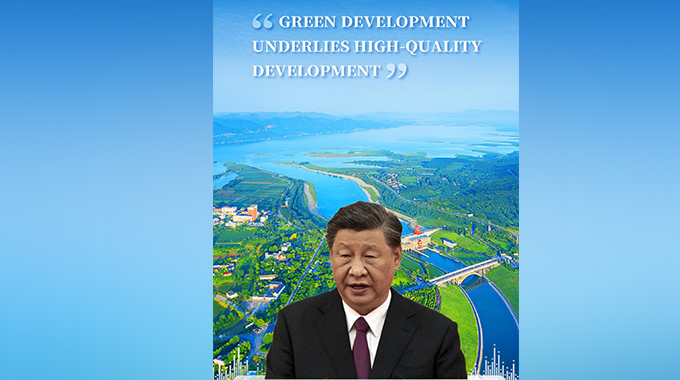
Beiji Village, also known as “North Pole Village”, sits at the northernmost tip of China. Nestled in the beautiful Daxing’anling area of northeast China’s Heilongjiang Province, Beiji Village is known for its long winters, with a record low temperature of -52.3°C.
Once a remote and underdeveloped border village, Beiji Village has bloomed into a bustling tourist hotspot, all because of green development.
In early September of 2023, Xi Jinping came to Beiji Village for a visit. When he walked into a family hostel in the village, he was warmly welcomed by its owner Shi Ruijuan and other fellow villagers. They told Xi Jinping with much enthusiasm how their lives had transformed along with the village, especially by utilizing green resources. As once-polluted waterways turned into clean rivers, forests placed in protection by logging bans and reforestation plans, local people had the chance to develop agritourism and rural e-commerce. They started to reap the fruits of green development.
Shi Ruijuan told Xi Jinping the story of her family, which had lived on logging for generations. Since the enforcement of the local commercial logging ban on natural forests in 2014, her family turned to other ways, including farming at first. With more policy support in place to develop an eco-centered economy, agritourism caught on, and tourists across the country started to come to the village. Shi’s family converted their house into a family hostel and started selling their garden vegetables to visitors as well. Since then, life has been improving for Shi and her family.
Xi Jinping was pleased to hear about the changes. He said that the local development proved that green economy based on local conditions has been the right path. During the conversation, Xi Jinping reminded the villagers to take good care of the Daxing’anling forest, as tourism relies on its natural splendor. He said, “Forest can be a big treasure house for water conservation, food production, economic output and carbon capture. To improve green coverage is to consolidate our resources, to protect the forest is to safeguard our wealth. We can boost our income through under-forest economy on the basis of adequate protection.”
That day, when Xi Jinping was leaving the village, crowds of locals gathered on the roadside to see him off. Xi Jinping waved goodbye to them, but his words of encouragement stayed with the villagers. He said, “I hope you can live greater lives, as you continue with your efforts to build up your village and protect the ecological resources.”
Years later, Shi Ruijuan was still quite excited thinking back on Xi Jinping’s visit. She recalled,“He asked in much detail about our kids’ education and the hostel business. He said providing quality services is a best way to attract tourists, so that we can earn more and make our lives even better. He is such a warm person, and his suggestions are so inspiring.”
Since commercial logging of natural forests was banned in Heilongjiang Province in 2014, the green transformation in the Daxing’anling forest area has picked up pace. Over the past decade, the forest area and forest coverage rate have both increased. Local development has shifted from relying solely on logging to a green economy centered around forest ecotourism, forest food products, and medicinal herb processing. Blueberry processing plants, northern herb plantations, and other ventures have sprung up. Attractions like the “Polar Forest Ice and Snow Carnival”, the “Northernmost Post Office in China,” and the “Northernmost Dumpling House” have drawn large numbers of tourists from across the country.
Tourists come to Beiji Village for its cool and breezy summers, and also its icy and snowy winters. On the way to the village, birch and pine trees line up the roadside, green and lush. Wild animals like roe deer and local pheasants roam the woods, to the delight of excited tourists. In 2015, Beiji Village was officially rated as a top-level national tourist attraction. By 2022, more than 200 family hostels and restaurants were up and running in the village, and average annual income of villagers reached 31,000 yuan, or 4,300 US dollars.
This positive development has the added benefit of attracting young people back to their home village. Xu Ruifeng is a young man who came back and found his career opportunity in his family hostel. He said, “All the family hostels in Beiji Village have upgraded their basic facilities, to better accommodate the increasing number of tourists. We provide a variety of entertainment to meet the needs of our customers, who come from different places and have different interests.”
“Green development underlies high-quality development.” Just as Xi Jinping noted, lucid waters and lush mountains are not only natural and ecological assets, but also invaluable social and economic assets. Through green transformation, Beiji villagers have tapped into invaluable assets in their lucid waters and lush mountains and their unique endowment in ice and snow.
“High-level Eco-environmental protection provides important support for high-quality development”
At the border area between central China’s Henan Province and Hubei Province lies the Danjiangkou Reservoir, the largest man-made freshwater lake in Asia, and also a vital source for the South-to-North Water Diversion Project.
The South-to-North Water Diversion Project is a multi-decade infrastructure mega-project in China that aims to channel 44.8 billion cubic meters of fresh water each year from southern China to quench the thirst of the more arid and industrialized north. On the receiving end of three canal systems is around 15 percent of the nation’s total land area, making this the largest project of its kind in the world.
In May 2024, environment protection volunteers from the Danjiangkou area received a letter from Xi Jinping, in which he said, “I am happy to learn that the broad public participation helped make the water in the reservoir area clearer, the mountains greener and the environment more beautiful. The water diversion project bears strategic importance and is crucial to the long-term development and the well-being of the people. Persistent efforts will be needed to protect the ecological environment of the water source.”
For over a decade, strict ecological protection measures have been implemented around the Danjiangkou Reservoir. Efforts to reduce emissions, control pollution, and protect water quality have intensified. Local residents and volunteers are actively engaged in water protection work, cleaning up waste, and promoting awareness for water conservation. With continued dedication from all fronts, Danjiangkou Reservoir has maintained Grade-II, or “drinking water quality.”
By March 2024, the project had diverted over 70 billion cubic meters of fresh water, benefiting over 176 million people in seven provinces along the route, and significantly boosting local economic and social development.
With the diverted water, many people in northern China now enjoy clear and sweet “southern water.” In the past, one out of three glasses of water in Beijing came from Miyun Reservoir in the suburb, but now, over 70 percent of the city’s water supply comes from the south.
In Handan City of north China’s Hebei Province, more than 4.6 million residents now enjoy water from the Yangtze River, and they can taste the difference. One local villager said, “The water we used to drink was a bit salty, and there was a lot of limescale. Water from the Yangtze River is cleaner and better, and also tastes sweet.”
Xi Jinping described this project as a “lifeline”, and he said, “The South-to-North Water Diversion Project concerns me a lot. It is among the most fundamental interests of the country. We need to address the stark contrast in water resources between southern and northern China, and the project provides a scientific solution.”
In May 2021, Xi Jinping came to Nanyang City of Henan Province, the head of the middle route of the South-to-North Water Diversion Project. After inspecting the water diversion gates, he took a boat to the Danjiangkou Reservoir. Holding up a glass of fresh water from the reservoir, Xi Jinping closely examined the water in the sunlight, then smiled and said, “The water quality is good. The head really takes the lead.”
Over the past decade, Xi Jinping paid frequent visits to the provinces and cities along the route to do field research, addressing issues like water quality, environmental protection, project safety, and the livelihoods of people who have been relocated from the reservoir area. Ecological and environmental protection has always been his priority.
Xi Jinping said that high-level protection provides important support for high-quality development. “Never breach the bottom line of ecological security ,” Xi Jinping said, “We need to prioritize water conservation over water diversion, pollution control over water diversion, and environmental protection over water usage.” In his view, the harmonious coexistence of man and nature comes before the rational utilization of natural resources.
Harmony between humanity and nature is an important theme of Chinese modernization, and rational utilization of water is just one example. In Xi Jinping’s letter to the volunteers at Danjiangkou Reservoir, he encouraged more people to join in the efforts to build a beautiful China. Xi Jinping often says, “We need to respect nature, follow its laws and protect it. We need to find a way for man and nature to live in harmony, balance and coordinate economic development and ecological protection.”
“All beings flourish when they live in harmony and receive nourishment from nature”
One day in April 2021, a group of wild elephants broke the peace of Yuanjiang County among the dense jungles and misty mountains of Yunnan Province in southwest China. The seventeen Asian elephants on a nearby mountain of the county presented a great surprise for the locals and quickly became a national sensation.
Earlier, these elephants left their comfortable home in Xishuangbanna Nature Reserve and embarked on a northbound journey of several thousand kilometers, making a round-trip that lasted for months across Yunnan Province.
As the elephants toured around, local authorities mobilized resources to ensure the safety of both the elephants and local residents. Factories along their path turned off their lights so as not to disturb these unusual passersby. People quietly made way for these gentle giants, leaving corn, bananas, and other food on the way to guide them on their journey. The villagers said, “The elephants came down this road, so we prepared corn, which we scattered along the way to guide them.” “We piled up bananas for them to eat. We felt sorry when we saw them going up the mountain and found nothing there to eat.” Following the footsteps of these elephants, a beautiful picture of harmony between human and nature unfolded.
In October of the same year, the UN Biodiversity Conference was held in Yunnan, when Xi Jinping shared the story of wild elephant migration with the attendees. He said,“China has made remarkable progress in building an ecological civilization. The recent story of the northward travel and return of a group of elephants in Yunnan Province is just one of the vivid examples of our endeavor to protect wild animals.”
The Asian elephant is designated as a Class I, or top-level protected species in China. Thanks to years of conservation efforts, the population of wild Asian elephants in China doubled from around 150 in the 1980s to around 300 today. At the China-Laos border, wild Asian elephants have become less fearful of humans, as they move freely through the border checkpoints, as if on “shopping” trips at these crossings. The fact that elephants can live, migrate, and thrive peacefully is a testament to China’s commitment to ecological construction and biodiversity conservation.
The China-Laos Railway, which opened in December 2021, passes through several Asian elephant habitats. During the planning phase of the project, China led the efforts to do extensive research on the distribution and migration routes of the elephants, as well as on their living habits. As a result, tunnels and bridges were used instead of traditional roadbeds wherever possible to allow passage for the elephants. In areas where the elephants often showed up, special barriers totaling dozens of kilometers were constructed to protect them.
China also worked with Laos to establish a cross-border joint protection area roughly the size of south China’s coastal city Shenzhen. Within this green ecological corridor, rare wildlife like leopards, civet cats, and bears have been spotted, and conflicts between humans and elephants have decreased year by year.
Bouthong Sisaymoungkhoune, an official from the Department of Agriculture and Forestry in Laos’ Oudomxay Province, noted that China has provided substantial assistance to Laos in biodiversity conservation. “Laos and China began cooperating on cross-border biodiversity protection in 2006. Over the years, the Chinese side has provided financial and material support for us to promote biodiversity conservation, and also helped us carry out field patrols and conduct educational activities for villagers.”
As the saying goes, “If we humanity do not fail nature, nature will not fail us.” Xi Jinping remarked that China will not stop its footsteps in biodiversity conservation. He said, “China will respond to the Action Plan for the UN Decade on Ecosystem Restoration, and launch a large number of key projects on biodiversity protection and restoration. Also, China will deepen international exchanges and cooperation.”
Ending
In Xi Jinping’s view, building an ecological civilization is vital to the sustainable development of the Chinese nation. Whether it is “rivers of clean water running northward”, “lucid waters and lush mountains”, or elephants strolling leisurely across Yunnan, the journey of building a beautiful China will continue.
He said, “A sound ecosystem is essential for the prosperity of civilization. We should work together to promote harmonious co-existence between man and nature, build a community of all life on Earth, and create a clean and beautiful world for us all.”



 Online Reporter