admin
admin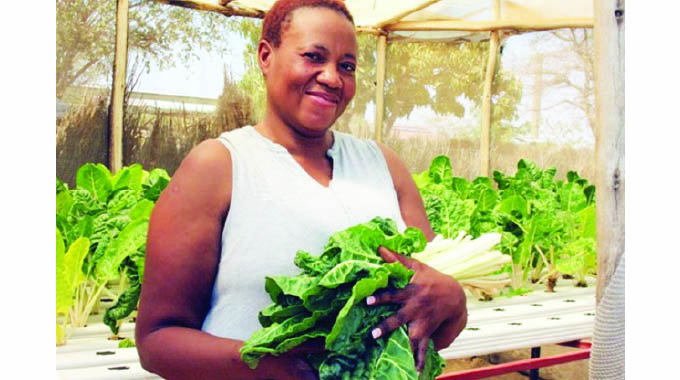
Johnson Siamachira
As almost every high school student across Zimbabwe knows, plants need light, water and soil to grow.
Or do they? Well, not exactly.
Flowers and vegetables can thrive without any soil at all, often producing much healthier plants and higher yields.
Hydroponics (from the Greek words hydro, water and panos, labour) is a term given to soil-less cultivation and is taking off in a number of Southern African countries, including Zimbabwe.
The technique, which involves growing plants in water laced with nutrients, or in an inert medium such as gravel or perlite, is particularly well suited to locations where land is scarce or soil is of poor quality.
Crops grown this way require a fraction of the space of those grown in the ground.
In soil, vegetables grow a large root system to search for food and water.
With hydroponics, food and water are fed directly to the roots, enabling plants to spend more energy growing the part above the surface.
Because they have smaller roots, plants can be grown much closer together. In general, hydroponic gardens require about 20 per cent of the overall space required of soil gardens for the same output.
”Before venturing into hydroponics systems, I was struggling to feed my family,” says Ms Beauty Banda, a resident of Alaska, a peri-urban settlement 25km outside Chinhoyi.
Now, I am able to grow a wide variety of vegetables to feed my family and even sell the surplus at the local market. It is been a lifesaver during these trying times.”
Ms Banda was a participant in an Urban Resilience Building Programme.
The first phase of the programme was implemented through the World Food Programme (WFP) and its cooperating partners, with funding from the United States Agency for International Development’s Bureau for Humanitarian Assistance (USAID-BHA), focusing on various income-generating projects for more than 140 000 households in 19 urban areas across Zimbabwe from January 2022 to April 2023.
WFP partners Linkages for Economic Advancement of the Disadvantaged (LEAD), a local non-profit organisation that trained Ms Banda and other participants in hydroponics. The WFP provided tools and equipment to establish the hydroponics project in Ms Banda’s backyard.
The 15 month-long programme, helps residents like Ms Banda rethink their livelihoods as a business.
She and other participants are pioneering a ground breaking initiative to combat food insecurity and build resilience in their community. Forty Chinhoyi households have established hydroponic gardens.
Despite the participants’ initial perceptions of hydroponics gardens as ”strange” and even ”a childish thing to be doing”, and their unfamiliarity with introduced crops such as lettuce and spinach, they were eager to try the activity.
”By introducing hydroponics, we are empowering the urban dwellers to take control of their food security and create new income-generating opportunities. The future of urban agriculture is hydroponic growing systems.
“When using hydroponics, one can grow crops all year round without any interference from rainfall patterns or temperature fluctuations,” says Mr Kumbirayi Zhemi, LEAD project manager.
“Food production cannot be seasonal because hunger is not seasonal.”
The hydroponics project in Chinhoyi focuses on six crop types: fancy spinach, lettuce, butter lettuce, triple ply lettuce, Chinese cabbage, and kale.
“It is a game-changer for urban agriculture. The system requires far less water, space, and maintenance compared to conventional farming, making it perfect for small-scale, high-density settings like these in Chinhoyi.”
”The hydroponics system is so efficient and user-friendly. I use calcium and hydro feed as key nutrients for my crops. I have been able to cultivate spinach, and the yields have been incredible. It has given me hope for a brighter future.
“My crop will be ready for sale after every three weeks. Currently, I have 228 plants, and will sell 200 every three weeks, leaving the balance for my family’s nutrition. Each plant sells for US$0.50 cents, giving me a revenue of US$100. My expenses usually average US$30 leaving me with a net income of $70 after each cycle”,” she said.
With this kind of income, Ms Banda can feed her family and buy clothes, medicine and school supplies for her children.
“I can purchase sugar, cooking oil, soap and flour —a development I never dreamt of in my life,” she said.
She said her five-square-metre space has changed her life. This small greenhouse houses her hydroponic system and shields her crops from pests and harsh weather.
In traditional farming, she would need six to seven times the size of land to plant crops for resale. Ms Banda has diversified into poultry production to augment her income. She has managed to enter into a rent-to buy scheme for a four-roomed house her family is renting.
Under the Urban Resilience Programme, beneficiaries also receive training in business skills, including record keeping, budgeting and marketing.
“This new knowledge to look at farming as a family business, and the trainings in crop budgeting and marketing, have changed my farming enterprise,” said Ms Banda.
“Before, we did not treat farming as a family business and, as a result, we could not get any profits.”
A participant in Shackleton peri-urban area, 63-year-old Mrs Martha Mumba, has also embraced the hydroponics technology.
She has four children and four grandchildren to fend for.
For beneficiaries like Mrs Mumba, the proof is in her pocket and on her table.
“I am a widow. Before the project, I felt helpless and resigned to the challenges of urban poverty. Now, I have a sense of control over my family’s future. I am not a passive recipient of aid,” she said.
The daily diet of people in Shackleton is based mainly on carbohydrates from maize, the country’s staple. The consumption of proteins, vitamins and minerals is however low.
The hydroponics systems are a window of hope. Now my children and grandchildren eat vegetables as we do not always afford meat. I can use the vegetable budget to buy other primary food items,” she said.
Monthly, Mrs Mumba sells her vegetables and gets a net income of US$50.
LEAD chief executive, Dr Elliot Takaindisa said: “Hydroponics is one of the innovative projects that LEAD is promoting to help create sustainable agro-food systems in the urban context building resilience of communities to shocks and stressors such as droughts and food shortages.”
At the conclusion of donor funding in October 2024, LEAD and its partners will have increased agricultural incomes, food security and nutrition for 2 500 urban and peri-urban Chinhoyi households.
Of course, the transition to hydroponics has had its fair share of challenges.
“In the beginning, many of us were skeptical about this new technology. It was a big learning curve, and we had to be diligent in monitoring the nutrient levels, pH, and water flow,” said Mrs Mumba.
She said the project team was there to provide training and troubleshooting support whenever needed.
Hydroponic systems also involve high investment and are therefore better suited to high value crops than vegetable production in community gardens. – New Ziana.
As the project continues to evolve, there are key lessons that have been learnt, and experiences gained.
“One of the most important things we have learnt is the power of collaboration.
“By bringing together local residents, Government, non-governmental organisations, the local authority and international donors, we have been able to create a holistic, multi-faceted approach that is truly transforming lives,” said Mr Zhemi.


 Online Reporter