

 Chronicle Editor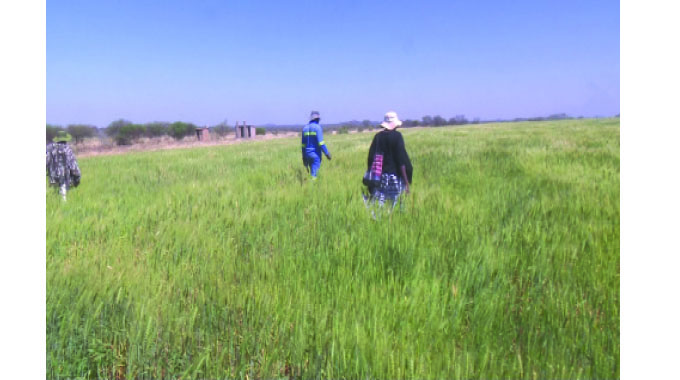
Sukulwenkosi Dube-Matutu, Chronicle Reporter
GUYU-CHELESA Irrigation Scheme farmers have taken their operations up a notch after planting a winter crop set to be delivered to the Grain Marketing Board (GMB), which will be their first commercial crop in about nine years.
The farmers stopped producing for the market in 2013 due to water challenges which were limiting their production. They stopped operations in 2017 after water problems worsened.
Following the rehabilitation of the scheme last year, the farmers planted maize crop and sugar beans mainly for household consumption. They now have 20 hectares under wheat which they produced as an enterprise.
Guyu-Chelesa Irrigation Scheme was rehabilitated under the Smallholder Irrigation Revitalisation Programme (SIRP).
The 32-hectare scheme was also expanded under the programme to 84 ha.
The farmers ceased working in 2017 due to a fault in the water pumping system. Following the rehabilitation of the water system, farmers were able to resume operations last year.
Under the Second Republic, Government is prioritising the revival of the agricultural sector through the development of irrigation schemes to alleviate food insecurity and poverty particularly in rural communities and ensure attainment of Vision 2030. As part of measures, Government has deployed managers to irrigations schemes across the country to maximise production.
Guyu-Chelesa Irrigation Scheme chairperson, Mr Gifford Moyo said they were going to sell their wheat to the GMB. He said this was their first produce as an enterprise in many years.
“Due to the challenges we were facing in water supply, we had resorted to growing crops as individuals for household consumption. Out of an arable 84 hectares we were only producing on 16 hectares and the crop wasn’t even doing well because of water challenges,” he said.
“This time around we have changed our focus. We have 20 hectares of wheat under irrigation and we planted this crop collectively. Once we have harvested our wheat, we will sell it to GMB. The first crop we planted last year after the irrigation scheme was rehabilitated was done on an individual basis but this time around, we are going commercial. This is our first commercial crop in nine years because prior to the shutting down of the irrigation scheme we were producing for household consumption.”
He said for the summer crop they will start with maize and butternut. Mr Moyo said they were also targeting to grow potatoes, sweet potatoes, ground nuts, water melons and vegetables. The farmers are targeting to have planted on all the 84 hectares by year end while 20 hectares has been reserved for fodder production.
Another farmer at Guyu-Chelesa Irrigation Scheme, Mrs Talent Sibanda said at first, they did not understand the concept of commericalising operations. She said through intervention from ARDA and Agritex they now understood the importance of producing for the market and its gains.
Ward 14 councillor, Mr Phineas Maphosa said the farmers had started reaping benefits of the SIRP programme. He said the entire community was on board and people were eager to see the irrigation scheme fully operational.
“Government has uplifted us as a community through the rehabilitation of this irrigation scheme and we are so grateful and people are really eager to work. The farmers have vowed that they will work tirelessly to ensure that this project is a success,” he said.
Mr Maphosa said there was also need for the irrigation scheme to be solar powered in order to ensure undisrupted production. The irrigation scheme’s water supply is powered by electricity.
Mr Maphosa said the irrigation scheme recently stayed for about two weeks without power which threatened the entire wheat crop.
Guyu-Chelesa Irrigation Scheme manager, Mr Tafadzwa Zvinokona said they were targeting an average output of 80 to 90 tonnes of wheat. He said most of the wheat was at late dough stage while the other what was at early dough and booting stage. Mr Zvinokona said harvesting was expected to start end of next month. He said while the prolonged disruption in power had affected the wheat crop, it had managed to recover.
The Small Holder Irrigation Revitalisation Programme (SIRP) programme was launched in November 2017 with the aim to assist the resuscitation of irrigation schemes across the nation through rehabilitation of infrastructure.
The programme is funded by International Fund for Agricultural Development (IFAD), Fund for International Development (OFID) and Government to the tune of US$52 million.
It is targeting the rehabilitation of 6 100 hectares of smallholder irrigation schemes in Zimbabwe.
In Matabeleland South the programme is in Gwanda, Insiza, Beitbridge, Matobo and Mangwe districts. Other irrigation schemes in the province that have been revived under SIRP include Tshikwalakwala Irrigation Scheme in Beitbridge which had been grounded for the past 15 years, Sebasa Irrigation which had been lying idle for several years.



 Blessing Chizhande
 Online Reporter