admin
admin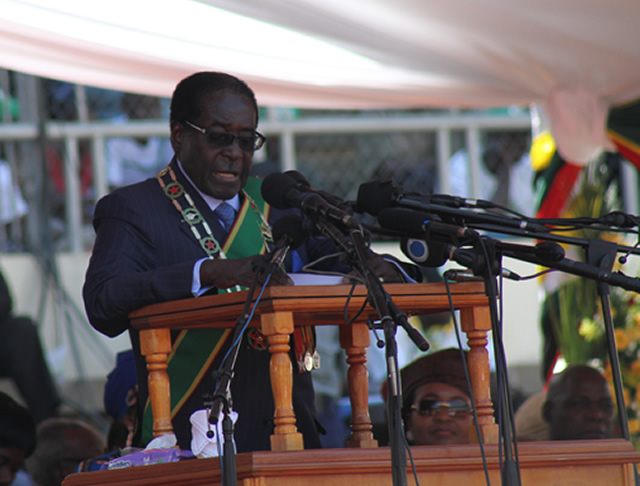
Wenceslaus Murape
In his address during the National Heroes Day commemoration, President Mugabe said salaries and conditions of service for civil servants, who have failed to get meaningful salary increments during the tenure of the inclusive Government, would be reviewed before the end of the year.In welcoming the announcement, Government workers’ unions that constitute the Apex Council — a body that represents civil servants — said they were putting their house in order to enable engagement in proper collective bargaining with their employer.
Outgoing Public Service Minister Lucia Matibenga declined to engage the workers in negotiations arguing the Apex Council was not properly constituted.
There is also need for the new Government to enforce collective bargaining in the private sector where workers have been at the receiving end as they are short-changed by their employers.
Strikes have rocked both the public and the private sector during the tenure of the inclusive Government.
Those who went on collective job action include public prosecutors, doctors, teachers and security guards, among many others. Questions have lately been asked why the new wave of industrial action intensified during the period of the inclusive Government in comparison to the past.
Indications are that companies are not honouring collective bargaining agreements they entered into with the workers, hence protracted disgruntlement.
Labour analysts have questioned the logic behind salary negotiations before previous agreements have been implemented. Employers have also been blamed for failing to disclose full information during the deliberations in contravention of labour laws, with workers pointing out the difference between slavery and employment as ultimately being the payment of agreed wages.
Employers on the other hand argue that the operating model for most companies reflected the excesses of the Zimbabwe dollar era that exhibited low productivity, high operating costs and inefficient manpower structures. They point out that unlike the Zimdollar era where real wages were close to nothing, the dollarised environment has brought about real costs from the wage perspective, and most companies now realise that they have excess labour whose productivity is very low.
Wage expectations are not being met even though corporate revenues have been increasing in general, as the productivity per employee is said to be lagging behind the increases in operation costs.
Zimbabwe’s labour laws have been described by employers as being archaic and tending to protect employees at the expense of the solvency of the companies that employ them. Employees have also been accused of engaging in illegal collective job action in contravention of the Labour Act (Chapter 28:01).
However, the employers are equally guilty of failing to honour CBAs that they would have agreed to in the first place. This brings about two questions: What is collective bargaining? What is collective job action?
Collective bargaining is a topical and hot issue in Zimbabwe since the early days of inflation to date. In the Zimbabwe context, it is synonymous with the term “salary increase” or negotiation for salary increments.
The majority of Zimbabweans cannot distinguish the two or whether such are one and the same thing, or the other is an integral part of the other (such as salary increment and collective bargaining).
Collective bargaining is a process of negotiation between management and union representatives for the purpose of arriving at mutually acceptable wages and working conditions for employees.
The International Labour Organisation Convention 154 defines collective bargaining as all negotiations which take place between an employer, a group of employees’ organisations, and regulating relations between them. The key features of collective bargaining are that its objective is agreement and is unlike mere consultation.
It assumes willingness on each side not only to listen to the other but to abandon fixed positions where possible in order to find common ground.
Collective bargaining requires objectivity as opposed to subjectivity, and also always requires the voice of reason and fair play.
The bargaining process is at most negative and involves a struggle to give and take on most issues. The partnership style of bargaining is more modern, and strives for mutual understanding and common education on the part of both labour and management.
It emphasises on each side being aware of its issues concerning the other side, and also called “interest” based bargaining.
A bargaining agenda mainly comprises of wages, hours of work, grievances procedures, leave days and vacation, union membership and job security — mainly evaluation, promotion and lay-offs.
The agenda also focuses on deductions, occupational safety allowances, among many others that are naturally lengthy and exhaustive.
However, in Zimbabwe, controversy in collective bargaining in recent years has been on the salary issue. The legal framework for collective bargaining is provided by Section 75 of the Labour Act, that provides for the obligation to negotiate in good faith and employers have been found wanting.
Section 76 provides for the duty to fully disclose when financial incapacity is alleged, and again employers have been found wanting.
Collective bargaining in Zimbabwe has faced many challenges because the country has undergone a unique phase in the history of labour due to hyper-inflation.
It has given both employers and workers headaches, while the year 2010 was a year of hangover of economic instability. This year, a number of challenges were encountered in collective bargaining, especially the question of longevity or length of negotiation periods.
Under the hyper-inflation environment, negotiations were done on a quarterly basis. By the end of 2007 it was almost on a weekly basis, a marked departure from the legal previous norm of once a years.
This was caused by an ever-increasing cost of production and retail good hourly or secondly as some consumers alleged those days.
However, when workers and employers moved from the hyper-inflation, they were still tied to the quarterly negotiations in terms of the Zimdollar era.
There is no doubt that parties when negotiating under such a scenario, they are bound to be suspicious of each other in light of future negotiations.
Utility bills (electricity, water, telephone) have been among major cost drivers to companies and also major cost of living drivers. This also applies to companies and, as a result, the parties have always been at each other’s throats in any negotiation.
[email protected].


 Online Reporter