Chronicle Editor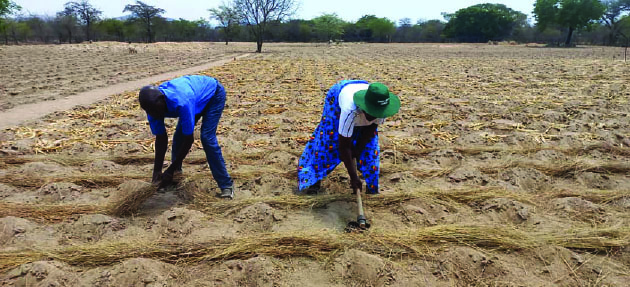
Sukulwenkosi Dube-Matutu, Matabeleland South Bureau Chief
AN elderly couple from Lumene Village in Gwanda District, Mr Dannie Dube and his wife, Sifelani, both in their 70s, have taken the lead as they have prepared over 10 000 holes under the Government-supported Pfumvudza/Intwasa scheme.
The Dubes continue to excel in terms of farming, and last year they hosted a field day at their homestead where they showcased their traditional grains.
The couple is ready to record a bumper harvest in the 2023/24 farming season after completing the herculean task of holing their seven plots.
Gogo Dube said they will put six plots under traditional grains and one plot under maize production.
On Friday, the couple received inputs under the Presidential Input Scheme, and the package comprised 50kg Compound D fertiliser, 50kg Ammonium Nitrate, 2kg sorghum seed, 2kg cow peas, 2kg sunflower, and squash butternut premium seed.
In addition to that, they also got demise 60EC insecticide and a nap sack spray. For the past nine years, Mr Dube and his wife have been producing traditional grains.
Gogo Dube said they are now waiting for the first rains for them to start planting having begun their land preparations in mid-August, and finishing last Thursday. Due to old age, the couple has hired workers but remains hands-on.
“We have prepared seven plots this farming season and we are now waiting for the first rains so that we start planting. I’m glad that we received inputs from the Government on time which means nothing will stop us now,” said Gogo Dube.
“We have always made it a point to plant early and this has helped us to record good harvest each farming season. We have benefited a lot under the Intwasa programme which comes with inputs and free education from extension workers.”
Gogo Dube said they record all their work and progress.
Mr Dube said they adopted Pfumvudza/Intwasa in 2008, and they have managed to record good yields by producing traditional grains despite some seasons characterised by low rains.
“From our personal past experiences, Intwasa has proved to be a game-changer and over the years, we have produced high yields. Someone may opt to do ox-drawn ploughing, but the system of holing traps water and that helps plants to survive with little rain,” he said.
Mr Dube said they have conservation structures in their field which help to preserve water. They have also dug contours in their field to help hold water and record good harvests.
Acting provincial director of Agricultural Rural Development and Advisory Services for Matabeleland South, Mr Mkhunjulelwa Ndlovu urged farmers to replicate the elderly couple’s model.
“We have some farmers who are underutilising their land while others are sticking to maize production. Farmers have to be highly productive,” he said.
A target of over one million hectares of crops under the Pfumvudza/Intwasa programme has been set for the 2023/2024 summer cropping season as the Government moves to ensure optimum production and guarantee food security.
Maize is scheduled to be planted on 400 000 hectares of land, soya bean (6 230 ha), sunflower (100 000 ha), sorghum (250 000 ha), pearl millet (126 577 ha) and cotton (180 000 ha), translating to over one million ha of crops under Pfumvudza/Intwasa the 2023/24 summer season.
Distribution of inputs is underway in all provinces and the programme has been extended to 3,5 million households.
Smallholder farmers are advised to speed up the digging of Pfumvudza/Intwasa holes to boost production.
The Second Republic initiated the Pfumvudza/Intwasa programme a few years ago to counter the effect of low rainfall caused by climate change.
Pfumvudza/Intwasa has helped the country attain food security in the last three seasons, and at the same time boosting farm incomes for small-scale commercial growers.
The programme entails the use of mulch to retain moisture for some time in the event of rain.
The main aim of the Pfumvudza/Intwasa concept is to address problems of low productivity, low production and low profitability in farming, which have, in recent years, been negatively affecting the food security situation in the country.
The concept has also come in handy as a way of mitigating the harsh effects of climate change that have caused severe food shortages in the wake of successive crop failures.
More farmers have joined the Pfumvudza/Intwasa programme this year, and the number of plots has correspondingly increased as farmers seek to make money from selling surplus grain to the GMB. Under the programme, farmers can prepare up to five plots. Depending on the district and the farming region, plots will have either maize or traditional grains, legumes, soya or sunflower.
Pfumvudza/Intwasa training is also progressing well with more farmers undergoing training. –@DubeMatutu


 Online Reporter