Vusumuzi Dube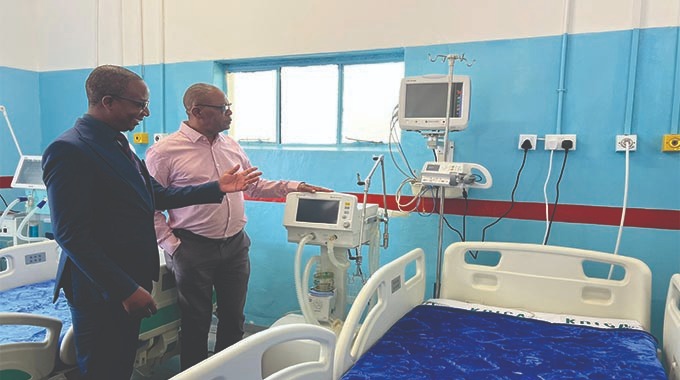
Sukulwenkosi Dube-Matutu, [email protected]
AN Intensive Care Unit (ICU) has been established at the Gwanda Provincial Hospital, a development, which is set to improve health care services at the institution.
The hospital is a major referral facility in the province, but has been operating without an ICU, forcing patients to be referred to Bulawayo for major case management.
In addition to clients from its geographic area, Gwanda Provincial Hospital, which is situated along the Bulawayo-Beitbridge Highway, normally handles patients from serious road traffic accidents, which occur along the highway, resulting in a need for the institution to have facilities to handle severe injuries.
Speaking recently, during a visit to the health facility by Health and Child Care Minister, Dr Douglas Mombeshora, Gwanda District Hospital medical superintendent, Dr Shadreck Gororo, said the ICU facility at present has four beds and is set to be expanded.
The project is a Government initiative and started during the Covid-19 pandemic period, but it came to a halt late.
The hospital administration then completed the project using hospital funds.
“This is our first ICU as an institution and it’s the first of its kind in Matabeleland South. The project is a Government initiative, which started during the Covid-19 pandemic. It was the aim of Government to set up ICUs in every province due to a high demand for the facility during the pandemic,” said Dr Gororo.
“The works stopped at about 85 to 90 percent completion. In 2025, as an institution out of the realisation that we still needed an ICU even after the pandemic, we pursued the project using money that we collected from clients.”
Dr Gororo said previously, clients that need ICU services had to be transferred to United Bulawayo Hospitals and Mpilo Central Hospital. He said this has caused delays in the provision of life-saving services and high costs for transporting patients.
Dr Gororo said the absence of an ICU also limited the scope of surgeries, which specialists could attend to.
“The ICU will greatly improve the standard of health care services that we offer at the institution. It will go a long way in relieving the burden of transfer of patients and ensure immediate provision of life-saving service to clients who need ICU admission,” he said.
Dr Gororo said in addition to the ICU, the hospital has recorded significant development over the years, including a cost recovery pharmacy, which was opened last year. The facility has gone a long way in ensuring the availability of medicine and surgical sundries.
He said at the pharmacy, there is internal production of methylated spirit sanitisers, toilet cleaning detergents, such as liquid soap. This initiative is aimed at reducing procurement costs, lower recurrent expenditure and improving supply reliability.
“We also expanded our laboratory testing capacity in 2025. We managed to expand the scope of investigations that are offered by our laboratory to include: urea and electrolytes, liver function test, lipid profile, uric acid levels, HBA1C, PSA, CRP H Pylori torches panel, thyroid function test and Vit B12 levels D dimers, female reproductive hormones (FSH, LH, Estradiol and Progestrone),” said Dr Gororo.
“Plans are underway to introduce Microbiology Services by March through these initiatives. Our laboratory department has become a source of revenue generation,” he said
Dr Gororo said while the hospital’s administration continues to explore innovative solutions to challenges faced by the health institution, such as shortage of staff – both general nurses and specialists, limited working space, shortage of staff accommodation, dilapidated infrastructure, transport constraints, shortage of medicine and surgical supplies, among others.
“The hospital was formerly a district hospital before its upgrade to provincial status. However, infrastructure development has not matched this upgrade,” he said.
“This has resulted in severe congestion, limited expansion capacity, compromised infection prevention and reduced efficiency of specialist services.
“Infrastructural challenges include but are not limited to ward congestion and infection risks due to limited space, and medical and surgical patients share wards. Tuberculosis patients are admitted to the same spaces as general patients. We don’t have a dedicated isolation capacity,” he said.
Government has committed to expedite construction of a provincial hospital on a 46-hectare piece of land that has been made available in the town.
Under the Second Republic, Government has invested in health infrastructure, human resources and medical supplies a priority, in line with efforts to achieve universal health coverage. Through the National Development Strategy and the Devolution agenda, authorities have been upgrading rural health facilities, improving the availability of medicines and modernising equipment to ensure no community is left behind.
-@DubeMatutu
Ends ckd pn



 Online Reporter