

 Chronicle Editor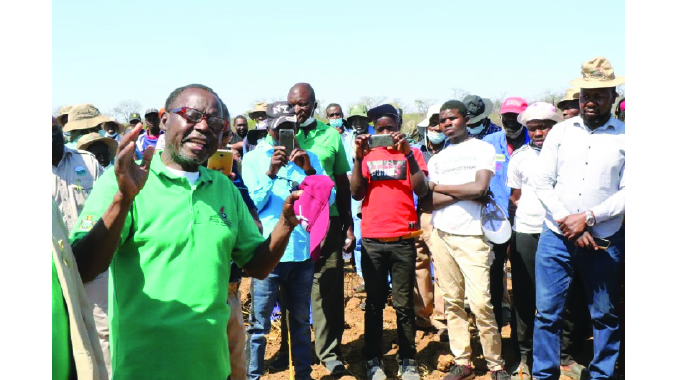
Sikhumbuzo Moyo, Senior Reporter
RADIO and Television legend Mr Haile Velaphi Mlangeni has hailed President Mnangagwa for living true to his philosophy that no one and no place will be left behind in Government capacitation programmes.
Mr Mlangeni was speaking during the Matabeleland North provincial launch of the Umfolo/Makandiwa Soil and Water Conservation blitz by the department of Agricultural Engineering, Mechanisation and Soil Conservation in the Ministry of Lands, Agriculture, Fisheries, Water and Rural Development at his homestead in Ward 16, Umguza district on Friday.
The programme is part of the Agriculture and Food Systems Transformation Strategy that seeks to achieve a US$8,5 billion agriculture economy by 2025. Government realised that for the country to attain Vision 2030, it has to enhance food and nutrition security by increasing productivity.
“When President Mnangagwa said no one will be left behind, some dismissed the statement as mere politicking but here we are, he is walking the talk. We are at my homestead deep down here in Umguza benefiting from this very important Government programme and I want to wholeheartedly say thank you to our first citizen, Umguza is fully behind him,” said Mr Mlangeni.
He said he was confident that the soil and water conservation blitz will not be the last Government project meant to empower farmers in the district and province at large.
“This is a very important programme and as a small-scale farmer, I hope to also contribute towards the national food security by increasing production,” Mr Mlangeni said.
The Government bought 30 tractors with ploughs out of the targeted 60 for the programme and each district will get one tractor, according to the acting director in the Division of Soil Conservation and Post-Harvest Technologies Engineer Herbert Gutu.
The soil conservation and water blitz programme was started after realising that over the years soil conservation was neglected.
“We have seen siltation of our rivers and dams. We have also seen the effects of climate change through either heavy rains in areas previously known as dry lands as well as very low rains in areas with normal or above normal rains which then affects our agricultural output as a nation,” said Eng Gutu.
He urged farmers and communities to work together to conserve soil and water.
“You cannot do any agricultural activity without this critical resource hence we all need to work in unison and stop this serious land degradation,” said Eng Gutu.


 Blessing Chizhande
 Online Reporter