admin
admin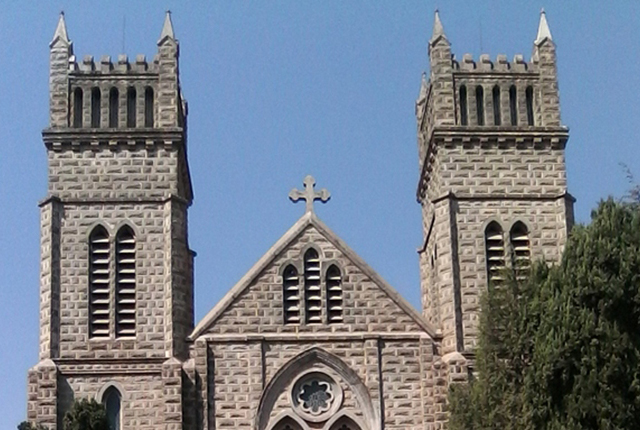
Stanley Mushava : Features Correspondent
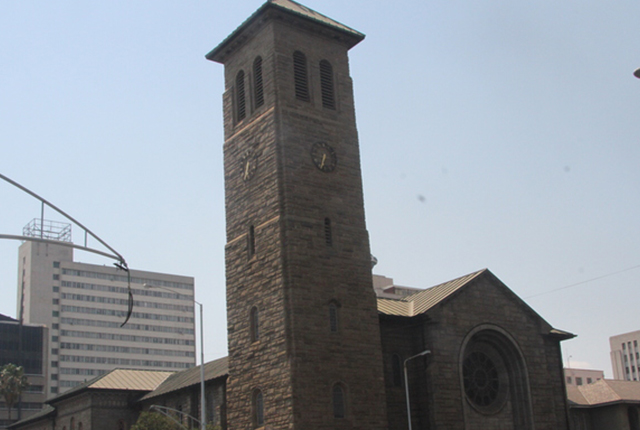
Towering from the heart of the city centre, the Anglican cathedral is a marvel and a crowning achievement in classical architecture. When the nocturnal hive that is Harare goes to sleep on weekends, the toll of tonne-sized bells in rhythmic notation calls the faithful to church where everything about worship is pure art.
From the ulterior, one is immediately struck by the cathedral’s intimate proximity to the Parliament building along Nelson Mandela Avenue, a reminder of Rhodesian incest between church and state.
On weekdays, the cathedral, hewn from granite and precast stone, opens its doors to anyone who hungers for righteousness from 6AM to 6PM to pray and meditate in silence.
But the clock perched on the cathedral, overlooking the city like a patient watchman, is not so much a science of the present as it is an art of the past, having lost the rhythm of local time.
Inside the house of God, the silence is almost audible, tangible even, something rare for a city centre where everything is a restless hustle. The silence is occasionally broken by the Christian events and gospel music concerts.
A giant Bible encased in glass by the entrance flips one page daily, allowing consistent visitors to go through the all scripture in a year.
On this particular visit, the religion segment of Herald Review is blessed with the company of the Very Reverend Farai Mutamiri, dean of the cathedral of the Harare diocese.
A diocese, roughly the religious equivalent of a province, is a region overseen by one bishop. In Anglican’s case, the Harare diocese is a vast lay, covering as far Kariba, Macheke, Muzarabani, Chirundu and Nyamapanda.
“The cathedral is the centre of the diocese because it is the bishop’s church. In fact, cathedral is from the word ‘cathedra’ which means the bishop’s chair,” explains Mutamiri.
The cathedral is home to the local parish of St Mary’s and All Saints but also the mother church of the bishop’s see.
The bishop’s chair, by the main altar, prominently overlooks the church, the foremost seat of clerical authority in the diocese. For years, it was a site of contest as the church underwent a split and subsequently a wrangle for assets.
There are four more altars which are used for smaller services, particularly weekday services, partaking of the eucharist (breaking of bread in the style of the last supper), observance of special days of the Anglican calendar and storage of sacraments (mediums of blessing).
Up the left aisle is St George’s Chapel; St Mary’s Chapel is behind the bishop’s chair; and, to the left of the high altar, St Cecelia’s Chapel and St Bernard Mizeki’s Chapel.
At the Bernard Mizeki chapel, artwork depicts the martyrdom of the patron saint whose work was recently celebrated by the church. Historians are at variance as to whether the martyrdom was purely spiritual or equally political.
History is a rich site of controversy within the cathedral. Plaques to the memory of Rhodesian “heroes” were destroyed by former Bishop Nobert Kunonga in a fit of nationalistic iconoclasm in 2006.
“A section in the cathedral used to display memorabilia from colonial times. This included horses and dogs used by the Rhodesian forces. The former bishop pulled these down on 13 December 2006,” Mutamiri says.
The dean, himself a historian, is of the conservative persuasion that all the original relics should be preserved as is for a consistent representation of history, even from a neutral perspective.
Talking of conservatism, the structure has been maintained as is since its completion in 1978.
“Our renovations are basically repair and maintenance. With supermarkets and others, you have rebranding or overhauls but we are not in the business of marketing. We are more interested in preservation,” Mutamiri explains.
The dean said the local church was responsible for the maintenance of the cathedral as no external funding is available. Charging constant visitors to the cathedral, the dean explained, is out of the question since the church is a not-for-profit entity.
“If people can come here, even from a tourist persuasion, we are happy as they would be coming in contact with the works of God,” the dean said.
In keeping with the Anglican Church’s roots, the walls are full of paintings allusive to the Bible and extra-biblical Christian traditions.
The Rose Window, perched above the entrance, is one such marvel. It contains insignias (logos) to each of the twelve apostles, with Christ’s insignia at the centre.
Christ’s insignia, which intersects an X and a P, is called the “chi-ro.” “This is taken from the first two letters of the word ‘Christ’ in Greek,” the dean explains.
“The paintings on the wall are ‘The Twelve Stations of the Cross.’ Each of these represents a special moment in the passion of Christ. You won’t find some of these, like Veronica wiping Jesus’ face, in the Bible but there are widely accepted traditions,” said the dean.
“Some people mistakenly feel that we worship graven images. These icons are just there to bring the Gospel to life in a different formant. We venerate the meaning they symbolise but we do not worship them,” he said.
Another piece of art the church boasts is an organ, confronting the player with “A Guide to Bach.” To the right, a magnificent set of 2049 pipes accompanies the hymns to holy melodies.
But the organ is of particular concern during the church’s English service which maintains the classical precision of the mother church.
The second service in Shona and English is less classical and at home with indigenous spirituals where rattles, drums and horns are staple fare.
The bell-ringer’s chamber inside the cathedral confronts the visitor with a prohibiting barbed wire fence and lock. The sound in the bell room is enough to kill the ringer, should an amateur mess with about, the dean explains.
“Keeping the bell-ringer locked is of utmost security concern. The biggest bell here weighs a tonne and there are ten bells. The chamber is constructed in such a way that it absorbs and muffles the sound of the bell,” Mudzamiri says.
On Saturdays, ringers come specifically for bell-playing. “It is an art in itself. One can play music from the ten bells,” he says.
Another site of interest is the Garden of Rest, where members of the church are laid to rest. There are more than a thousand spaces for cremated remains, with carefully maintained lawn on the top of some.
Along Simon Mzenda Street stands an equally iconic structure, the Catholic diocese of the Harare diocese. I am received by the administrator, Father Kennedy Muguti, but he keeps me outside as renovations are in progress.
“The cathedral, like all main churches for our dioceses, was designed in the Vatican. It was opened in 1924 and we have since maintained the design,” Fr Muguti said.
The Gothic-type building is evocative of the buildings in the Vatican where renaissance designs have been maintained for centuries. It has been inducted in the National Museums and Monuments’ record of historic sites.
“This is the church that hosted Pope John Paul II (the late pontiff, Karol Jozef Wojtyla) in September 1988. The mass he celebrated here would be the high point but we also hold our ordinary services and weekly masses here,” he said.
As with their “daughter”, Anglican Church, the cathedral also houses the seat of the bishop of Harare, Archbishop Robert Ndlovu and was, for years, the turf of his celebrated late predecessor, Archbishop Patrick Chakaipa.
“The archbishop only comes here for special occasions such as the Christmas vigil, the Easter vigil and conferment of sacraments, particularly the ordination of priests,” Muguti says.
Another classical relic is a peculiar organ which the administrator suspects is the only one of its kind in Southern Africa. Father Emmanuel Ribeiro of the “Muchadura” fame composes some of the music for the players.
However, the instrument has also lost competition to horns, drums and rattles. Since the coming of Vatican II, the church has embraced indigenous cultures as the language of worship, “in so far as they do not contradict the church’s interpretation of the Bible.”
The cathedral also boasts a massive bell but it is no longer in use. “The bell tower was hit by lightning a few years ago. Given its size, we fear that ringing it could endanger the structure,” says Fr Muguti.
The main church, four confessionals, sacristy (where priests vest), altar servers’ room and administrative offices make the cathedral.
The art, in sculptures and paintings, is used for occasions such as the observance of the way of the cross.
Again, originality means all to the mother church. They may change the sheets or lick some sections with fresh paint but the Vatican-commissioned design will not be altered.
The other Catholic dioceses, Hwange, Bulawayo, Masvingo, Gokwe, Gweru, Mutare and Chinhoyi, also boast beautiful structures. The Bishop House is situated a stone’s throw from the cathedral.
Feedback: [email protected]


 Online Reporter