Online Reporter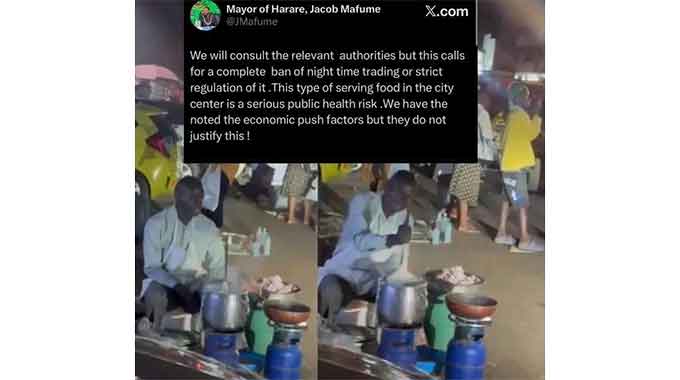
Emmanuel Kafe-Check Point Desk
Harare’s central business district is on the brink — one gas leak away from disaster.
The heart of the capital is increasingly resembling a powder keg as street vendors cook with gas cylinders, turning pavements and alleyways into high-risk kitchens in crowded public spaces.
As night falls, the CBD transforms into a sprawling open-air food court.
The scent of frying chips, roasting meat and steaming sadza drifts through the streets, drawing commuters, taxi drivers and revellers.
But beneath the convenience and affordability lies a growing danger, one that fire safety experts warn could trigger a catastrophic urban disaster.
Across the CBD, from dimly lit alleyways to busy pedestrian corridors, informal vendors are relying heavily on liquefied petroleum gas (LPG) cylinders to prepare meals in densely populated areas.
The practice is most pronounced in the evenings, when demand for cheap, accessible food surges.
A survey conducted by this publication over several nights this week found dozens of vendors operating portable gas stoves perched precariously on wooden tables, plastic crates or directly on pavements.
From Copacabana, Market Square, Charge Office and Fourth Street bus terminus — the Avenues areas and popular beer spots in the capital cylinders are often placed within arm’s reach of customers, with no protective barriers, safety markings or fire extinguishers in sight.
In the Avenues area, a makeshift kitchen at the corner of Livingston Avenue and Seventh Street mainly patronised by construction workers at the nearby site operates an open gas stove where they fry mainly potatoes.
In some cases, these makeshift kitchens operate just metres from Town House, the headquarters of Harare City Council, highlighting what critics describe as a widening gap between regulation and enforcement.
By around 7pm, entire stretches of the CBD morph into informal cooking zones.
Vendors prepare sadza, rice, chips and fried meats as crowds gather tightly around them in narrow spaces with little ventilation.
At one alley near a cluster of beer halls along Second Street, two vendors fried chips side by side while another stirred a pot of sadza less than a metre away, as customers pressed in close.
Nearby were piles of cardboard, plastic packaging and other highly combustible materials.
To fire safety experts, such scenes are deeply alarming.
“If one cylinder explodes in a crowded area, the consequences can be devastating,” said Harare-based fire safety consultant Mr Misheck Nhamburo.
“Gas cylinders contain highly flammable pressurised gas. An explosion could trigger fires, serious injuries or even a chain reaction if other cylinders are nearby.”
While LPG is widely used in homes and formal restaurants, experts stress that it requires strict handling standards including proper storage, ventilation and safety equipment — conditions largely absent in street vending setups.
The risks are compounded by congestion.
Unlike controlled indoor environments, these street kitchens operate in tight, chaotic spaces where people constantly move, bump into equipment or cluster around cooking areas.
A single knock, leak or spark could have immediate and far-reaching consequences.
Beyond fire hazards, public health concerns are also mounting.
Environmental health experts warn that food prepared in such conditions is vulnerable to contamination from dust, vehicle emissions, waste and poor sanitation.
“Food vending is regulated for a reason,” said public health expert Professor Johannes Marisa.
“Cooking should take place in environments where hygiene can be controlled, with access to clean water, proper waste disposal and routine inspections. In these street setups, that is rarely the case.”
Despite these risks, enforcement of municipal by-laws appears inconsistent.
Harare City Council regulations require vendors to operate from designated areas and comply with health and safety standards.
Open-air cooking in busy pedestrian zones without licences or inspection potentially violates several of these rules.
Yet the continued presence of gas-powered cooking stations — even in highly visible areas — suggests limited monitoring, particularly at night.
Formal businesses say the situation has deteriorated in recent months.
“These gas cylinders are everywhere now,” said a shop manager operating along a busy pedestrian route at Market Square bus terminus.
“If something goes wrong, it won’t just affect the vendors. It will affect customers, nearby shops and everyone waiting for buses here.”
For many vendors, night-time cooking remains one of the few viable income streams.
A woman preparing sadza and chicken near Copacabana bus rank said evening demand sustains her business.
“People want something quick and affordable after work or when they are coming from bars,” she said, stirring a pot over a gas burner.
However, city authorities warn about public safety.
Harare Mayor Jacob Mafume said the situation poses serious risks to both lives and infrastructure.
“But people must understand that Harare is not a refugee camp. Harare is the capital city. You cannot bring fire, especially gas canisters, in the middle of the city where people are moving up and down with their cars,” he said.
Mafume warned that any fire outbreak could have far-reaching consequences.
“What will happen is that if a fire breaks out, it will destroy properties and commerce. And if people fall sick, they will come to the city council to say that you have failed to take care of our public health,” he said.
“Those people who fall sick, those people who die, end up suing the city. And the city ends up paying. And the residents at the end of the day are the ones that are paying.”
He stressed that people must not undermine public safety.
“We must earn our living in a manner that does not harm other people’s right to life and health,” Mafume said.
The mayor indicated that authorities are now considering stronger measures.
“We will consult the relevant authorities, but this calls for a complete ban of night-time trading or strict regulation of it. This type of serving food in the city centre is a serious public health risk,” he said.
As Harare’s night-time economy continues to expand, experts warn that without urgent intervention through stricter enforcement, designated safe vending zones and improved safety awareness the city may be inching closer to a preventable disaster.
Because in a crowded street lined with gas cylinders, all it takes is one leak, one spark — and seconds to change everything.