admin
admin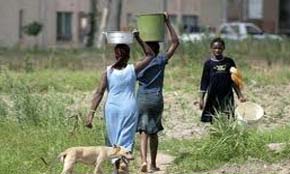
There are growing fears from authorities that the city and surrounding areas might dry soon.
The city claims this is linked to power outages due to the ongoing annual maintenance work at Kariba Power Station.
Since the commencement of the annual maintenance work by Zesa on Wednesday last week, Harare City Council’s water pumping capacity has fallen from the required 1 200 megalitres to 600 megalitres per day.
This has seen most suburbs in the city experiencing acute water shortages.
Hatfield and Mainway Meadows have been without water for between three to seven days while areas such as Greendale and Chitungwiza started experiencing the shortages before the beginning of the maintenance work at Kariba.
Harare City Council spokesperson Mr Leslie Gwindi said water supplies were erratic adding that the crisis was likely to spread to all parts of the city.
Mr Gwindi insisted that the power cuts were the sole reason behind the current problems, while Zesa refuted the allegations.
He said levels at most reservoirs have fallen and if the power cuts continued the whole city would run dry soon.
“We have electrical supply challenges that are affecting operations at Morton Jeffrey Water Works. The problem affects the whole of Harare. As long as there are power cuts, we will have an acute water shortage in all suburbs.
“We are unable to bring up the water levels (in reservoirs) due to these frequent power cuts. It takes time to raise enough water to fill up the reservoirs after a power cut and this has resulted in some areas being deprived of water,” he said.
However, Zesa is on record saying it is not solely responsible for the erratic water supplies experienced in the city in view of reports of burst pipes and leakages around Harare that council is failing to repair.
Mr Gwindi, however, said the council would do everything in its capacity to ensure the restoration of water distribution to affected suburbs.
The country is currently experiencing increased load shedding due to the annual maintenance of generator transformers being carried out by Zesa Holdings at the Kariba Power Station.
Mrs Joyce Kadandara, a Greendale resident, said people in her neighbourhood were going through hard times as they spent hours moving around looking for water.
She said Harare Water should have water tanks as backup to relieve residents.
“People can be seen early in the morning with containers looking for water.
“Authorities at Harare Water must provide us with backup water tanks to aid residents with water and not to just neglect us,” she said.
As the winter season begins, Zesa customers are also bracing up for increased load shedding as the power utility has started rationing power distribution.
The power utility has blamed the irregular load shedding to the current Kariba annual maintenance, which is a statutory requirement.
Zesa spokesperson Mr Fullard Gwasira said power supplies would return to normal after the maintenance programme.
However, consumers including winter wheat farmers preparing for the season expressed doubt that Zesa would be able to offer normal service during the season.
In Harare some residential areas are having power cuts in the morning and evening.
Winter wheat farmers have also indicated that production would be severely affected by the erratic power supplies.
In interviews in Harare yesterday, residents accused Zesa of beginning load shedding without prior notice to the consumers.
“It just started last week ahead of the holidays when we woke up without power and they have actually returned to their old schedule without advising us,” Mrs Janet Jambawu from Warren Park D said.
A Kambuzuma resident, Mr Naboth Zuze, said Zesa should make prior announcements so that customers could make plans ahead of the power cuts.
“You get home from work and there is no electricity. It returns when many people have already gone to bed.
“The next morning power is switched off as early as 5 am and what we do not understand is whether Zesa is really against the people or what?”
The situation has also been the same in such suburbs as Mabelreign, Avondale, Malborough, Greencroft, Glen View, Glen Norah and Highfield.
Customers also hit out at Zesa for charging them high tariffs when they do not deliver.
“They continue issuing estimates and charge us for power which rarely is available. I think this needs intervention at the highest level,” Mr Simon Chimuka said.
Wheat farmers said they would never realise their potential to increase production because of the erratic power supplies.
Zesa has, however, assured farmers of uninterrupted power supplies.
“The farming community clusters require up to 162 megawatts of electricity for successful agricultural activity.
“To support this massive effort, Zesa has procured 165 trucks to ensure that activities on the farms are not hampered by electrical faults.
“A preparedness maintenance programme is already being implemented to ensure that supplies are not adversely affected by unplanned outages,” Mr Gwasira said.
However, wheat farmers said there was constant loading with power being switched off at 5am and was only available late at around 10pm.
“Zesa’s assurance of minimum power disturbances has always been rhetoric and the practical side is the opposite.
“Recently we have had two days without electricity and this affects irrigation of the crops,” he said.
A Glendale farmer said resorting to irrigation using generators was not sustainable, as a farmer would need a drum to run a 100 horsepower engine every eight hours.
Goromonzi wheat farmer Mr Paddington Zhanda said unreliable power supplies have affected production.
“A farmer fails to complete an irrigation cycle per day because of the unavailability of power.
“Even if there is a 100 percent germination, a farmer would never be sure if the crop would reach maturity stage because of the power shortages,” he said.
Another farmer from Mazowe said he experienced 60 percent germination failure because of load shedding last season.
“We have since resorted to reducing our hectarage because you can never plan on promises from Zesa.”
In a recent statement Zesa Holdings said Kariba Power Station was going through its mandatory annual maintenance to ensure continued operational efficiency.
The maintenance started on April 27 and would be complete on Sunday.
“During this period, a total of 250MW will be lost to the national grid. In the meantime, alternative arrangements have been made with other regional utilities to augment supplies, but such supplies may not be availed at peak times.”
Zesa said this would lead to intensified load shedding leading to the authority failing to follow published schedules.
Mr Gwasira said Zesa has already made some contingents measures that would see customers getting better supplies.
“We have started stockpiling coal at all thermal power stations, that is, Hwange, Munyati, Harare and Bulawayo. Zesa has also introduced CFL (fluorescent) bulbs that save energy.”
He said Zesa would introduce a repro-control mechanism in Harare and Bulawayo.
“This mechanism would technically switch off geysers and other high energy consumption devices in homesteads,” he said.
Zesa, Mr Gwasira said, had also imported more power from the DRC to cover for the winter period.
On Kariba, he said, “The current maintenance would ensure that the generators are operating on full capacity so that consumers have enough power.”



 Online Reporter