Online Reporter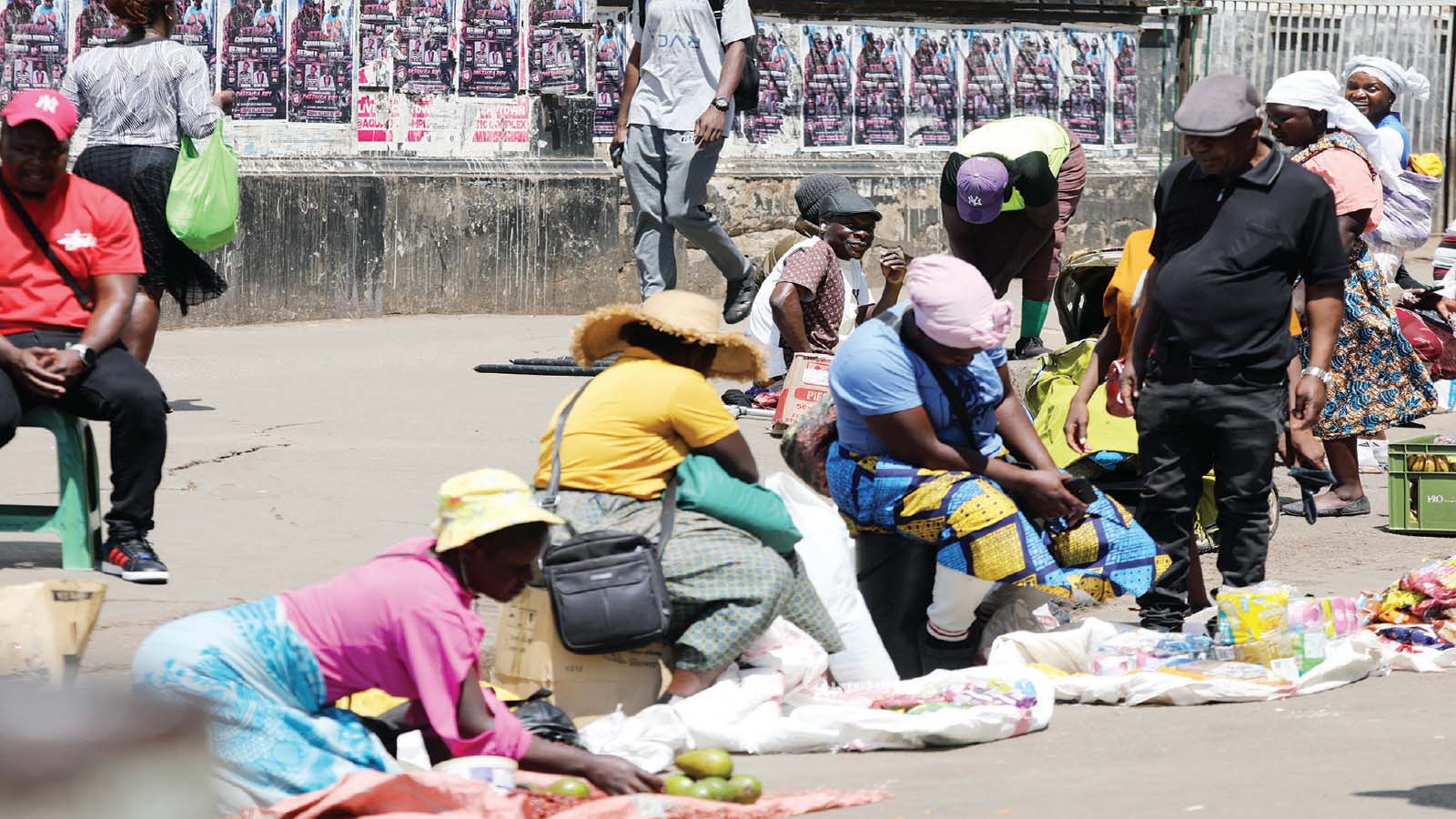
Emmanuel Kafe and Trust Freddy
A municipal police truck has barely disappeared from Harare’s First Street Mall in the central business district (CBD) and the pavement begins to come alive again.
A table appears first, then another.
Crates are dragged back into position, plastic sheets are stretched over makeshift stalls and braziers are lit.
In the blink of an eye, the traders who had been chased away are back, selling vegetables, clothes, cooked food and other goods as if nothing had happened.
The cycle has become almost routine: clear, disperse, confiscate, retreat and return.
For Harare City Council, the battle is about restoring order and enforcing regulations.
However, for thousands of informal traders, it is about taking advantage of the gaps in enforcement to sell their goods.
Beneath the daily confrontation between authorities and vendors lies a more concerning question: why does Harare keep clearing its streets yet fail to keep them clear?
The city has for years tried to move illegal traders from pavements, road verges, intersections and other undesignated spaces into designated markets with little or no success.
Chaos after dark
After 6pm, when many municipal workers have gone home and formal businesses are closing, parts of the Central Business District (CBD) take on a different character.
Open-air kitchens begin serving customers.
Vegetable and fruit vendors continue trading.
Second-hand clothes are spread across pavements while green mealies and meat are roasted over open fires.
The informal economy does not appear to be winding down.
In fact, it gathers momentum.
Under current regulations, informal trading in the CBD is not allowed after 6pm, while traders in high-density suburbs have an additional two hours until 8pm.
Yet the reality on the streets raises questions about how consistently those rules are being enforced.
But what makes the CBD more attractive than designated markets?
For many vendors, the answer is simple economics: access to a wider pool of customers.
Moving a trader to a market where there are few customers may make the operation legal, but it may also make it commercially unsustainable.
That is where Harare’s vending crisis becomes more than a law-enforcement problem.
Numbers that do not add up
Council figures reveal a striking contradiction. Harare’s database reportedly lists 947 licensed traders operating in the CBD.
Outside that group, the council estimates that between 20 000 and 30 000 vendors are operating illegally on pavements, intersections and other undesignated spaces.
While the same council reportedly has capacity for about 17 660 stalls, only 8 545 are occupied. That leaves more than 9 000 stalls vacant, unusable, undeveloped or abandoned. Inside the CBD itself, eight primary market sites reportedly provide 933 stalls, but only 207 are occupied.
A staggering 726 are empty.
Adding to that figure are about 720 stalls at the Seke Road/Dieppe Road intersection that are also empty.
Urban town planning expert Engineer Godfrey Masaka said these figures raise an uncomfortable question.
“If vendors are being removed because they are trading without legal space, why are so many formal trading spaces apparently empty?”
He argues the answer cannot simply be that vendors are refusing to obey.
“The designated markets must themselves be examined. Are they properly serviced? Do they have water, toilets, lighting, shelter and security? Are they accessible by public transport? Are customers willing to travel there? And, crucially, can a vendor make the same income there as on a busy CBD pavement?” queried Masaka.
He notes that until those questions are answered, every enforcement operation risks becoming another temporary clearance rather than a permanent solution.
Authorities speak
Local Government and Public Works Minister Daniel Garwe says the removal of illegal vendors from city centres will continue indefinitely as Government intensifies efforts to restore order and improve service delivery in urban areas.
He emphasised that the ongoing clean-up programme was not intended to prevent people from earning a living, but to ensure informal trading is conducted legally, safely and in an orderly manner.
“Our cities and towns must be places where people can work, conduct business, move safely and live in clean, orderly environments. The clean-up programme is not a once-off exercise, but an ongoing initiative focused on restoration, enforcement, rehabilitation and improved service delivery,” he said.
The Government is also working on gazetting amended Hawkers and Vendors By-Laws, which will introduce updated licensing and control measures, including regulations covering third-party-owned vending and trading sites.
Harare Mayor Jacob Mafume says the city cannot allow vendors to continue operating wherever they choose.
Vendors operating in the CBD, he said, should move to designated trading areas, while municipal police are being deployed to prevent cleared areas from being re-occupied.
He said the vending problem could not be viewed in isolation, arguing that uncontrolled trading, blocked roads and a lack of adequate toilet facilities were contributing to wider sanitation and public order challenges.
“Not that all vendors are causing that, but if you are all over and there are no toilet facilities, you are blocking the roads, the whole set-up then becomes untenable,” he said.
It is believed that the proposed legal changes would form part of a broader transformation of Harare as authorities seek to establish a smart city.
“We cannot put lipstick on a frog and call it beautiful. We need to change the whole aspect of the city. We are trying to make this city attain its smart city status, not only smart in terms of its presentability, even its people,” he said.
The ongoing Operation Chenesa Harare is targeting illegal vending and the occupation of undesignated public spaces.
The economics of returning
For vendors, the pavement is not necessarily attractive because it is illegal. It is attractive because it is where people are.
A trader selling vegetables at a busy intersection can access several potential customers passing through the area.
But a trader moved several kilometres away may have a legally compliant stall yet fewer customers.
This becomes a challenge as business returns often fail to meet licensing requirements.
Pundits argue this is why the enforcement cycle keeps repeating itself.
Council removes the physical structures, but it does not remove the convenience and viability of the illegal stalls and the need for thousands of people to earn an income.
Vendors argue they are willing to comply with regulations if authorities provide trading spaces that are accessible, affordable and capable of attracting customers.
“This is where the customers are. I sell clothes and people who come into town easily notice us and buy. Customers rarely visit designated markets because they are not easily accessible. Besides, the requirements are just too much for us,” said Tonderai Mbirike, who operates along Robert Mugabe Road.
His colleague weighed in.
“We are not coming back because we want to fight council. We are coming back because we need to eat. I sell cooked food here because it is on demand by workers and commuters,” said a Copacabana-based vendor, Nomsa, who sells cooked food.
Gladys, a vegetable vendor, said she tried the Coca-Cola market but it was not viable.
“When they chased us from Park Street, I went to the Coca Cola market, but there were few customers there. In town, we get high volumes of people since people come for work, shopping among other errands.”
Corruption
A closely knit syndicate of some municipal police officers is allegedly conniving with some vendors, who are then given permission to continue operating illegally in the CBD in exchange for a protection fee.
This explains another apparent contradiction: why some traders are repeatedly removed while others appear able to operate with relative impunity.
The Government has proposed a four-pillar approach — legislate, provide, formalise and enforce — in an attempt to move away from an endless cycle of raids.
The plans include servicing 100 identified vending sites with water, sanitation, lighting, shelter and storage, developing a modern satellite market on the CBD periphery and rolling out a 60-day one-stop formalisation drive. Part of the process involves the relocation of vendors to official sites.
The Government also intends to establish a Harare Vendors Council for co-management and to strengthen the CBD Urban Management Command under the principle of “Clear, Clean, Keep”.
Processing of the Municipal Police and Courts Bill is being expedited to enable the Harare municipal police to enforce relevant by-laws and to operationalise municipal courts, ensuring the expeditious prosecution of municipal offences through simplified procedures.
Engineer Masaka said the test, however, will not be the number of directives issued.
“It will be whether the alternatives actually work. If a trader can earn twice as much in the CBD as at a designated market, enforcement alone is unlikely to produce lasting compliance,” he said.
Lessons from Africa
Harare is not the first African city to struggle with informal trading.
Cities including Johannesburg, Cape Town, Kampala, Nairobi, Dar es Salaam, Accra, Kigali, and Lusaka have all grappled with questions surrounding street vending, public space, licensing and enforcement.
Their experiences show that simply chasing traders from streets does not necessarily eliminate informal trading.
The challenge is finding a workable balance between public order and livelihoods.
For Harare, that means creating markets that traders actually want to use, making permits accessible, improving infrastructure, addressing corruption and ensuring that enforcement is predictable and fair.
It also means recognising the commercial reality of the informal economy.
Another urban planning expert and former lecturer, Dr Andrew Bedza, said the vending crisis cannot be solved by municipal police alone, nor can it be solved by vendors simply ignoring regulations.
“The city needs to answer why thousands of traders remain outside the formal system while thousands of legal stalls remain unused. It needs to establish whether the vacant stalls are genuinely available, whether they are commercially viable and what prevents traders from occupying them. And where corruption exists, it must be confronted,” he said.
Until then, he reckons, Harare will remain trapped in the same cycle.
The authorities will arrive, the vendors will scatter, the pavements will briefly become empty — then, as the enforcement vehicles disappear, tables, crates, braziers and plastic sheets will return.
And Harare’s informal economy will begin again.