Online Reporter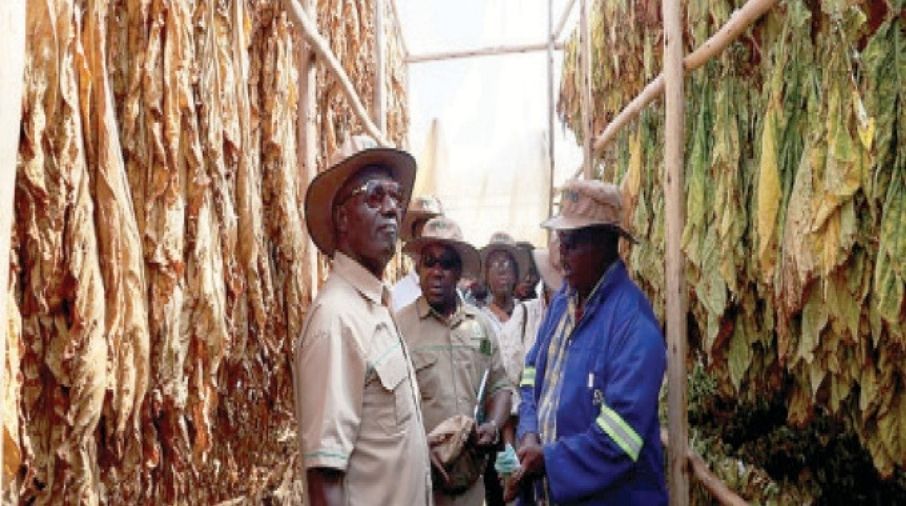
Theseus Shambare
UNDER the harsh Matabeleland South sun, rows of golden tobacco leaves hang quietly inside large transparent barns, their lemon-yellow colour glowing through sheets of UV-protected plastic as temperatures rise with the heat of the day.
Outside, the landscape still reflects a region long known for cattle ranching, drought and dry, dusty plains. But inside these unusual structures — known as marula barns — farmers in Mangwe District are trying something many once thought impossible: growing and curing tobacco in one of Zimbabwe’s driest areas.
For first-time grower Mr Reed Sola of Woolendale Farm Plot 32, the move into tobacco farming has been a mix of hope, uncertainty and learning through experience.
“This is the first time we are doing this crop and we are learning every day,” he said while checking leaves hanging on wooden racks inside the barn.
Mr Sola expects to produce 30 bales from his first crop cured using the marula barn system, an innovation now attracting interest in Matabeleland as farmers look for ways to deal with changing climate conditions. Although the process requires careful management, farmers say the marula system is cheaper and more environmentally friendly than the traditional flue-curing method widely used in Mashonaland.
After harvesting, the leaves are sorted by quality before being carefully hung inside the barns. Once cured, they are graded again, tied into “hands” and later pressed into bales for sale.
In Mashonaland, tobacco is usually cured in brick barns heated by firewood or coal. This process uses large amounts of energy and requires workers to constantly monitor temperatures and feed fuel into the system day and night. The marula barn works differently. Covered with UV-protected plastic, it traps solar heat during the day, creating natural curing conditions without using firewood or coal.
Farmers control temperature and moisture by opening and closing ventilation points instead of managing fires. This reduces both labour and production costs.
“There is no need for somebody to spend the whole night feeding firewood into a furnace,” one farmer explained during the curing process.
Instead, workers spend most of their time monitoring airflow and moisture inside the barns. The system is also attracting attention for its environmental benefits at a time when concerns over deforestation linked to tobacco curing continue to grow.
According to the Forestry Commission of Zimbabwe, the country loses about 262 000 hectares of forest each year, with tobacco curing being one of the major causes. Officials estimate that tobacco production contributes between 15 and 20 percent of this loss due to heavy reliance on firewood.
Research has also shown the scale of the problem. A 2014 study found that traditional curing methods can use up to 14 kilogrammes of firewood to cure one kilogramme of tobacco. During the 2019/20 season, when Zimbabwe produced nearly 260 million kilogrammes of tobacco, more than two million tonnes of wood were used in curing.
As a result, the marula barn, which uses solar heat, is being seen as a more sustainable option, especially in semi-arid areas like Matabeleland South where environmental pressure is already high.
However, the system also has challenges. Too much moisture can cause mould, while poor ventilation can affect leaf quality. Overcrowding leaves can trap humidity and slow down the curing process. For farmers in Mangwe, managing airflow has become one of the biggest lessons of the season.
Commercial farmer Mr Gary Rosenvale, one of the pioneers of tobacco growing in the Marula area, said the crop is not entirely new to the region.
“Tobacco was grown in this area around 1961 to 1964 by my parents. I don’t know if you are familiar with Turkish tobacco but it has got a much smaller leaf. They did very well out of it and then Unilateral Declaration of Independence (UDI) came and export of the tobacco was discontinued,” he said.
For many years afterwards, tobacco production remained concentrated in high rainfall areas in Mashonaland, while Matabeleland focused on cattle and drought-resistant crops.
But changes in weather patterns are beginning to shift those traditions. Studies have shown that climate change is affecting where certain crops can be grown, with some areas receiving more rainfall than usual.
In Matabeleland South, where rainfall normally averages between 450 and 500 millimetres a year, recent seasons have recorded much higher figures.
“This season has been exceptional. We have had nearly 900 millimetres of rain, which is unusual for us in Matabeleland,” said Mr Rosenvale.
While this created opportunities for tobacco farming, it also brought new challenges.
“What caught me by surprise was how fast the crop ripened because of the wet conditions,” he said.
Mr Rosenvale said the learning process has been difficult. He planted seedbeds on June 15 but found that cold winter nights slowed growth.
“The seedlings took much longer to grow because our night temperatures are colder than Mashonaland. We only planted out in the first week of October because of the cold soil temperatures.”
Farmers then had to learn how to cure the crop using the new system. Inside the barns, temperatures varied.
“The top of the barns reached temperatures of around 65 degrees Celsius, almost like a conventional barn. The middle tier was getting around 56 or 57 degrees, but the bottom tier was only reaching about 40 degrees,” said Mr Rosenvale.
This uneven heat created problems. During cold and rainy periods, the barns did not produce enough warmth, and some leaves turned a darker colour instead of the bright lemon colour preferred on the market.
Moisture also became a major issue.
“When we first started, we created almost a rainforest environment inside the barns,” Mr Rosenvale said laughing.
“When the wind blew, all the moisture that had condensed on the roof would fall back into the tobacco and create mould.”
Farmers later realised they had packed the leaves too closely, preventing proper airflow.
“We realised we had to spread the leaves further apart to improve airflow. It is all about opening and closing the vents properly to control moisture and heat.”
Despite these challenges, there have been positive results.
“We were getting very nice lemon-coloured tobacco from the top tiers,” said Mr Rosenvale.
Even with some losses, production levels have reached around 2.5 tonnes per hectare.
“Those are the school fees you have to pay,” he said.
The phrase reflects the reality of farmers adapting to new conditions. For years, cattle have been the main source of wealth in Matabeleland, but drought, disease and shrinking grazing land have reduced herd sizes.
“A lot of the cattle numbers in communal areas are no longer what they used to be. There have been diseases that affected cattle numbers considerably,” Mr Rosenvale said.
The Tobacco Industry and Marketing Board (TIMB) said the move towards natural curing is being encouraged as a cheaper and more sustainable option.
TIMB chief executive Mr Emmanuel Matsvaire said the system removes the need for firewood and coal, cutting costs and reducing environmental damage.
“For half a hectare, the average production cost is around US$471, while a hectare costs about US$1 100,” he said.
Small-scale farmers are currently producing about 1 600 kilogrammes per hectare, while commercial farmers are reaching nearly 3 000 kilogrammes.
TIMB said around 390 farmers are already growing tobacco in the region, with plans to expand to nearly 1 000 hectares by 2027.
As a result, more farmers are now diversifying their income sources.
“If we could even get to producing 50 million kilogrammes in Matabeleland, what that would do for Bulawayo’s economy would be huge. For small-scale farmers, this could become a very important alternative source of income,” he said.
Across Africa, experts warn that agriculture is becoming more vulnerable to climate change. However, they also say innovation can help farmers adapt.
In Mangwe, that adaptation is already taking shape through marula barns and new farming methods.
Still, challenges remain.
“My only hope is that we don’t have severe droughts that discourage people from growing tobacco,” Mr Rosenvale said. “So far, we have had two good rainfall seasons, but nobody knows what the future holds.”
Even so, there is growing optimism.
“I am planning for 30-hectare irrigated crop and 10-hectare dryland this year,” he said.
Inside the barns, workers continue adjusting vents as sunlight filters through the plastic. Slowly, the leaves change colour, moving closer to market readiness.
For Mr Sola and other first-time farmers, this is about more than tobacco. It is about new opportunities.
It is the possibility that Matabeleland can move beyond cattle and drought. It is the hope that innovation can bring growth instead of decline.
And in a region once seen as too dry for such a crop, farmers are learning — step by step — how to turn the harsh land into something of value.