Rumbidzayi Zinyuke
Health Buzz
MANY years ago, I once shared a room with a friend during one of our work field visits.
When we woke up the following morning, she suddenly began making strange sounds, repeatedly clearing her nose and throat as though she was struggling to breathe properly.
Alarmed, I rushed to check what was wrong, expecting that something serious had happened. Instead, she burst out laughing and told me there was nothing to worry about. This was a familiar morning routine for her, brought on by the irritation she experienced whenever she was exposed to dust, pollen and other allergens.
What I had mistaken for a sudden health emergency was, for her, simply another morning of living with as hay fever.
Hay fever, medically known as allergic rhinitis, is one of those conditions that can easily be dismissed as nothing more than a runny nose or an inconvenient bout of sneezing. Yet for millions of people around the world, it can be a recurring problem that interferes with sleep, concentration, school, work and general quality of life.
Estimates vary because studies use different definitions and diagnostic methods, but a 2025 review estimates that between 400 million and 500 million people worldwide experience allergic rhinitis. Another major international review found that the prevalence of allergic rhinitis varies widely between populations, with worldwide estimates ranging roughly from five percent to 50 percent.
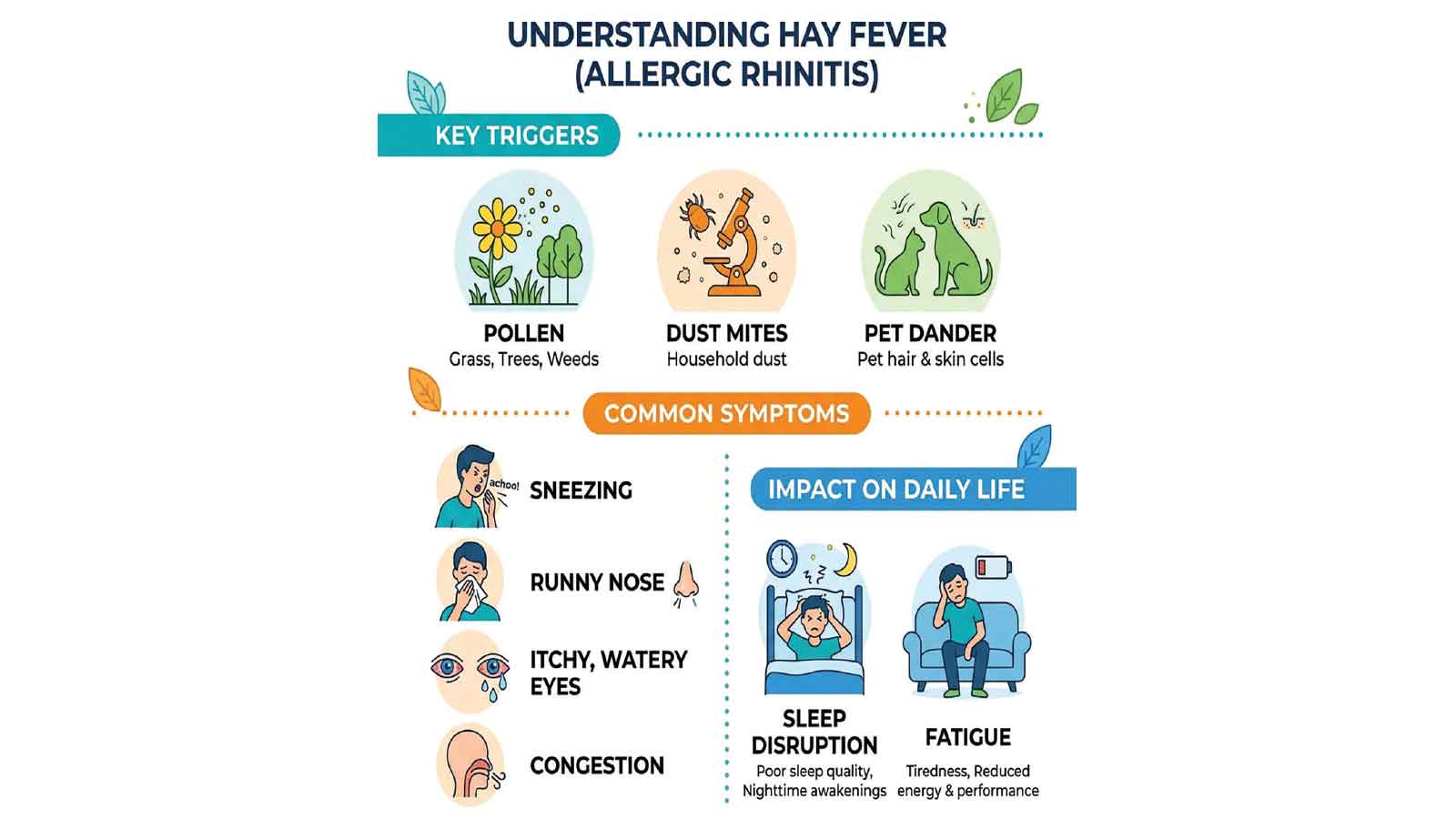
The condition occurs when the immune system reacts to substances that are normally harmless. These can include pollen from grasses, trees and weeds, house dust mites, mould, animal dander and other airborne allergens.
For someone with hay fever, exposure to a trigger can cause the lining of the nose to become inflamed. The result can be repeated sneezing, a blocked or runny nose, itching of the nose, throat or eyes, watery eyes, coughing and a feeling of mucus at the back of the throat.
And that is where the condition can become particularly frustrating.
A person may wake up congested, spend the morning sneezing and then battle itchy or watery eyes throughout the day. At night, a blocked nose may make it difficult to sleep properly. Poor sleep can then translate into tiredness, difficulty concentrating and reduced performance at school or work.
Research has increasingly recognised allergic rhinitis as more than a minor inconvenience as the condition is associated with fatigue, sleep disturbance and impaired concentration.
Zimbabwe is not spared
While Zimbabwe may not have an up-to-date prevalence figure for hay fever, available local research suggests that allergic conditions are far from uncommon.
A study conducted among 496 people in rural Gwanda found that 26,53 percent reported symptoms suggestive of hay fever. The same study found that 31,17 percent of participants who underwent skin-prick testing had evidence of atopic sensitisation, meaning their immune systems showed sensitivity to one or more allergens.
Importantly, this does not mean that 26.53 percent of Zimbabwe’s population has hay fever. The Gwanda research involved a specific rural population and relied on self-reported symptoms for the hay-fever figure. It nevertheless provides an important indication that allergic respiratory symptoms deserve greater attention locally.
Local research has also identified environmental allergens that can contribute to allergic disease.
A study of aero-allergen sensitisation among Zimbabwean children found allergic rhinitis in 15.6 percent of the children assessed, with house-dust mites and Bermuda grass among the common allergens identified.
These findings are particularly relevant as Zimbabwe moves through different seasons, with changes in vegetation, pollen, dust and other environmental exposures potentially affecting people who are sensitive to them.
Why does pollen cause such a reaction?
Pollen is a fine powder released by plants as part of reproduction.
For most people, breathing in pollen does not cause a problem.
But in people with allergic rhinitis, the immune system mistakenly identifies certain proteins in the pollen as a threat. This triggers the release of chemicals involved in the allergic response, producing inflammation in the nose and surrounding tissues.
This explains why one person can walk through a grassy area without noticing anything while another starts sneezing repeatedly within minutes.
Hay fever is also not necessarily restricted to pollen. Some people experience symptoms throughout the year because their triggers include house-dust mites, mould or animal allergens.
The word “hay fever” can therefore be misleading because the condition does not necessarily involve hay, nor does it cause a fever. In fact, a genuine fever is more suggestive of an infection than straightforward allergic rhinitis.
Climate and changing environments
There is growing interest in the relationship between environmental change and allergic disease.
Longer pollen seasons and changes in the distribution and amount of pollen can affect people who are sensitive to these allergens.
Globally, allergic rhinitis has become increasingly recognised in developing countries. The World Health Organisation has previously noted that prevalence has been increasing in developing countries, while large international studies have reported substantial differences between regions.
For Zimbabwe, this makes understanding local environmental allergens important. More research is needed to establish which allergens affect different communities, how seasonal patterns influence symptoms and whether changing environmental conditions are altering the burden of allergic disease.
Not every blocked nose is hay fever
One of the biggest challenges is distinguishing allergic rhinitis from other causes of nasal symptoms.
A cold, for example, can also cause a runny or blocked nose, but it is usually caused by an infection and tends to resolve after a relatively short period. Allergic rhinitis can recur whenever a person encounters a particular trigger.
People should also avoid assuming that every episode of sneezing requires medical treatment for hay fever. Persistent, severe or unexplained symptoms warrant assessment by a healthcare professional, particularly when they interfere with sleep, school, work or normal activities.
Allergic rhinitis can also occur alongside asthma and other allergic conditions.
Hence awareness can make a difference.
Perhaps the most important message about hay fever is that people do not simply have to accept persistent symptoms as part of their daily lives.
Recognising a pattern is an important first step. If symptoms repeatedly appear after exposure to dust, grass, pollen or another suspected trigger, that information can help a healthcare professional determine whether allergy is involved.
Reducing exposure to known triggers may also help, while appropriate treatment can be recommended by a medical professional depending on the individual’s symptoms and circumstances.
For parents and teachers, recognising allergic rhinitis in children is equally important. A child who is constantly rubbing their nose, sneezing, struggling with nasal congestion or complaining of itchy, watery eyes may not simply be “catching colds” all the time.
Hay fever may not attract the same attention as many other health conditions, but its widespread nature means that its impact should not be underestimated.
My friend’s strange morning sounds turned out not to be a crisis, but they were a reminder that symptoms which appear ordinary to one person can represent a persistent health challenge for another.
Sometimes, understanding the reason behind the sneeze, the blocked nose or the constantly irritated throat is the first step towards helping someone breathe and live more comfortably.
Feedback: [email protected]