Online Reporter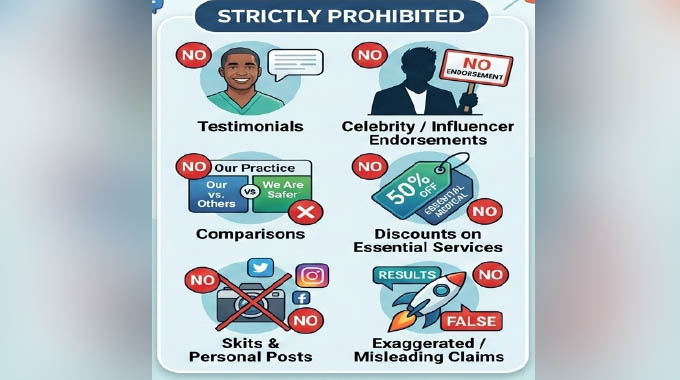
Robin Muchetu, [email protected]
A DRAFT Statutory Instrument of the Health Professions Advertising Regulations 2026 has been issued, with members expected to adhere to a strict list of permissible conditions, which also prohibit endorsement by celebrities or influencers.
Previously, regulations were restrictive regarding the advertising of services by medical and dental practitioners, as it was deemed unethical.
However, regulators have now opened up the advertising space with the consultative process having ended in Bulawayo last week. The meeting was to explain the rationale and key provisions of the draft, receive stakeholder feedback and strengthen regulatory clarity before finalisation, which will chart the best way forward for health services in the country.
There have been concerns over the unavailability, publicly, of information regarding specialists in Zimbabwe, as they have not been allowed to advertise their services, leading to some patients going as far as India to seek health services while the specialists are available locally. Mr Tonderayi Kadzere, director of policy planning and health economics in the Ministry of Health and Child Care, said the consultations were meant to preserve the integrity of the professions and inform the public to ensure ethical promotion of health services.
Highlighting some of the key issues included in the draft, he said a lot of misleading claims have been circulated around social media, which is a cause for concern.
“We have the issue of digital and social media platforms; we felt that we cannot be here today and ignore what we are seeing, so we want as professionals to regulate this too,” he said.
“We don’t want false or misleading claims in the advertisements or exaggerated results and claims. We need to guard against this.
“There is the issue of manipulated images that create a false impression on people about the services offered,” said Mr Kadzere.
He emphasised that practitioners need to obtain express consent before posting on social media and also maintain professional boundaries on these platforms.
“No skits on our health care services. This is the thinking we have: professional boundaries have to be kept. Individual cases must also not be discussed publicly,” added Mr Kadzere.
To maintain practitioner-patient boundaries, he said practitioners shall establish a professional page where they post information about their practice and general health information and when participating on a social networking site that may include patients in their practice, avoid communicating personal or private information.
When advertising their services, professionals are mandated to ensure the information they publish is factual and can be checked, and does not exploit patients’ vulnerability or lack of medical knowledge.
Mr Kadzere said they were further placing an obligation on hospitals, clinics, or individual practices to keep organisational accountability of what they are advertising. Informed consent was also highlighted and that whatever image will be used before or after procedures must be authorised to be used.
The draft regulations are also proposing that any advert must contain services offered by the individuals or institution, contact details, office hours, registration status and qualifications of the professional.
Another proposal states that adverts must highlight payment methods accepted, medical aid societies that are accepted at the practice and safety concerns for invasive procedures.
Regarding radio and television adverts, the proposal is to have a 30-second commercial limit.
“The advert must have basic factual information only and we are saying no to celebrity endorsements or influencers.
Regarding the internet and website, there shall be no third-party product promotion, your service cannot be advertised by anyone, nor can you advertise another practitioner’s service,” he said.
“Provided the use of recognised celebrity personalities should not be used to endorse the service offered, but longer informational commercials are permitted as long as personal promotion is limited to the above criteria and the rest is educational information of a public service nature subject to clearance by Council,” read the regulations.
However, the regulations state that nothing shall prohibit a practitioner from participating in promotions of more than 30 seconds when dealing with matters of a purely academic nature, public health, hospital or clinic administration and other similar matters of public importance.
A practitioner may flight adverts on billboards approved by the council, provided that the size of the billboard shall be approved by the council for a prescribed fee and the information shall be legible.
Vehicles used in carrying out the business of the practice or institution may be branded, limiting the content to the name of the practice or practitioner or institution logo mark and contact details.
“Provided the branding shall be limited to both the left and right front vehicle doors and no practitioner shall brand ambulances,” reads the draft.
The amendment also speaks to professionals having to declare a conflict of interest as they advertise. According to the draft regulations, no Practitioner shall:-
“(a) Use testimonials or ostensible testimonials
(b) make direct or suggested comparisons to their practices and those of others.
(c) claim that the services they provide are better or safe or safer than others.
(d) take advantage of their superior knowledge to unduly influence consumers to access their services through scare tactics or putting pressure on the members of the public, patients, an audience or vulnerable groups.
(e) claim to offer exclusive services or unique “magical” cures.
(f) offer discounts or specials on the essential medical services they offer”.
A practitioner shall have a maximum of four directional signs per institution that must be first approved by the Council.
“The size of a sign of an individual health institution shall be a maximum of 1.5m x 1m and the size of a sign for a hospital shall be 2m x 2m and shall contain operating hours, standard cross sign denoting a hospital, signs denoting ambulance entrance and parking areas or hospital or practice entrance,” reads the regulations.
Medical practitioners who attended the consultation in Bulawayo acknowledged that they need to be accountable, also raising pertinent questions about the draft.
Dr Henry Kuzanga from Bulawayo questioned the use of testimonials by satisfied clients.
“How do we regulate testimonials from clients? They are all over the show, patients come and post about their experiences and refer others, it is already an advertisement and you cannot regulate an individual who posts on their social media,” he said.