Trust Freddy
Herald Correspondent
IT is a sight that would make any sugar consumer think twice before picking up a packet from the shop shelf.
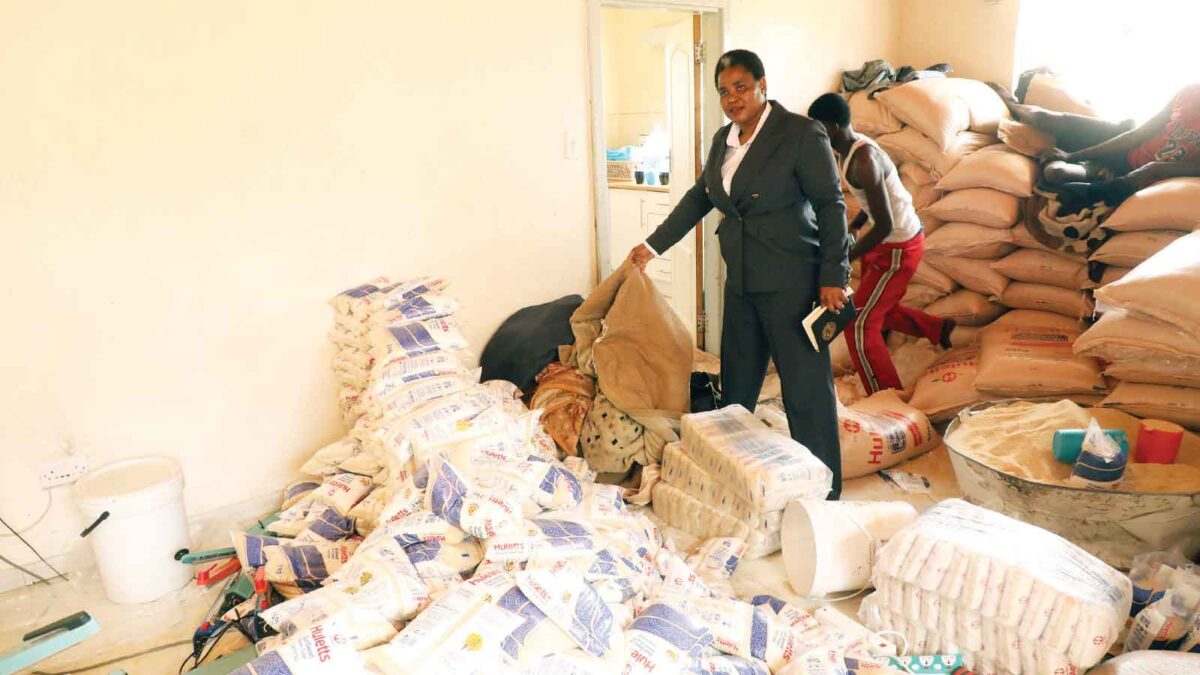
When Zimbabwe Anti-Corruption Commission (ZACC) officers raided a rented apartment in Waterfalls suburb in Harare on Wednesday, they found about 10 tonnes of sugar, but it was not the mountain of 50kg bags stacked against the wall that shocked them.
It was the sight of a young man seated on a dirty blanket, his bare feet submerged in a large plastic washing basin filled with sugar.
He appeared completely at ease, as though relaxing in his living room, oblivious to the health risks posed by the unhygienic operation around him.
The sugar was not for personal consumption. It was being scooped, repackaged and sealed into packets branded Tongaat Hulett, each labelled as containing 2kg, before being supplied to tuckshops in Waterfalls, Mbare and surrounding areas.
Inside the apartment, 12 young men had established what amounted to a counterfeit sugar packaging factory.
The floor was littered with dirty blankets and mud-caked shoes, some placed directly on open sugar bags. The plastic containers used for repackaging, similar to ordinary washing basins, were blackened with dirt.
There was no weighing scale. The suspects were estimating quantities by eye, with some allegedly using their feet to aid packaging of the sugar.
ZACC spokesperson Ms Simiso Mlevu said the operation raised serious public health concerns beyond the violation of trademark laws.
“The Commission executed a targeted raid on this house in Waterfalls where we arrested 12 suspects who have been repackaging Tongaat Hulett sugar into 2kg plastic packages,” she said.
“The sugar is between 1,7kg and 1,8kg. They do not have a scale in place, so they are just estimating.
“When ZACC raided this place, some of the suspects had their feet deeply in these containers. So, the feet could be sweating and you do not even know what infections people have.
“We do not know what other contaminants are found in this sugar. If you notice the area around, you will see blankets which are very dirty, shoes which are very dirty, even the containers which are being used to package are very dirty. We are looking at the impact of corruption on the health of citizens.”
The syndicate had reportedly been operating for two months, initially from Mbare before relocating to Waterfalls two weeks ago.
One of the suspects, Peter Kaitano, gave an account of the operation.
“We have been operating in Mbare and this is our second month. However, here in Waterfalls we have only been operating for two weeks since we started renting this apartment.
“On a daily basis, we have been supplying 30 to 40 cases per day to local tuckshops and selling each case at US$23.”
The figures point to a lucrative operation built on short-changing consumers.
Each case contained 10 packets labelled as 2kg, meaning buyers were being offered what appeared to be 20kg of sugar.
However, each packet reportedly weighed between 1,7kg and 1,8kg, a shortfall of 200g to 300g per packet.
At US$23 per case, supplying 30 cases a day would generate US$690, while 40 cases would bring in US$920.
That translates to weekly sales of between US$4 830 and US$6 440, or monthly revenue of between US$20 700 and US$27 600, assuming the operation maintained the reported daily volumes.
The 10 tonnes recovered at the apartment also point to the scale of the operation. At an estimated 1,8kg per packet, the consignment would yield about 5 555 packets, equivalent to roughly 555 cases.
At US$23 per case, the stock could have fetched approximately US$12 765.
But the financial losses to consumers were only part of the problem. The conditions in which the sugar was being handled raised more serious questions about the safety of products reaching household kitchens.
“Other than robbing unsuspecting citizens of their hard-earned cash by selling them underweight sugar, there are also health concerns,” Ms Mlevu said.
ZACC is now following leads to establish the source of the sugar and identify other people allegedly involved in the wider distribution network.
“We are not in a position to reveal the information that is being shared with us because it might jeopardise the ongoing investigation, but we have been given useful information which will lead us to the wider syndicate repackaging Tongaat Hulett sugar in Zimbabwe,” she said.
The 12 suspects are facing charges of violating the Trade Marks Act.
The Waterfalls operation, however, is part of a broader challenge confronting consumer protection authorities, with counterfeit and substandard products increasingly targeting established brands.
Figures presented by the Consumer Protection Commission (CPC) show that 12 105 inspections were conducted countrywide since January, resulting in 1 615 non-compliant businesses being issued with prosecution notices.
The sale of expired goods accounted for the highest number of violations, with 572 cases recorded.
Other offences included improper labelling, misleading representations and failure to display prices.
CPC board chairperson Commissioner Respina Zinyanduko said recent seizures demonstrated that counterfeiters were targeting a range of established brands.
“Recent seizures of counterfeit Hulett sugar and Eversharp pens, as well as fake Nivea and Shield Sheen products, show that even well-known brands are being targeted by counterfeiters,” she said.
Industry and Commerce Minister Mangaliso Ndlovu said Government was moving to strengthen regulation of the manufacturing sector to curb the production and circulation of counterfeit and substandard goods.
Speaking at the 2027 Pre-Budget Seminar on Thursday, he said gaps in the existing regulatory framework had allowed some manufacturers to operate without adequate oversight, resulting in unsafe products, including counterfeit vehicle fluids and illicit beverages.
He said Government was considering strengthening the Consumer Protection Act and introducing additional legislative measures, including mandatory manufacturing oversight, to improve consumer safety, enforce standards and impose stiffer penalties on offenders.
For consumers, the Waterfalls raid is a reminder that the appearance of a familiar brand on a packet does not necessarily guarantee the quality or safety of what is inside.
And for authorities, the challenge now extends beyond the 10 tonnes recovered in Waterfalls: tracing the supply chain, identifying those behind the operation and preventing similar products from finding their way onto shop shelves.