admin
admin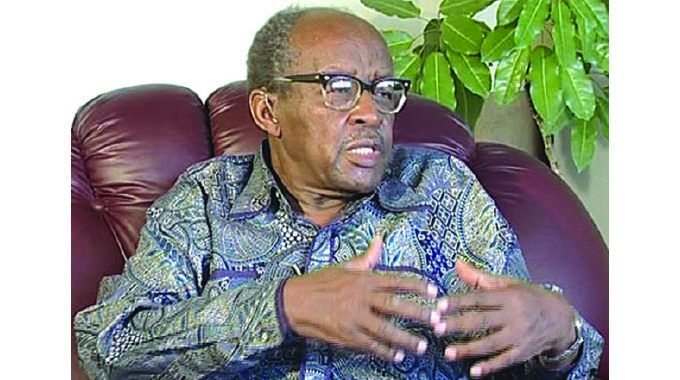
Cde Nathan Marwirakuwa Shamuyarira was a doyen of Zimbabwean journalism, a Zanu-PF Politburo member and long-time Cabinet minister before eventual retirement, who died on 4 June 2014, at West End Clinic in Harare, from a chest infection.
Cde Nathan Marwirakuwa Shamuyarira was born in 1929 to Ben Tafirenyika, an Evangelist of the Methodist Church, and Maria Sadini, in a family of three: two boys who were Nathan and Musa, and a girl, Evelyn. Hailing from Mhondoro, Cde Shamuyarira’s father settled in the Mahusekwa area, near Marondera, where he carried out his evangelical work until his retirement.
Cde Nathan Shamuyarira received his primary education at Waddilove Mission, followed by training as a primary school teacher at the same institution.
As a qualified teacher, the young Shamuyarira taught at a number of primary schools in the area while at the same time completing his secondary education by correspondence.
Joining the ranks of other educated blacks, Cde Shamuyarira taught for some time at Tegwani School in Plumtree before moving to Domboshawa Training Centre where he taught animal husbandry from 1950 to 1953.
His proximity to Harare (then Salisbury) exposed Cde Shamuyarira to other professions that were either not known or easily accessible to many educated blacks. Thus, in 1953, he left the teaching field to chart a new career path in journalism. He got a job as a cub reporter with African Newspapers Ltd. and rose through the ranks to become editor of the Daily News in 1956.
He did well in his chosen profession and became Editor- in-Chief of African Newspapers Ltd. from 1959 to 1962 until he resigned due to racial policies that he found repugnant.
As a journalist, Cde Shamuyarira travelled far and wide both on the African continent and beyond on reporting assignments which exposed him to political processes in other independent African countries and those who were still fighting for political independence.
With a group of fellow journalists from Commonwealth countries, he, in 1959 went on a six-week tour of Britain followed by a three-month tour of the United States.
Generally, the West invests in Third world journalists to try and brainwash them into carrying out their propaganda work.
It required a courageous and patriotic journalist like Cde Shamuyarira to continue to use the pen to defend their own people.
By the time that Cde Shamuyarira resigned from the African Newspapers Ltd, the revolutionary spirit among blacks in this country to fight white settler colonialism was growing more and more rapidly and there was no stemming back the tide of the liberation struggle.
The Zimbabwe African People’s Union (ZAPU) had intensified its recruitment drive to swell its ranks with African intellectuals.
Cde Shamuyarira was one such intellectual who was targeted for recruitment. The late national hero, Dr Samuel Parirenyatwa, persuaded him to join ZAPU, and once he was convinced that this was the right way to go. Cde Shamuyarira joined nationalist politics and never turned his back on the liberation struggle.
In 1962, Cde Shamuyarira became an active member of ZAPU participating in the formulation of various strategies to confront the settler regime. Quite naturally he also became a target of the settler regime’s surveillance system monitoring his every movement and political activities.
In September of the same year, the colonial settler regime banned ZAPU in order to undermine the African nationalist movement and prevent it from rallying Africans around the struggle for political independence. When the party’s leader, the late Vice President Dr Joshua Nkomo led a delegation to the United Nations in New York to petition the international body to recognize the right of Africans to self-determination, Cde Shamuyarira was included in that delegation although he held no official position in the movement at the time.
Upon his return to then Southern Rhodesia, he was appointed lecturer in Adult Education at the University College of Rhodesia and Nyasaland.
When political differences emerged among the ZAPU leadership, Cde Shamuyarira joined hands with other nationalists who broke away from the party to form a new political party, the Zimbabwe African National Union (ZANU), in August 1963.
In September of the following year he left Southern Rhodesia to study Political Science at Princeton University in the United States.
After his graduation, he lectured at the University of Dar-es-Salaam in Tanzania while also doubling up as a player in the politics of his country.
His career as a lecturer was interrupted on a couple of occasions as he joined hands with fellow nationalists to try and bring together ZAPU and ZANU so that they fight the enemy as one liberation force.
When those efforts failed, he participated in the formation of another political party, Front for the Liberation of Zimbabwe (FROLIZI), which was launched in 1971 and was led by James Chikerema.
He became its treasurer. By 1973 he had grown disillusioned with the manner the party was being run, precipitating his resignation in the same year and resuming his lectureship at the University of Dar-es Salaam.
The late former President, Cde R.G. Mugabe would persuade him to rejoin ZANU and relocate to Mozambique which he did in 1977.
He initially served as Director for Administration before being appointed Deputy Secretary for Information and Publicity in 1978.
The post-independence era saw Cde Shamuyarira serving his country in leadership positions of the party Zanu PF and in Government as Cabinet minister.
He was appointed Member of Parliament for Chinhoyi through the system of proportional representation in 1980, and in 1985, Cde Shamuyarira won the Chinhoyi seat resoundingly, a feat he repeated in the subsequent elections of 1990 and 1995.
He initiated many developmental projects in his constituency and in the province.
In 1982 after the Dande Bus disaster which killed over 60 farmers from Makonde, Zowa and Msengezi, Cde Shamuyarira took over the welfare of the orphans left by the farmers, ensuring that none of them dropped out of school due to lack of funds through the establishment of a scholarship programme.
One of the beneficiaries is Cde Betty Biri, who was educated through Cde Shamuyarira at Chibhero Agricultural College.
Full article on: www.herald.co.zw
She later went on to acquire a degree in Environmental Science and today she is a ZINWA national board member and chairlady of the Zimbabwe Liberation War Collaborators’ Organisation in Mashonaland West.
Between 1983 and 1984, Cde Shamuyarira was instrumental in the establishment of women’s projects at the Domestic Science Hall in Chinhoyi, where, together with the late Tete Sabina Mugabe, they sourced knitting and sewing machines to help women establish co-operatives to sustain themselves and their families.
The construction of the Kawondera Dam between 1993 and 1994 in Makonde district, an area that was highly drought prone.
The establishment of a market garden at Gunhill in Chinhoyi.
He helped source a water pump for the project and a number of youths in Chinhoyi have benefited from it. — A Guide to the Heroes Acre
At Lions’ Den in Mhangura, Cde Shamuyarira worked with a group of women to establish a restaurant as an income generating project. Also accompanying this project was the establishment of a poultry farming project in Mhangura.
From the income generated by these projects, several women who were part of the co-operative managed to acquire their own houses at Murereka, Lions’ Den, where to this day, some of them still live.
At Matoranjera in Makonde Rural, Cde Shamuyarira established a farmers’ warehouse after realising that communal farmers were travelling all the way to Chinhoyi to procure farming inputs, thereby incurring huge transport costs.
As Minister of Government, Cde Shamuyarira will be remembered for his role in spearheading the decolonization process of the media in Zimbabwe with the establishment of the Zimbabwe Mass Media Trust (ZMMT) which brought the newspapers, national news agency, radio and television services under one umbrella.
Thus, were born the Zimbabwe Inter-Africa News Agency (ZIANA), the Zimbabwe School of Mass Communication, Kingstons and the Zimbabwe Newspapers Pvt. Ltd. The electronic media was already in public hands, but the big task for the information minister was to give the Zimbabwe Broadcasting Corporation a sound operational structure and define its new role as a public broadcaster under the new order.
At the time of his death, Cde Nathan Shamuyarira was survived by wife Dorothy and a daughter. — A Guide to the Heroes Acre


 Online Reporter