Online Reporter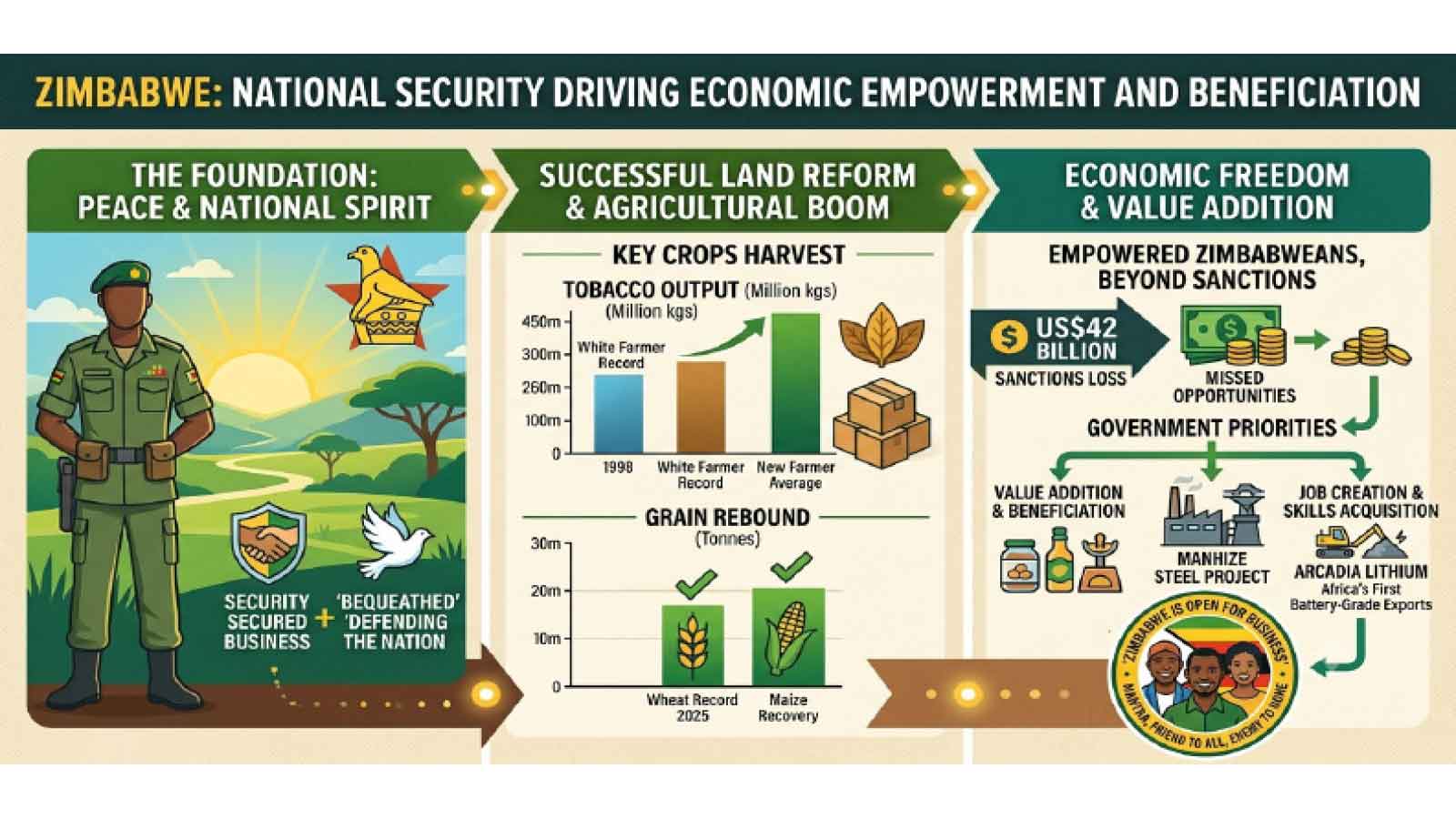
Hebert Zharare
Day Editor
Some perished and their remains were never recovered, some were maimed and became inactive forever, while others survived to chronicle the story of how they, as a formidable force, prosecuted the protracted liberation struggle.
The spirit of protecting the country’s territorial integrity, defending national ethos and interests, defending Zimbabweans against any form of externally perpetrated disturbances and foreign aggression has been bequeathed to the current serving men and women in uniform.
Zimbabweans are free today, free to venture into any economic sector their skill can allow them. We now have black millionaires and billionaires and more are in the making and the credit goes to the dedicated efforts of the uniformed force members to ensure Zimbabweans conduct their business fearlessly and that they perpetually remain secure.
On Monday and Tuesday next week Zimbabweans commemorate Heroes Day and Defence Forces Day respectively to be presided over by President Mnangagwa.
Provincial ministers in the country’s 10 administrative provinces and senior Government officials will preside over the events, representing the President.
As the country celebrates these two national holidays, the people should never forget that the peace and tranquillity being enjoyed came at a huge price.
Land Reform Programme of 2000
Land has become one of the most powerful economic empowerment tools post-independence, where over 400 000 people were directly allocated land under the hugely successful agrarian reforms under the A1 and A2 schemes.
According to statistics, Zimbabwe has over 16 million hectares reserved for agriculture activities and among these, about 4,2 million hectares comprise the country’s most arable land that supports crop production.
Before 2000, approximately 4,500 white commercial farmers controlled 70 to 85 percent of the arable land, a disparity rooted in colonial-era land apportionment laws. The Government of Zimbabwe subsequently initiated the fast -tracked Land Reform Programme to address these historical injustices.
Hundreds of thousands of Zimbabweans were crammed in hilly and dry areas that hardly supported sustainable agriculture.
The peace being enjoyed in Zimbabwe today has enabled new landholders to plan their agricultural activities, registering growth in areas such as tobacco, wheat, maize and horticulture.
The new farmers have broken tobacco output records ever achieved by white former farmers of 260 million kg in 1998 and are now producing over 350 million kg of tobacco year in year out, earning over US$1 billion in revenue.
The country achieved a historic record wheat production of 639,942 tonnes during the 2025 winter cropping season. The yield represents the highest harvest achieved in the country’s 59 years of commercial wheat farming, surpassing the national annual consumption requirement of 360,000 tonnes.
In the maize sector, production reached approximately 1,8 million tonnes according to post-harvest reports for 2025, marking a strong rebound from the prior drought, with Mashonaland regions leading in output.
Economic Empowerment
Political leadership in Zimbabwe has steadfastly insisted that political independence without economic freedom, where indigenous people control the means of production is futile.
The successful land reform programme, the liberalisation of the economy that saw thousands of entrepreneurial Zimbabweans venturing into many sectors, predominantly populated by whites such as mining, the financial services sector, transport, among others has seen the creation of new millionaires and billionaires.
Thanks to the relentless efforts of our security services to ensure that peace and security prevail, which is one of the ingrediencies of national economic development, the sky is the limit for Zimbabwean entrepreneurs to achieve success.
And the economy is now effectively in the hands of Zimbabweans, determining their destiny and if it were not for the economic sanctions imposed on the country for rightly taking her land from white former farmers, Zimbabwe would be a jewel of Africa.
Reports say due to the sanctions, Zimbabwe has lost over US$42 billion in missed business opportunities and goodwill.
Value addition
Now that the economy is in the hands of Zimbabweans who are now masters in the fields such as mining, the thrust now is for Government to assist indigenous businesses to venture into value addition and beneficiation of local resources before exporting them.
Job creation and external skills acquisition should now be a major priority so that the country is not held to ransom by expatriates who will again like the colonial era, assist their countries to exploit Zimbabwe.
The peace and the tranquil environment are one of the greatest assets we have as a country that should, unlike other countries in Africa and beyond, enable us to attract Foreign Direct Investment.
Like what President Mnangagwa has repeatedly said ‘Zimbabwe is Open for Business and our country is a friend to all and an enemy to none’ mantra, we should see more countries, including our erstwhile enemies mellowing their hardline stance against Zimbabwe.
This has already seen an accelerated investment in minerals value addition and beneficiation like steel at the Manhize Project, Lithium, Gold, Platinum Group Metals among others and no such development can be achieved in a chaotic state where citizens’ security is not guaranteed.
The Manhize Steel Plant is a massive, multi-billion-dollar industrial project in Zimbabwe developed by Dinson Iron and Steel Company and Tsingshan Holding Group. Manhize’s expected annual steel capacity is approximately 1,2 million tonnes during the first phase.
The country has major active lithium mining and processing projects, anchored by key operations such as Bikita Minerals, Arcadia Mine and Kamativi.
The Government has enforced strict local beneficiation and value-addition mandates for lithium producers, moving from raw ore bans to restricting concentrate exports while introducing conditional export quotas tied to local processing plant construction.
Prospect Lithium Zimbabwe started exporting refined lithium sulphate from its US$400 million processing plant in Goromonzi in April this year, marking Africa’s first production and export of battery-grade lithium salts.
This shift from raw or concentrated ore to support national beneficiation goal can only be done as investors are assured of long-term investment due to peace and stability as a result of invaluable efforts by our security forces.