Online Reporter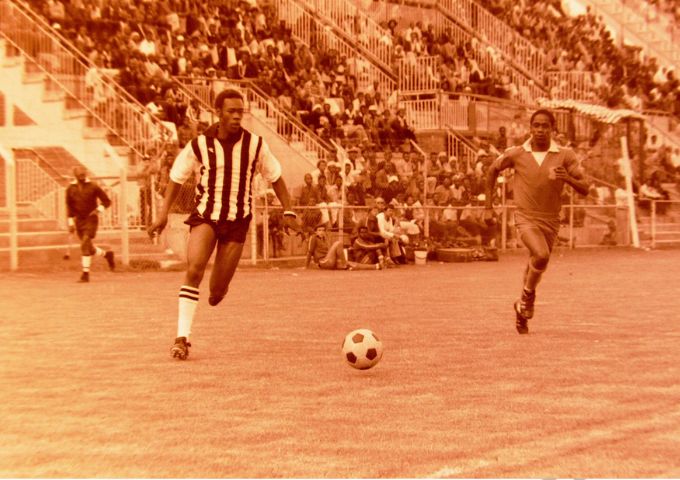
HIGHLANDERS’ legend of the 1970s, arguably the best player for that decade Tymon Mabaleka is among some of the best attacking midfielders to emerge out of Bulawayo and go on to have a national appeal.
Many believe he was born at the wrong time and could have made the grade anywhere in the world because of his brilliance.
He was a cut above the rest gifted with all the attributes of a midfield general, in the mould and class of mark, win it and carry it forward like the great Stanford ‘Stix’ Mtizwa, Honour Gombami,
Rodrick Simwanza, Tito Paketh, the late Blessing Makunike and William Sibanda.
His chest control, space intelligence, dribbling, ball distribution, headed ball control and shooting were masterly and won him admirers wherever he played.
Mabaleka was among legendary manager and coach Silas Ndlovu who went on to excel as chairman’s first recruits in 1973.
For a decade Highlanders’ play revolved around him as he asserted himself as a big asset of the institution, directing operations in the middle of the park and a vital cog of the strikeforce until his retirement in 1983.
Mabaleka edges Barry Daka for consideration for the Highlanders Player of the 1971-1980 Decade after the former diminutive midfielder’s departure unceremoniously to Olympics, a move that cost Highlanders a near entire first team.
Mabaleka was on hand after the 1973 Chibuku Trophy triumph, three consecutive regional league titles and the 1974 national league play-off to win the Chibuku Trophy and Heroes Cup in 1980.
He capped a magnificent career with national caps in 1980 and 1981 among a crop of legendary footballers like Sunday Chidzambwa, Oliver Kateya, Frank Mkanga, Raphael Phiri, Charles Sibanda,
Archieford Chimutanda, David Muchineripi, Shaky Tauro, George Rollo, Mark Watson, Ephraim Moloi, Misheck Chidzambwa, Oliver Kateya, Stephen Chuma and Max Chuma.
Several other attacking midfielders found their way in Highlanders colours and gave a brilliant shift towards making the brand stand and maintain the legacy of excellency and reason why fans had to throng stadia.
Daka was outstanding and prior to his 1970 move to Wankie, he had led Highlanders to promotion to the elite league before sealing a first ever national cup with the coalminers when they won the 1970 Castle Cup playing as Bud Sibanda in Rhodesia’s first live cast on television match. He returned to Highlanders at the beginning of the year in 1974 to play for one of the most exciting
Highlanders sides. His stay lasted up to 1976 when he left to form Olympics and would return in 1984 as coach.
Stanford Ntini and Titus Majola were some of the Highlanders attacking midfielders of the early days of Independence. They were versatile and covered the whole field with a good rate.
Ntini was more of a ball player like another star who had a short-lived stay at Bosso Francis Paketh whose ball wizardry stolen from legendary Majuta Mpofu’s bags of tricks did not stay long at the club to grow in stature.
Ernest Sibanda signed from Contex in 1979 was among the best attacking midfielders too.
Ntini and Paketh did not stay long enough at the club as attacking midfielders like the late Ronny Jowa, Tutani Moyo, Summer Ncube, David Phiri and Thoko Sithole all of whom excited fans for a short spell and left.
They had the big match temperament and left fans with some memories as did Amin Soma-Phiri brought from Olympics where he was a free scoring striker to a Highlanders side teeming with a lot of talent in midfield and because of his versatility he was played as anchorman, Number Eight (8) or behind and scored a number of goals for the club.
Back then Highlanders appeared to thrive with ball winning midfielders and attacking ones with flair who combined well with wingbacks, wingers and strikers. It was no surprise that some of the midfielders often found themselves on double figures on the goal scorers’ charts.
Tito Paketh rates among the best attacking midfielders to don the Bosso colours. He was every coach’s dream midfielder, aiding defence, dominating play in midfield and coming in handy with assists and brilliant goals.
Phiri and Moyo were very good ball players and always made their presence felt in the middle of the park, while Sithole was brilliant on taking on opposition on the run, with Ncube very skilful and calculating in every instant with the ball.
Several other Highlanders Number 8s and 10s left legacies while turning out for Highlanders.
There were players like Benjamin Mpofu, Benjamin Nkonjera and Lazarus Mwambopo who dominated opponents in the department and made Bosso glow.
Mwambopo a former Eagles and Wankie player had skill, ball control excellent dribbling skills and vision to change play with one dissecting pass at range and made many wingers visible.
Nkonjera an unassuming character always full of life was great as an anchorman, attacking midfielder on the right or just behind strikers.
He was capped at Under-23 and senior national team ahead a competitive group of midfielders of the early to late 1990s era.
The 2000s ushered a new era for Highlanders attacking midfielders throwing onto the hat names like Siza Khoza, Johannes Ngodzo, Dabwitso Nkhoma, Charles Chilufya, Richard Choruma and Honour Gombami.
Eddie Nyika, Eddie Dube and Thabani Masawi were more like attacking linkmen than strikers at Highlanders because of their technical and creative abilities.
They were the reasons why Highlanders started dominating the turnstiles. They drove the team, they made it the much talked about club and won five league titles in eight years, for the club’s most successful spell.
Each Tshilamoya era has had very outstanding attacking midfielders who have been the cornerstone of the successes.
Who were your best attacking midfielders?
– [email protected]